
A new study from Transport & Environment (T&E) finds that accelerating the transition to electric company cars across Europe could generate hundreds of thousands of jobs and billions in investment by 2030. The analysis highlights the economic impact of the EU’s Clean Corporate Vehicles Regulation, which sets ambitious electrification targets for large corporate fleets.
Major Job and Investment Gains Projected
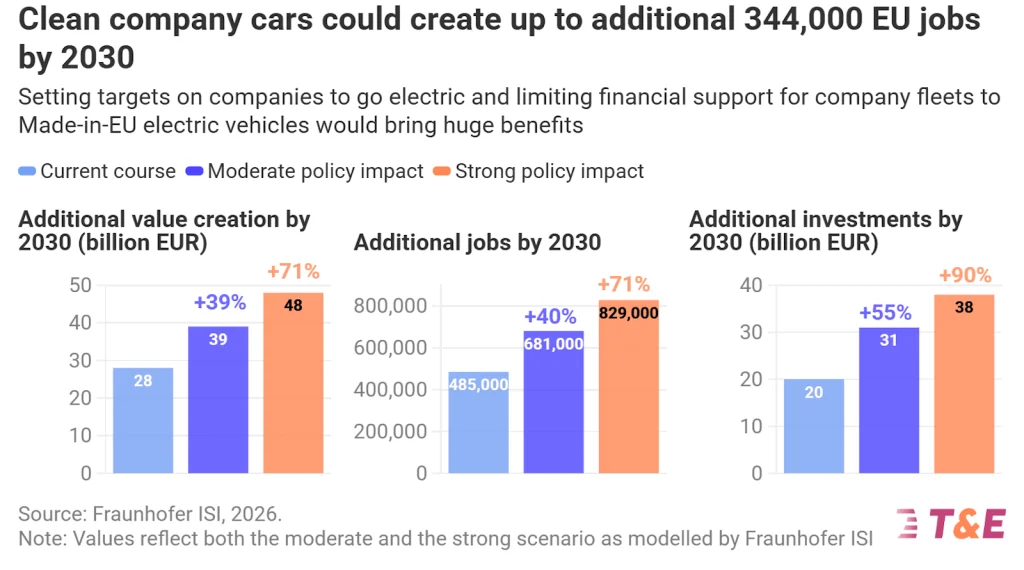
According to the T&E study, implementing EU-wide electrification targets for large company car fleets—while restricting fiscal incentives to electric vehicles made in Europe—could result in 344,000 additional jobs and $20.2B (~AUD 28.9B) in extra investment by 2030. Even under a more moderate scenario, the study projects 196,000 new jobs across the EU.
The Clean Corporate Vehicles Regulation requires that 45% of new car sales in large corporate fleets be electric by 2030. The most significant economic benefits are expected if financial support for company cars is limited, starting January 2028, to low and zero-emission vehicles manufactured in Europe.
Country-Level Impact: Germany and Poland Lead
Germany and Poland are poised to see the greatest employment gains. The study estimates that Germany could add 134,000 jobs—representing 39% of the additional EU jobs—while Poland could see an increase of 38,500 jobs, with 82% of these in the battery sector.
In Poland, battery cell production is projected to more than double, rising from 31 GWh to 81 GWh by 2030 under the strong scenario.
Economic and Industry Effects
T&E’s analysis suggests that a rapid shift to electric company cars could boost economic gains from $31.4B (~AUD 45B) to $53.8B (~AUD 77.1B), and increase investments from $22.4B (~AUD 32.1B) to $42.6B (~AUD 61.1B) by 2030.
Volkswagen, for example, plans to cut 35,000 jobs by 2030. However, the study indicates that the new regulation could generate up to 56,300 additional direct jobs at the automaker over the same period.
Competitor Comparison
Volkswagen Group, BMW, and Mercedes-Benz are among the leading manufacturers supplying electric vehicles to corporate fleets in Europe. Volkswagen Group captured approximately 27.6% of the market with 2,988,870 units sold in 2025 and saw a 5.7% year-over-year increase in the first half of 2026.
Battery-electric vehicles accounted for 22.2% of the regional market share in the first half of 2026, reflecting the growing adoption of electric models from these major brands.
Historical Context
The European electric vehicle market has experienced steady growth, with Volkswagen Group leading in sales and market share. The transition to electric company cars is expected to further accelerate this trend, particularly as regulatory targets become more stringent.
The Clean Corporate Vehicles Regulation sets a new baseline for fleet electrification, building on the momentum established by previous years’ sales and policy initiatives.
Why this matters
The findings from T&E underscore the potential for electrifying company car fleets to drive job creation and investment within the EU. By focusing on vehicles made in Europe, the regulation aims to strengthen the region’s automotive industry and supply chain, particularly in battery manufacturing.
With significant job gains projected for countries like Germany and Poland, the policy could help offset planned job cuts and support the EU’s competitiveness in the global EV market.
What this means for buyers
For corporate fleet managers and buyers, the regulation signals a shift toward electric vehicles as the default choice for company cars. Organizations should prepare for stricter eligibility criteria for fiscal incentives starting in 2028, prioritizing low and zero-emission models produced in Europe.
Buyers can expect a broader selection of electric company cars from established brands, with increasing support for local manufacturing and supply chains.
Key Specs
- Projected Additional EU Jobs (Strong Scenario): 344,000 by 2030
- Projected Additional EU Jobs (Moderate Scenario): 196,000 by 2030
- Clean Corporate Vehicles Regulation Target: 45% of new large fleet car sales electric by 2030
- Projected Additional Investment: $20.2B (~AUD 28.9B) by 2030
- Projected Economic Gains (Strong Scenario): $53.8B (~AUD 77.1B) by 2030
- Germany Job Gain (Strong Scenario): 134,000 additional jobs
- Poland Battery Cell Production Increase: 31 GWh to 81 GWh by 2030
- Volkswagen Potential Additional Direct Jobs: Up to 56,300 by 2030
Images sourced from: eleport.com, unsplash.com, europa.eu

