
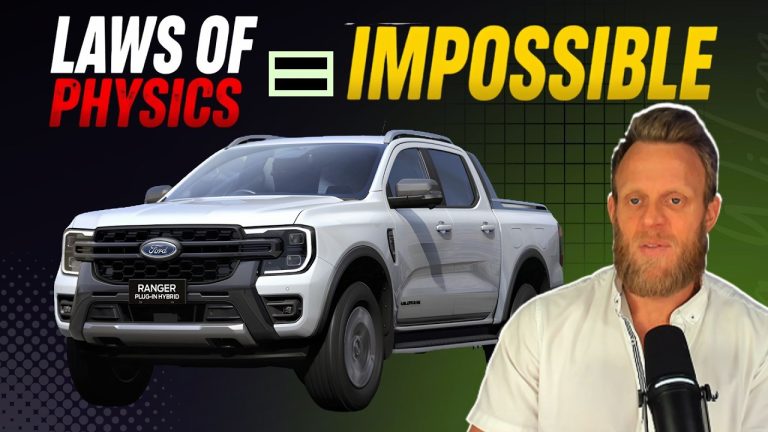
Ford Australia has ruled out an electric Ford Ranger, with its vehicle program director blaming “the laws of physics” at the launch of the updated 2026.5 Ranger. Sam Evans says the claim doesn’t hold up against electric utes already on sale, and that the real reason is money.
Ford Blames Physics, Demand and Chargers
The comments came at the launch of the 2026.5 Ford Ranger, which Sam says is barely any different from the previous version. Ford Australia’s vehicle program director told the media that an electric Ranger is not coming, and said “the laws of physics” are the reason. His argument was that EV technology cannot deliver the capability a ute or pickup truck needs: “if you want to deliver that capability, the laws of physics, you can’t get there.”
He also pointed to weak customer demand and a lack of chargers.
Get the latest EV news first. Follow us on:
Electric Utes Already Out-Tow the Ranger
Sam says Ford’s argument falls apart when you look at what is on sale today. The Rivian R1T is about the size of a Ford Ranger and tows up to 4,990 kg, which is more than any Ford Ranger apart from the Super Duty. The quad-motor version does 0 to 100 km/h in 2.6 seconds and has 420 miles of real-world EPA range.
The Tesla Cybertruck has 11,000 lb (about 5,000 kg) of towing capacity and a 2,500 lb payload. The Ranger itself weighs around 2,200 kg, so Sam notes that electric trucks available right now can tow more than twice the weight of the whole Ranger. Ford’s own F-150 Lightning towed up to 4,500 kg before Ford cancelled it and pivoted to extended-range EVs.
Sam says he is not telling anyone to buy a Cybertruck or a Rivian. His point is that the people at Ford seem to be paying no attention to the global car market.
A Business Decision, Not a Physics Problem
Sam says the Lightning’s cancellation is the key to understanding Ford’s position. Ford has taken a $19.5 billion (~AUD 29.4 billion) charge on its EV programs through 2027. Sam believes this is a business decision dressed up as a capability argument, much like what Toyota was saying one or two years ago.
In Sam’s view, what Ford really means is that it doesn’t have the money or the will to build an electric ute right now and can’t make one at a profit. He says that would be a fair and honest thing to say. Blaming physics and battery technology while Rivian and Tesla sell electric pickups that tow around 5,000 kg and have good range is, Sam says, anti-EV marketing spin. He adds that those figures don’t even account for the newer, more advanced batteries revealed in the last six months.
Ford’s Own Plans Contradict the Claim
Sam points out that Ford trademarked the name Ranger Lightning a couple of years ago, so at one point it clearly intended to build an electric Ranger. Ford is also reportedly developing a new, smaller midsize electric pickup under a different name in the United States, which it says will be priced at around $30,000 (~AUD 45,200). Sam says this means Ford is effectively saying an electric pickup is both possible and impossible.
What It Means
Sam says buyers are now left waiting for Chinese brands such as BYD to deliver electric pickups because Ford isn’t interested. He believes Ford’s hesitation isn’t protecting customers but handing the future to its competition. According to Sam, the technology and the capability already exist. What’s missing is Ford’s commitment to building one.
