
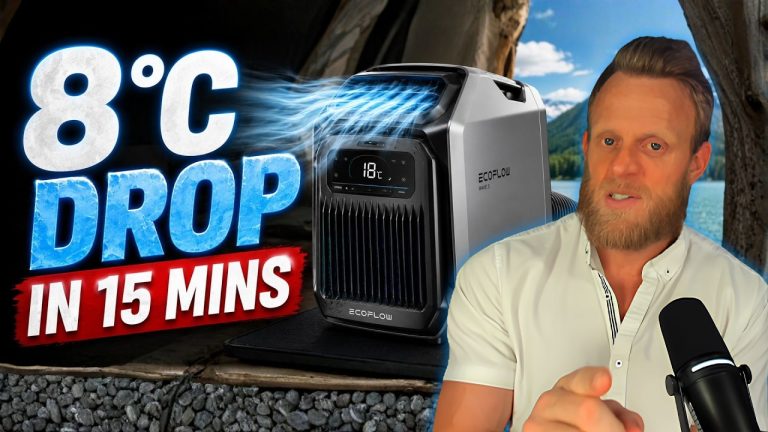
EcoFlow’s Wave 3, pitched as the most powerful portable air conditioner you can actually carry around, has been put through its paces by Sam Evans, who says it genuinely punches well above its size class. The unit combines an air conditioner, heater and dehumidifier in one box, and sells in Australia for A$1,799 (~$1,194) on its own.
One Box for Tents, Vans and Bedrooms
The Wave 3 is a battery-capable unit built for tents, vans, caravans, utes, boats, off-grid cabins, or any room in a house that doesn’t have an air conditioner. Sam says it is easily carryable, and he points out that many people living in apartments are often not allowed to install air conditioners in their bedrooms, making this a really good solution for them.
Its rated cooling area is 11 to 17 square metres, which Sam says covers rooftop tents, swags, pop-top campers, fold-out camper trailers, and an apartment or house bedroom. The unit weighs 15 kg and measures around 520 x 297 x 336 mm, a little bigger than a typical portable power station.
Get the latest EV news first. Follow us on:
Reviewers have said that with the battery attached it feels heavier than spec. Sam says that makes sense, but he doesn’t understand the complaint, because he would carry the battery and the unit separately rather than together.
The Numbers
The Wave 3 puts out 6,800 BTU of heating, up from the Wave 2’s 5,100 BTU. Reviewers consistently report an 8°C (15°F) drop in just 15 minutes inside a small enclosed space, and Sam says that when he turned it on and put his face in front of it, he could feel the temperature drop significantly within about a minute.
Air volume is 330 cubic metres an hour, the temperature setting range is 16 to 30°C, and it will operate in ambient temperatures from 5°C up to 50°C.
EcoFlow has switched from R32 refrigerant to R290, and there is only 112 g of refrigerant inside the unit. It has also moved to an inverter compressor that modulates output continuously instead of cycling on and off, which is more efficient and gives more run time. It is a dual-hose system, which Sam says is far more efficient than cheap single-hose units, and it carries IPX4 water resistance, so a little water while it is outside will be fine. Modes include pet care, sleep and dehumidifier, and the ducting design lets the whole unit sit inside a tent while venting hot air out.
Noise and Power Draw
EcoFlow rates the Wave 3 at between 44 and 56 decibels, and independent testing measured 52 decibels at 6 feet. Sam says it makes a little noise at startup but is fairly quiet in normal operation.
EcoFlow’s rated cooling power is 690 watts, but Sam’s own testing in Newcastle, New South Wales, in temperatures of 27 to 33°C, with the unit set to 23°C on medium fan, showed a draw of 260 watts. He says draw depends heavily on the temperature and fan settings, but it is significantly less than a standard caravan air conditioner.
Sam says that if an old caravan air conditioner breaks, he would potentially buy one of these instead of a new built-in unit, because it is more portable, unless you live in your caravan full time.
The Battery Question
The Wave 3 doesn’t come with a battery, but an optional add-on 1,024 Wh lithium iron phosphate battery is rated for around 4,000 cycles, which EcoFlow says equals a 10-year lifespan. Recharging it takes 2 hours from a wall outlet, 75 minutes with AC and solar combined, or 102 minutes from a car alternator, which Sam says is pretty fast for an alternator.
Sam says that battery will run the unit for about eight hours on average, but in hot temperatures it gives only about four hours of overnight cooling. For that reason he recommends skipping the add-on battery and buying a bigger one, such as the EcoFlow Delta 2 Max, which is twice the size, costs A$2,161 (~$1,434) and can be found on sale, and gives about eight hours, enough to run it all night. A 200 amp-hour 12-volt battery gives 10 hours, which Sam says is probably the ideal situation.
Sam believes a 2 kWh battery is probably the best solution because it is easy to carry, while anything bigger becomes a bit awkward. A Delta 3 Pro, with 4,096 Wh, costs around $3,000 (~AUD 4,520) and will run the Wave 3 for two full nights and a bit extra.
Pricing, Finish and Warranty
In Australia, the Wave 3 alone is A$1,799 (~$1,194), or A$3,059 (~$2,030) bundled with the add-on battery, which effectively prices the battery at about A$1,250 (~$829). Owners of the unit can buy the add-on battery separately for A$1,299 (~$862). Sam has seen the unit on sale a couple of times for maybe A$100 to A$200 (~$66 to $133) off, and says around A$1,500 (~$995) is probably what to expect from Australian retailers. In the US it is cheaper, with the unit and battery bundle costing $1,450 (~AUD 2,186).
Sam found the premium plastic shell can scratch easily when moved around, which he says is not a big deal. The warranty is 2 years, and Sam believes that at this price it should be longer, suggesting four years is what he would aim for if he were EcoFlow.
Sam’s Verdict
Sam says that for a pop-top camper or van without factory air conditioning, or for anyone who doesn’t want to run their engine all night, having air conditioning retrofitted costs double the Wave 3’s price in labour alone, making this way cheaper. He adds that anyone who has tried to sleep in 34°C at Cape York will know it is worth its weight in gold.
Sam calls it the most refined portable air conditioner EcoFlow has ever built and believes it is the one to beat right now. If it can be had for a decent price, he says there is not really anything else on the market that matches it on specs and price. It is the first portable air conditioner Sam has tested, and he hopes to compare it with others in the future.
