
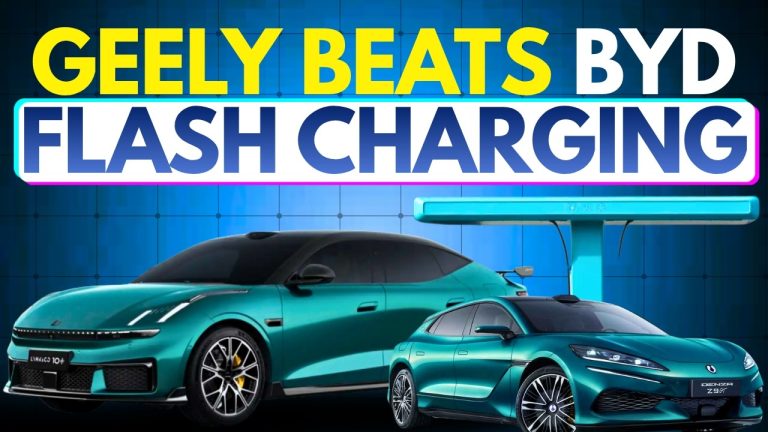
Geely has just launched a car in China that takes direct aim at BYD, and the charging numbers are genuinely impressive. The new Lynk & Co 10 can charge from 10% to 80% in 5.5 minutes, which makes it the fastest-charging car in the world and puts it ahead of BYD’s flash charging.
Geely vs BYD
The rivalry between these two has been heating up. Geely actually outsold BYD in January, but in the last couple of months BYD has overtaken Geely again. BYD fought back with its 1,000 kW flash charging, and now Geely is essentially saying “hold my beer.”
The Lynk & Co 10 series is a mid-to-large pure electric sedan that has just gone on sale in China. Remember, Lynk & Co is the sister brand to Zeekr, so I think this tech is probably going to go to Zeekr very soon. Geely is coming out swinging, because the top-spec version charges faster than BYD’s flash charging.
Get the latest EV news first. Follow us on:
How the charging compares
BYD’s first-generation flash charging system peaks at 1,000 kW and achieves 10% to 70% in 5 minutes. Probably even more impressive is 10% to 97% in about 8 minutes and 56 seconds. The updated Flash Charging 2.0 pushes that to a peak potential charging speed of 1,500 kW.
The Lynk & Co 10’s 900-volt high-power variant peaks at 1.1 megawatts, which is over 1,100 kW, and it charges a fair bit faster than BYD’s flash charging. 10% to 80% takes 5.5 minutes, and 10% to 97% takes 8 minutes and 42 seconds, about 15 seconds faster than BYD. It’s really that 10% to 80% figure in 5.5 minutes that makes this insane. That is just unbelievable charging speed.
Crucially, the car sustains close to 500 kW even after it goes past the 80% charge point, which I’ve never seen before. Most EVs fall off a cliff in charging speed when they get to 60% or 70%. The Lynk & Co 10 doesn’t.
The battery behind it
So why can it do this? Hardly anyone is talking about Geely’s new batteries, and to be honest, they should be. That charging speed is enabled by a 900-volt architecture paired with what Geely calls its Golden Brick battery, now in its second version. It’s an LFP pack with a capacity of 95 kWh, and when plugged into a compatible ultra-fast charger it adds 2 km of range every single second. There’s also a standard 800-volt variant with a 77 kWh battery, which charges from 10% to 80% in 10.5 minutes.
Geely’s new LFP cells also have more life now. They’re rated for 4,500 cycles before they degrade to 80%, which is more cycles than pretty much any other LFP battery currently on the market in EVs, so they’ll last a lot longer than that. The maximum range of the long-range 900-volt version is 816 km, which is pretty impressive considering it’s an LFP battery in a big car.
Size, performance and tech
And it is big. It’s just over 5 metres long at around 5,050 mm, nearly 2 metres wide at 1,966 mm, and it has a very big wheelbase of over 3 metres. It’s a proper large sedan.
The standard Lynk & Co 10 comes with two rear-wheel-drive, single-motor options. The base model has 300 kW (402 hp) and does 0 to 100 km/h in 5.9 seconds, while the higher-output version has 370 kW (496 hp) and does it in 5.2 seconds. Then there’s the 10 Plus, which goes a lot faster thanks to dual motors with a combined 680 kW, or 912 hp, and 913 Nm of torque. 0 to 62 mph takes 3.2 seconds and top speed is 240 km/h. It gets Michelin Pilot Sport EV tyres, Brembo four-piston brake calipers, 21-inch forged wheels and a carbon fibre rear wing, which I think actually looks good. Because of all that performance, its CLTC range is significantly lower at 536 km. Every model gets front double-wishbone and rear multi-link independent suspension with continuous variable damping.
The interior is pretty well loaded, with a 25.6-inch augmented reality head-up display, a 15.4-inch central touchscreen, a 12.7-inch digital cluster and a 23-speaker, 1,600 W audio system. It runs Flyme Auto 2 on a Qualcomm 8295 chip. There are two driver assistance systems. One uses Nvidia’s Orin chip with 200 TOPS and lidar, which to be honest isn’t that much compared to some of the newer chips on the market. The higher-spec system uses an Nvidia Thor chip with 700 TOPS, the same as XPeng’s Turing chip, and comes with full-scenario autonomous driving capability. Is it really capable of full self-driving? Absolutely not, but it’s certainly an improvement on previous Geely cars.
Pricing
Launch pricing is promotional and starts at $25,000 (~AUD 37,700), which is a remarkably good price for a car with this kind of charging speed. That’s what Tesla has to compete with in China, and honestly, I don’t know how Tesla sells so many cars there. The most expensive version is the full 10 Plus racing version with all-wheel drive and the carbon fibre wing at $34,700 (~AUD 52,300), which seems like a bit of a bargain if you ask me.
The catch: chargers
There’s one caveat worth mentioning. Geely’s charging network is not nearly as big as BYD’s. BYD already has 5,000 megawatt-class charging stations in China and is targeting 20,000 by the end of the year. I don’t think it’ll hit 20,000, but it’s a good target, and it’ll probably have around 10,000. Geely has 2,000 stations in 215 cities, including 1,200 ultra-fast 800-volt locations.
I’ve looked into it but can’t confirm whether these cars are cross-compatible, meaning whether you could charge a Lynk & Co, or maybe future Zeekr cars with this 1,100 kW charging, on a BYD flash charging station or vice versa. It’s going to be interesting to find out. Having a car that can charge this fast is one thing; actually finding a charger that can deliver those speeds is another thing entirely. On paper, the Lynk & Co 10 wins the charging race, but in the real world, I think BYD’s infrastructure advantage makes a pretty significant difference.
