
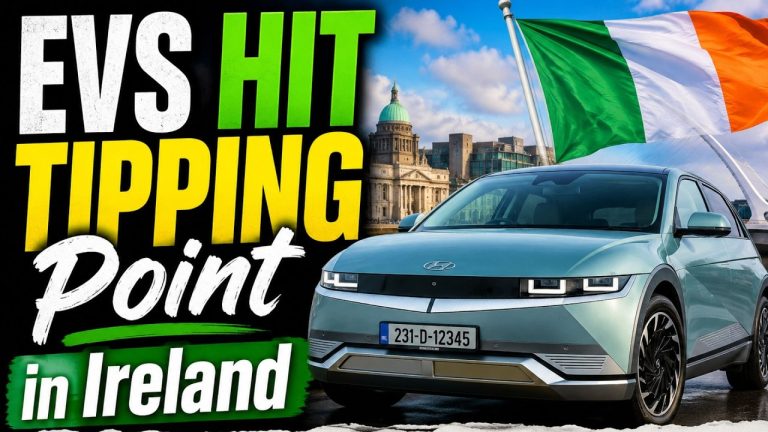
Electric car sales in Ireland have gone ballistic this year. Nearly 17,000 EVs were sold in the first four months of 2026, which means one in every four new cars sold in Ireland, 25%, was fully electric. That’s not hybrids, just fully electric cars. One of you sent me this news, and I honestly didn’t realise, because it hasn’t been as big a story as what’s happening in Norway, Sweden and Denmark. It also isn’t just a response to the war and fuel prices. It started before that.
The Irish Examiner asks if the age of oil is nearly over
The story comes from an interesting article in the Irish Examiner titled “As Ireland’s EV sales surge, is the age of oil powered vehicles nearly over?” According to the Examiner, Ireland’s EV sales are up 48% this year, an increase of just under 50% on last year. Ireland isn’t yet at the level of the Nordic countries, but a 25% market share is a big deal.
The Examiner also asks how long it will be before many petrol stations become unavailable at this rate. I’ve been saying that to people for a long time. People worry about EV charging stations. I say you should be worried about petrol stations, because they’re going to disappear incredibly quickly.
Get the latest EV news first. Follow us on:
EVs dominated before, and horse manure was the problem
The Examiner makes an intriguing point. In the early years after the motor car was invented in the 1880s, the new industry was dominated by electric cars. The paper says that if that trend had continued, the oil-soaked and bloody history of the last century and a quarter would likely have been radically different. Ironically, much of the push to develop the motor car came from a pollution crisis caused by the manure of all the horses used for transport. A newspaper report from the late 1850s described the streets of New York as a massive reeking, disgusting filth, in some places piled so high that vehicles could barely get through.
I find it interesting that back then plenty of people said the motor car would never catch on and that they were sticking with their reliable horse. Then things changed very quickly.
Electric and petrol cars competed at the start of the 20th century, but the cheap, mass-produced Ford Model T arrived in 1908 and sounded the death knell for that short-lived EV age. Petrol cars were dirty and noisy, but they had a longer range and were faster to refuel. There was no proper charging network, and at that time 70% of Americans didn’t even have electricity at home, so you can see why EVs were never going to take off then. EVs kept a niche, largely among female drivers using them for short local trips. Henry Ford sold 15 million Model Ts, but his wife Clara was unimpressed and drove a Detroit Electric instead. As it turns out, Clara Ford was right after all. It has just taken a century for the internal combustion engine’s long reign to come to a juddering halt.
Norway, Denmark and Germany show what’s coming
For many industry observers, 2026 signals the tipping point, particularly in Europe and China. That is the moment after which the terminal decline of fossil-fuelled motoring gathers unstoppable momentum. The Examiner points to Norway as a glimpse of the near future. In 2015, one in ten new cars sold there were EVs. In 2025 it was 96%, and this year it’s 98%. Only 12 petrol cars have been sold in Norway this year. Twelve. Imagine the resale value of a petrol car, especially a luxury one bought a couple of years ago. You would have lost so much money.
In Denmark, four in five new cars sold so far this year are electric, and sales of second-hand petrol and diesel cars have collapsed. Even in Germany, famous for its car-mad petrol heads and autobahns with no speed limits, the dam is starting to break. More than one in five new cars sold there so far this year are fully electric, a jump of over 40% compared with 2025.
Myths, efficiency and cost
The Examiner says EV uptake has been held back by disinformation campaigns sponsored by fossil fuel interests, often spread by right-wing media outlets to undermine confidence in the new technology. I’d add that a lot of it is also spread by people who are afraid of change and by people who simply love petrol cars. Some people think EVs are a fire hazard, but in reality petrol and diesel cars are far more likely to catch fire. The Examiner reports that in 2024 a senior official from the UK Department for Transport told a Lords committee that there is an anti-EV story in the papers almost every day, nearly all of them based on misconceptions and untruths. It says attacks on EVs, heat pumps and renewable energy have become the new form of climate denial.
One persistent myth is that an EV is more carbon intensive than a petrol car, and that’s ridiculous. Over the whole life of the vehicle, an EV emits vastly less carbon, even on a grid running on coal or other fossil fuels. If it’s powered by solar, the difference is astronomical. The reason is efficiency. In a typical petrol or diesel car, less than 20% of the energy in the tank actually turns the wheels, and the rest is lost as heat and through the transmission and gears. In an EV, almost 90% of the energy in the battery turns the wheels. EVs can also act as a virtual power station and send energy back to the grid when it’s needed. Carmakers have spent billions of dollars on ever more sophisticated engines that, honestly, don’t do anything better than the previous generation. They’ve hit a brick wall of diminishing returns from a century-old technology that is inherently inefficient and highly polluting.
The Examiner says the 10-year total cost of ownership of an EV in Ireland is on average substantially lower than that of an equivalent petrol car. Crucially, 2026 is the year EVs reach purchase price parity in many countries, including Ireland, which removes a major stumbling block.
Range anxiety is fading, pump anxiety is growing
The Examiner says the last and perhaps most important tipping point concerns what has long been the Achilles heel of EVs: limited range and patchy public charging, which led to range anxiety, or at least the perception of it. The writer has driven an EV since 2018. Back then, the longest-range EV available was extremely expensive and managed less than 400 km of real-world driving. He recently drove from South Dublin to Cork City and back to Dublin the following day, a round trip of over 570 km, on a single charge. Had he needed to top up, there are now plenty of high-speed chargers on the way, but he didn’t need them. His new EV’s battery has a 10-year or 250,000 km warranty. That’s better than the warranty on any petrol car I’ve ever heard of, and it’s really proof of how reliable EV batteries have become.
The Examiner says that with the US stuck in reverse gear, Europe is finally waking up to the EV revolution, while the US falls behind. China has already powered ahead. Chinese manufacturers have recently unveiled relatively affordable models with more than 1,000 km of range that can be fully charged in 9 minutes. EV technology is also spreading fast to trucks, buses, e-bikes, skateboards, tractors and machinery.
The paper says the rise of EVs could deal a fatal blow to the fossil fuel industry, and that industry is fighting against it constantly. Last year EVs cut global oil demand by more than two million barrels a day. By 2040, experts believe that figure will be more than 20 million barrels a day from EVs alone, pushing energy corporations into a death spiral of falling demand and falling prices. Range anxiety is now being replaced by pump anxiety, as soaring fuel prices caused by the Iran war have pushed millions of people to finally get rid of their expensive gas guzzlers. The Examiner also notes that the Irish state will need new ways to fairly fund road maintenance as revenue from fuel taxes falls.
The ICE age is over
The Examiner points out that despite three decades of intergovernmental climate conferences and solemn commitments, oil consumption has kept rising. It says renewable energy and advanced battery technology are now our best and final chance to avoid a fossil-fuel-driven collapse of the global climate system by mid-century. Its conclusion is simple: the ICE age is over. If you haven’t made the switch yet, now is the time. There’s not a minute to lose.
