
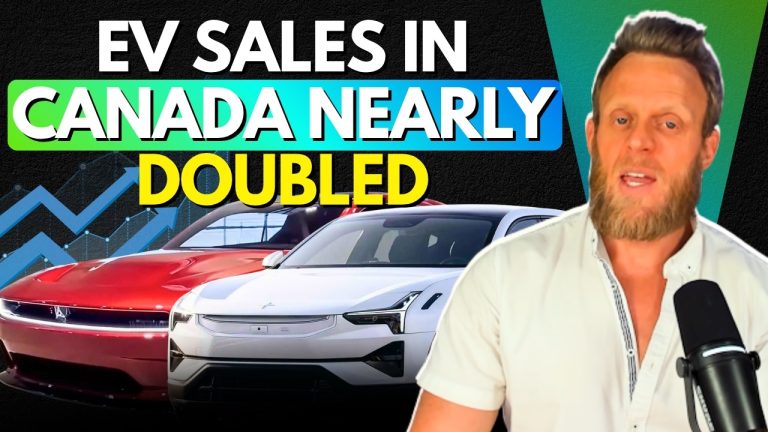
Electric car sales in Canada have blown out. Sales in May 2026 were up by more than 80%, nearly doubling, and I think it comes down to one thing, or maybe two.
Tesla or Chinese EVs?
Some people say the jump is down to Tesla, because Tesla brought in the new Model 3 at half the price of the previous version, and it’s basically the same car. Others say it’s Chinese EVs. But of all the vehicles sold in Canada under the new Chinese import program, only about 25 were from Chinese brands. The rest were Teslas. So maybe the Tesla argument is correct.
New subsidies are driving buyers
New car buyers in Canada are clearly taking advantage of the new EV subsidies under Canada’s new electric vehicle affordability program, which was introduced on 16 February. The money is spread over the next five years. It sounds like a lot, but broken down over five years it’s not really all that much.
Get the latest EV news first. Follow us on:
The incentives only apply to vehicles below a price threshold. By my rough conversion that’s around $35,000 (~AUD 52,800) or less, so they are only available for really cheap, affordable EVs. That means you can now get a Tesla Model 3 under the scheme, which is unbelievable. Incentives also cover fuel cell vehicles, not that anyone’s buying those, and plug-in hybrids.
Canada had a similar program from 2019 to 2025. When it was cut, EV market share in Canada fell from 18% to 10%. So it made a huge difference. According to CTV News, EV sales jumped more than 80% in March compared to February, and we’re hearing similar numbers for April. Unfortunately, the exact unit-by-unit registration tallies are guarded by provincial registries, which is annoying.
Canada’s top 10 EVs this year
We do know the top 10 best-selling EVs in Canada this year. Number one is the Tesla Model Y, followed by the Tesla Model 3, the Hyundai Ioniq 5, the Chevy Equinox EV, the Hyundai Kona, the Ford Mustang Mach-E, the Volkswagen ID.4, the Kia EV6, a Cadillac in ninth, and the Chevy Blazer EV in tenth.
The rebate threshold, based on the base model MSRP, has really shaped this list. Vehicles like the Chevy Equinox EV and the Hyundai Kona Electric are seeing big volume surges because they qualify for the subsidy, while cars above that price don’t. General Motors has made a big push in Canada, aggressively delivering Ultium platform vehicles: the value-focused Equinox base model that qualifies for the rebate, the mid-tier Blazer EV, and Cadillac, with the Lyriq actually leading premium EV sales in Canada. GM is giving Tesla its most serious challenge.
Chinese brands are coming
This could change in the next few months as more EVs from Chinese brands such as BYD and Xpeng hit Canada. We know they’re coming. I’ve heard they’re on ships right now and will be landing very soon. According to recent surveys, around 60% of car buyers in Canada would consider a Chinese electric car, a number I’m guessing is giving legacy automakers serious concerns.
Canada’s trade minister goes to China
Really, this is mostly thanks to Donald Trump. Canada’s international trade minister, Maninder Sidhu, has flown to Guangzhou during an official visit and engaged with BYD, Xpeng and GAC, which makes the Aion EV brand. According to a statement released on Thursday on the Canadian government’s website, he had in-depth discussions with them about market entry pathways and setting up production in Canada. He also highlighted Canada’s regulatory and supply chain requirements, and the prospects for long-term investment and collaboration. I’d guess he probably spoke with others as well.
Meanwhile, the Trump administration has blocked Chinese EVs, and Ford CEO Jim Farley has said they cannot be allowed to enter. The way I see it, that’s because the Chinese simply make better cars at lower prices and Ford can’t compete. The Trump administration also says it will block any Chinese EVs coming across the border from Canada into the United States.
A pivot point for Canada
A minister doesn’t fly to China just to discuss bringing in 50,000 EVs a year. That’s already done; it’s a formality. He’s obviously there to get Chinese automakers to set up factories in Canada and help save Canada’s automotive industry. If he’s gone all that way, you can almost be certain that at least one of these Chinese companies, probably several, is in serious talks to build car factories in Canada. As for the US threat to block them, once those factories have been building cars for five years and there’s a new administration, I don’t think it’s something that will be enforced. I’d say this is a pivot point.
