
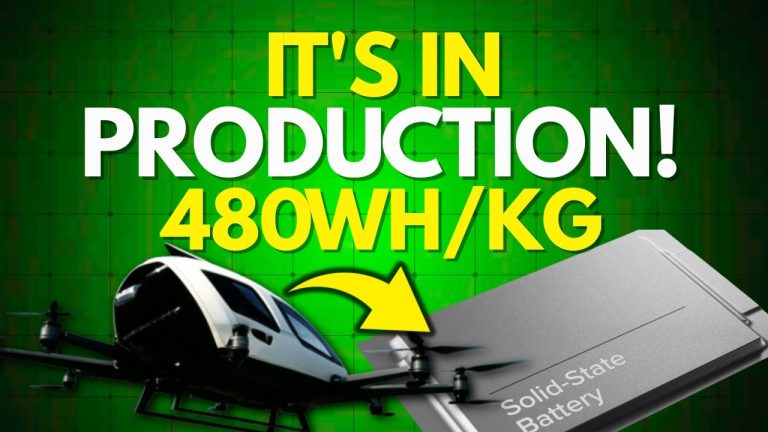
A lithium metal solid-state battery rated at 480Wh/kg is already flying in China, powering EHang’s EH216S passenger drone and increasing its travel distance by 60 to 90% compared with the NMC cells it used before. Sam Evans says it shows solid-state batteries are already in vehicles people can buy, just not in EVs yet.
Solid-state batteries are already here, just not in cars
Sam notes that Toyota has been saying since 2014 that buyers would be able to get its EVs with solid-state batteries, and because that hasn’t happened, it can feel like the technology will never arrive. He says it actually has arrived, in China, in multi-seat drone-style aircraft that can be bought right now.
Sam points out that solid-state batteries already exist in tiny devices, but that isn’t what he is talking about. The aircraft are the first real use case he can see of a product on sale today with large solid-state batteries. The batteries can’t be bought on their own. Apparently they come only in the aircraft.
Get the latest EV news first. Follow us on:
Guangzhou’s flying car rivalry
Sam describes an intense rivalry to build flying cars in Guangzhou, the city where GAC, maker of the Aion brand, and XPeng are based. He says these are really passenger-carrying drones known as eVTOLs, a name he doesn’t think will catch on, so he prefers “flying cars”. In the city precinct there is a street of display showrooms where around 20 different companies show their aircraft. Sam says he stumbled on it by accident while walking through the city, passing one flying car shopfront after another.
China has reported that the government plans to develop its low-altitude economy into an emerging pillar industry, with a 15-year plan under which it will subsidise the industry to help it grow.
Orders, autonomous flights and bigger aircraft
Sam says a factory, which he believes is owned by GAC, is now making 100 flying vehicles a year. These include a two-seat multicopter aircraft with a range of 30 km. Sam says that range could give him a bit of range anxiety. The aircraft costs $248,000 (~AUD 374,000) and has 2,000 orders.
Autonomous passenger flights have reportedly already entered commercial operation with the EHang EH216 series, which is China’s first certified autonomous passenger-carrying eVTOL. It runs regular sightseeing services from bases in Guangzhou and Hefei and flies its route on its own, without a pilot. Sam says he didn’t know this and would have tried to get a flight if he had. XPeng also makes very large aircraft that can carry up to 12 people, which Sam says look like a spaceship and have, he thinks, around 10 propellers.
According to Car News China, a six-seat electric aircraft is undergoing certification testing in Chengdu. It is aimed at intercity transport, with a range of 200 km and a top speed of 230 km/h. Car News China also reports that a lift-and-cruise aircraft is being tested in Guangzhou for cross-city, coastal and mountainous transport. It combines vertical lift rotors with a separate pusher propulsion system for forward flight. That layout improves cruise efficiency compared with multicopter designs while keeping vertical takeoff capability.
The 480Wh/kg battery
EHang and a Shenzhen-based energy company have apparently jointly developed a lithium metal solid-state battery that uses a metallic lithium anode and an oxide ceramic electrolyte. Its energy density is 480Wh/kg, which Sam says is nearly double what you get from a Tesla cylindrical cell.
The battery enabled the EH216S to complete a 48-minute flight and increased its travel distance by 60 to 90% compared with the previous NMC cells. Sam says the variation makes sense because the result depends on headwinds, tailwinds, crosswinds or calm conditions, and weather affects an aircraft even more than a car.
What it could mean for EVs
Sam believes that if this battery can increase range by 60 to 90% in the air, it would improve range by at least that much in an EV. He says an 80kWh battery already provides up to around 700 km, so with this battery EVs could probably reach about 1,200 km of range on WLTP, not CLTC. No current EV in the world has that range, and Sam says that is the kind of range where the ICE car is officially killed off.
Sam says he doesn’t know many more details about the battery yet and plans a dedicated video if he can find more information. He believes it deserves more attention because it is being used right now, and he says it certainly isn’t Toyota that is first to put solid-state batteries into vehicles.
