
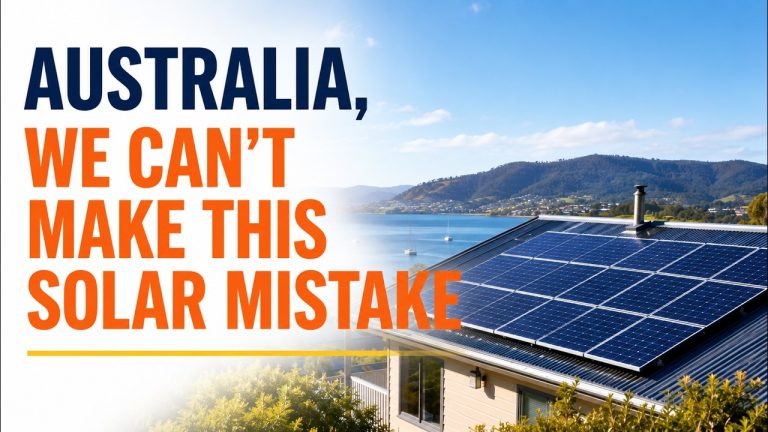
Australia now has more solar panels per person than any country on Earth, but Sam Evans warns it is on the verge of losing its seat at the world’s most important solar collaboration table. Federal funding for Australia’s participation in two International Energy Agency solar programs will run out in March, and there is no confirmed long-term funding pathway.
Solar overtakes coal in the US
Sam reports that solar is booming in the United States, with Republican states leading the way. According to Sam, 74% of all new solar installed in the US went into Republican states. America has also broken its all-time solar record, and for the first time in history solar has generated more power in the national grid than coal. Sam says gas is next “very soon”.
Australia, meanwhile, leads the entire world in rooftop solar per capita. Sam points out that the situation differs from the US, where much of the country is cold and very snowy. Most of Australia is very warm and sunny, which he says gives it a big advantage for solar.
Get the latest EV news first. Follow us on:
Two programs at risk
For nearly 50 years, Australia has been a member of two key international programs run through the International Energy Agency. The first is the Photovoltaic Power Systems program, which Australia has been part of for more than 30 years. The second is the Solar Heating and Cooling program, which Australia joined at its inception almost five decades ago.
Sam says these are not talking shops but a global network spanning more than 55 countries. Their work covers grid integration, recycling, solar buildings, market analysis and technical standards.
Many of the headline statistics Australians celebrate come largely from Australian experts working inside these programs. These include the country’s world-leading solar capacity per capita, its rooftop penetration rates, its annual market updates, and the finding that it installed more batteries over the past year than in the previous five years combined. More than 40 Australian experts currently contribute across the programs, and the reports they help produce are referenced by governments, analysts and industry around the world. Sam says he wants to encourage the Australian government to stay in these organisations because “we need to be”.
Why it matters now
Sam says solar is driving the fastest shift in electricity generation in human history, and it is still accelerating. Module prices have fallen roughly 10,000-fold as global capacity has exploded, and every doubling of capacity makes the next gigawatt cheaper. Measured from the year each technology first passed 100 terawatt hours, solar and wind are growing faster than coal, gas, hydro or nuclear ever did. Batteries are climbing even more steeply.
One modelling firm has renewables reaching around 80% of global electricity by 2035. Sam believes many coal power plants, coal mining companies and gas companies will go bankrupt as a result, saying there is “just no other alternative”.
Every prediction of a slowdown since 2015 has been wrong, Sam says, including predictions from pro-renewable energy websites. He acknowledges that people call him an idiotic optimist, but says renewables continuing to speed up is the one thing he has definitely got right. In his view, this is happening not because of feelings or because the world is heating up, but because of maths, science and money. Renewables are cheaper and simply a better option.
A race Australia helped start
Sam notes that Australian researchers pioneered the solar cell technology that powers most of the world’s panels today, something he says very few people know. If Australia genuinely wants to be a renewable energy superpower, as the government keeps saying, he believes keeping a seat at the global solar table shouldn’t be a question. Sam says the country is heading in that direction. In his view, walking away now after 50 years of leadership would be one of the most shortsighted decisions in Australian energy history.
Sam’s view: it will be okay
Sam also wants Australians not to feel too bad. He points to a recent survey showing Australians feel worse than they have in 50 years, with sentiment more negative than at any point in that time. Sam says he understands, but believes technological innovation is the solution and that people don’t need to worry.
He says projections from bodies like the IEA can sound optimistic, and the world might still face irreversible heating. Even so, Sam is confident the world is on the right track. The world is absolutely heating up, he says, but it is moving in the right direction, and far quicker than people realise.
