
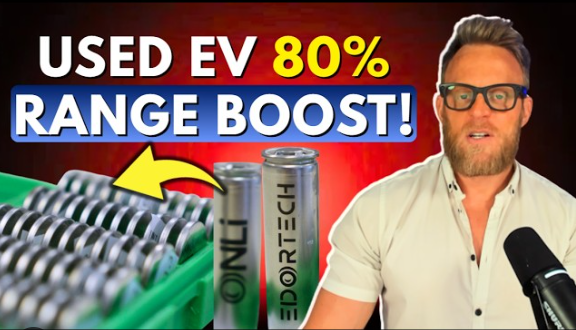
Edortech, a battery company based in Hungary, says its new anode technology could give electric cars a 60 to 80% range boost. It also says the technology could help EVs charge faster and use less energy. Sam Evans says the company is probably looking for distributors, which he believes could be a good business opportunity for a startup in Europe.
A New Approach to the Anode
A viewer sent Sam the company. The work focuses on the anode, one of the two electrodes inside a lithium-ion battery. Engineers at a laboratory in Budapest spent years testing ways to improve battery performance. Researchers believe the anode could play a major role in increasing energy density.
Edortech’s chief technology officer said: “In order for you to make a good cell, you need to go inside this container and you need to look at what’s happening inside with the lithium ions.” He described the company’s work as reimagining and re-engineering the way the anode of a battery cell is made.
Get the latest EV news first. Follow us on:
Most lithium-ion batteries used today rely on graphite in the anode. Sam notes the executive is referring to NMC batteries, not LFP. Sam also points out that most EVs now use lithium iron phosphate batteries. He says people assume lithium is the main part of these batteries, but it makes up only about 10%, while the phosphate makes up around 60%.
Metal Alloy on Copper
Edortech’s technology replaces the conventional anode material with a metal alloy formed directly on copper. The CTO said the company does “a one-stop shop in a single step.” It creates a metal bonding on the copper surface and an anode material that he said is durable and flexible.
He said the capacity is double what graphite can produce. Sam says he doesn’t know if drivers would really get double the range in the real world, but it sounds like the technology would increase battery range. The company says the process can increase battery capacity while simplifying production. Every electric vehicle contains thousands of battery cells, so even a small improvement in each cell can have a big impact on the whole battery.
60 to 80% More Range in 21700 Cells
The CTO gave a specific example. He said replacing the conventional 21700 cells found in millions of Teslas with Edortech-based 21700 cells would give about a 60 to 80% capacity increase. That would mean about 60 to 80% more range.
Sam says he found this precise. It names an exact cell type that is in millions of cars on the road, along with a specific range improvement. He says this makes him think the company must have already tried it.
On cost, the CTO said the initial cost of graphite is lower than Edortech’s material. However, he said the cost of the graphite coating technology is “insane” and that Edortech is “less than one-tenth of that cost.” Sam says he doesn’t know exactly what was meant by that. The executive also described the process as fast, scalable and cheap.
Supplying Anodes, Not Building Cells
Edortech is not planning to manufacture complete battery cells. Instead, it hopes to supply anodes to battery producers around the world. The CTO said interest from automakers is growing and that the company is in talks with several big car manufacturers about the technology.
Sam guesses those talks could involve companies such as BMW, which has new large cylindrical NMC cells. He says the technology would make sense in a vehicle like that.
The technology is still in development, and commercial deployment is targeted for 2028.
Upgrading Batteries Like Modifying Engines
Sam admits the idea sounds too good to be true at first. But he compares it to the modifications millions of people have made to combustion cars for decades, such as adding turbochargers, superchargers, new intercoolers and high-flow fuel lines to small 1.5-litre Mazda Miata engines. He says upgrading a battery is far less complex than that. He asks why people wouldn’t upgrade a five-year-old EV when new technology comes out.
Sam says it won’t work with every battery. He says Tesla’s newer packs with 4680 cells, which are filled with pink goop, are so hard to take apart that it would be a nightmare. He says BYD’s Blade battery 2.0 is even harder to get into. Other battery types are much easier to open.
The CTO also said the biggest problem with electric cars is price, not range or charging speed. Sam says that was probably true a few years ago in some places, but EVs have become cheaper. An EV journalist and vlogger quoted in the coverage said he doesn’t understand why prices are still so high. He pointed out that battery prices have really come down and that an electric car is much easier to build than a petrol car. Sam agrees it’s a good point and says battery prices have come down by 42% in the last 12 months.
What It Means
Sam says the bad news is that the technology won’t reach the market until 2028. The good news, he says, is that people will definitely be able to rejuvenate their batteries in the future by putting in new cells, and it won’t be all that expensive.
He says insurers pay far less than people think to replace batteries. Based on insurance data he has seen, an entire 70 kWh battery pack costs only about $7,000 (~AUD 10,500), and prices keep falling. Sam suggests that in 10 years the price might be $3,000 to $4,000 (~AUD 4,500 to 6,000). That could mean buying an older vehicle, putting in a new battery pack and doubling its range.
