
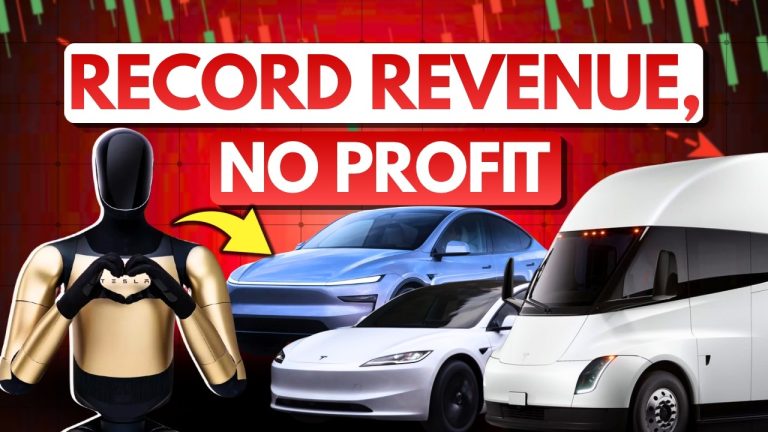
Tesla has reported its second quarter 2026 results, posting record revenue and a big miss on profit in the same quarter. Sam Evans calls them some of the strangest numbers he has ever seen. Revenue climbed 26% and deliveries beat forecasts by 80,000 vehicles, but operating income fell 57%.
Record revenue and a delivery surprise
Tesla brought in $28.24 billion (~AUD 41.6 billion) in revenue in the second quarter, up 26% year-over-year. That comfortably beat Wall Street’s expectations of $26.4 billion (~AUD 38.9 billion) by nearly $2 billion (~AUD 2.9 billion). Sam points out that this is revenue, not profit. It is still Tesla’s first real revenue growth in more than a year, and it pushed the company past $100 billion (~AUD 147.5 billion) in trailing 12-month revenue for the first time ever.
Record deliveries drove that milestone. Tesla delivered 480,000 vehicles, up 25% year-over-year, in what Sam describes as Tesla’s second best quarter ever. Wall Street was expecting around 400,000 deliveries, so Tesla beat the delivery numbers by 80,000. Sam calls this a genuine shock to analysts. He notes that Tesla achieved it even after losing the $7,500 (~AUD 11,060) federal EV tax credit, which had made a big difference to its sales in the past.
Get the latest EV news first. Follow us on:
Services revenue also jumped by 50%. Tesla deployed 13.5 GWh of energy storage, growth of 40% from a year earlier.
A heavy miss on profit
Non-GAAP earnings came in at just 33 cents (~AUD 49 cents) per share, against analyst expectations of 53 cents (~AUD 78 cents). That is a 38% shortfall. It is also down 18% from the same quarter in 2025, even though Tesla sold far more cars.
Sam says discounting did not cause the miss. Gross margin held up at 16.8%, down less than half a point from a year ago. Sam says that figure actually sounds really good, because Tesla sold a record number of cars without slashing its margins to do it.
The damage happened below the gross margin line. Operating income fell 57% to only $398 million (~AUD 587 million). Sam says that is better than making a loss, but it is a very small number. Operating margin collapsed to 1.4% from 4.1% a year ago.
Spending on AI, Optimus and robotaxis
Operating expenses rose 47% to $4.35 billion (~AUD 6.4 billion). Tesla is spending heavily on AI, the Optimus robot and the robotaxi program, plus stock-based compensation tied to Elon Musk’s 2025 pay package. Capital spending more than doubled to $5.8 billion (~AUD 8.6 billion). That pushed free cash flow to negative $1.1 billion (~AUD 1.6 billion), Tesla’s first cash-burning quarter since early 2024 and the first in more than two years.
Sam believes this is a good thing. He says he does not see the point in doing what Apple did for so long, sitting on mountains of cash without investing it to build the future. Sam also says Tesla’s profits on the products it sells are still remarkable. In his view, Tesla leads the industry by a mile on EV profitability per car, and no one else in the EV sector is close.
Regulatory credits have fallen off a cliff
Sam says the story that matters most long-term is regulatory credits. Tesla booked just $146 million (~AUD 215 million) in credit revenue, down 67% from $440 million (~AUD 649 million) a year ago. Credit sales peaked at $2.76 billion (~AUD 4.07 billion) in 2024. Because the credits cost Tesla nothing to produce, Sam says they were essentially pure profit.
A year ago, credits added almost two full points to Tesla’s gross margin. This quarter they added barely half a point. Sam says this is not coming back anytime soon, at least not in the United States. The federal EV tax credit expired at the end of September 2025. A change in US law, led by Donald Trump, also zeroed out the penalties automakers pay for missing fuel economy standards, which was the entire reason rivals bought Tesla’s credits in the first place. Sam says that market is simply gone in the United States and that Trump killed it.
He believes most of the credits Tesla did sell this quarter were probably in China and Europe, with some in Australia, and none in the United States. That means this quarter is the first clean look at Tesla’s margins without US credit income. It comes at the same time as the company is spending billions of dollars on its new programs.
Bitcoin props up net income
GAAP net income of $1.11 billion (~AUD 1.64 billion) was down only 5%. However, it leaned on a $590 million (~AUD 870 million) gain in other income, including mark-to-market gains on Tesla’s Bitcoin holdings. Strip that out, Sam says, and the underlying trend is clear: record revenue and shrinking profit.
The stock closed down just over 1% at $374 (~AUD 552) ahead of the earnings call.
What Sam makes of it
Sam says the shrinking profit is not because Tesla is failing to make good money on the cars it sells. In his view, it is because Tesla is burning cash on its future programs, which he believes makes sense. He frames the key question as whether Tesla is wisely sacrificing today’s profits to fund AI, Optimus and robotaxis, which Elon Musk says will make Tesla the most valuable company on Earth. The alternative is that Tesla’s core car business can no longer carry the weight of its ambitions. Sam calls it one of the most intriguing quarters in Tesla’s history.
