
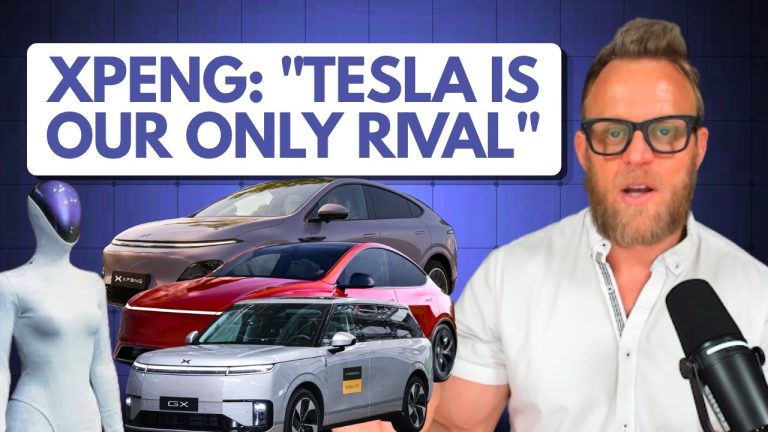
XPeng has told Australian media at an event in Melbourne that BYD is not its competitor and that Tesla is. Sam Evans says the claim makes sense when it comes to AI and autonomy, but he believes that writing off BYD is a very confident, maybe slightly arrogant thing to say.
Tesla, not BYD
XPeng’s head of international development said the company does not see BYD as a rival at all, in China or globally, because the brand positioning, products and customers are all different. The company XPeng names as its benchmark is Tesla, which it describes as a tier one global player on technology.
BYD would disagree. BYD claims it has the technology to beat both Tesla and XPeng, including its own chip foundry that it says can make chips more advanced than Tesla’s and XPeng’s. Sam points out that no one has seen that technology yet.
Get the latest EV news first. Follow us on:
On pure car sales, Sam says XPeng, BYD and Tesla obviously are competitors. People compare cars such as an XPeng G6, a BYD Sealion and a Tesla Model Y, and some families own all three brands. The context also makes XPeng’s claim bold. XPeng registered just 24 deliveries in Australia in June, and its factory-backed operation is only just beginning here under a cloud of controversy. Sam says he does not know whether it will go well for the brand in Australia. Globally, XPeng sells about 30,000 cars a month, or roughly 90,000 a quarter. Sam puts that at about a fifth or a sixth of what Tesla sells, and says XPeng is not remotely close to BYD on deliveries.
A ‘physical AI ecosystem’
Sam says XPeng is not measuring itself on today’s numbers, and globally it does have some receipts. XPeng calls its strategy a physical AI ecosystem, and Sam says this is not marketing fluff. Its foundation model, VLA 2.0, is meant to be the equivalent of Tesla’s self-driving software. It underpins XPeng’s road cars, its robotaxis, its humanoid robot and its flying car: the same software brain in four different bodies.
Sam says only one other company on Earth is attempting that combination and doing it well, and that is Tesla with Full Self-Driving, Cybercab and Optimus. When XPeng names Tesla, Sam says, it is not comparing sales. It is naming the only other company playing the same game the same way. He adds that XPeng has basically copied Tesla’s entire way of doing things, and that it is working quite well.
Robotaxi, robot and flying car
In May, XPeng’s first mass-produced robotaxi rolled off the line in Guangzhou, making it the first automaker in China to reach robotaxi mass production. Sam says the vehicle does not yet work as a proper robotaxi and is not as advanced as Tesla’s Cybercab. He expects it will not have the software to perform as a robotaxi for at least a year, maybe a little longer. He still calls the vehicle pretty impressive. It runs four of XPeng’s Turing chips for 3,000 TOPS, which Sam says makes it the most powerful car in the world for compute capacity, and response latency is under 80 milliseconds. XPeng says pilot operations start in the second half of 2026, and it is targeting a fully autonomous service without a safety officer in early 2027. Sam stresses that ‘targeted’ is the key word and says nobody knows whether that will happen.
XPeng wants capacity for its Iron humanoid robot above 1,000 units a month by the end of 2026, ahead of a global rollout it says will happen in 2027. The robot will start as a showroom assistant in Chinese stores in the first quarter, then in overseas stores later that year. Iron is under 170 cm tall, has more than 60 joints and a solid-state battery, and uses three Turing chips. XPeng’s flying car program has already taken more than 7,000 orders, with mass production targeted for 2027.
Sam on the timelines
Sam says the media has not mentioned one point. At XPeng’s own event in China in 2025, which media attended, the company’s head of robotics said its robot would not be a usable, produced product for at least five years. Now XPeng says it is happening next year. Sam believes a lot of this is marketing, and he says XPeng needs that marketing to lift its stock, stay in business and have enough cash to reach its goals.
Sam calls these timeframes ‘Elon Musk time frames’ and says they are not realistic. He believes the company can achieve these things, but says the timeframes have changed drastically. In his view, the marketing department is setting the message, not the engineers doing the work. He says the marketing team is under immense pressure and is in many cases spending crazy amounts of money, including on YouTubers. Sam says he is aware of a conflict going on inside XPeng and will cover it separately.
Sam also notes that XPeng has blacklisted him, so he has no preferential arrangement with the company and none of his information came from XPeng’s PR department. He still says the products themselves are very, very good. His caution is about the timelines.
XPeng Vice Chairman Brian Gu has said he expects the robot business to be bigger than the car business within 10 to 20 years. Sam says that is the real thesis: cars are the volume product that funds the AI and feeds it training data. Sam says he has spoken to Gu, has a lot of respect for him, and thinks what Gu says here is very likely to be accurate.
What it means for Australia
Gu said Australia is the fourth-largest right-hand-drive market in the world. He confirmed that the flying car and the robotaxi are both planned for Australia once regulations allow them. Sam does not expect flying car regulations to change or the flying car to come to Australia. He says it is not really relevant, calls it a side mission for XPeng, and personally thinks the flying car is a complete waste of money.
XPeng says its VLA self-driving is coming to Australian cars in 2027 at no extra charge, which Sam says is aimed at rivalling Tesla and winning sales. He says the models already announced for Australia cannot support it. The new XPeng G6 does not have the chips needed for VLA 2.0. If the system depends on those cars, the answer is no. If it comes with new cars that have different specifications, it is possible.
Is XPeng right to write off BYD?
Sam says XPeng is only partly right, and this is where he pushes back. BYD is spending insane amounts of money, and its God’s Eye system is being rolled out across the entire lineup. Sam does not think God’s Eye is the future of full self-driving. BYD’s new 4-nanometre driving chip is, according to BYD, capable of supporting Level 3 and Level 4 driving, though Sam says he does not know if that is true. He says it is arguably the widest deployment of autonomy hardware by any carmaker on the planet, but stresses that hardware and software are two completely different things.
In June, BYD publicly confirmed it is developing humanoid robots and floated selling household robots through its dealer network, with industrial robots coming first. Sam says BYD was late to say this out loud but is not absent, just less focused on these products than Tesla and XPeng. He puts BYD about four to five years behind both companies in artificial intelligence. XPeng also cannot wave away scale. BYD sold 321,000 vehicles in China in April alone, and Sam says that volume lets it hire more people and grow faster, which counts in BYD’s favour.
Sam’s read is that XPeng is correct about the direction. He believes the price war in the car industry will end with many small and even medium-sized carmakers disappearing. He also doubts most people in 2040 will want to buy a car without full self-driving when they don’t have to. He says the fight is moving from kilowatt-hours and charging times to chips, foundation models, AI and autonomy, and that XPeng is further down that road than perhaps anyone except Tesla. But he says telling the world BYD doesn’t matter is a very confident, maybe slightly arrogant claim when BYD builds more cars in a fortnight than XPeng builds in a year.
