
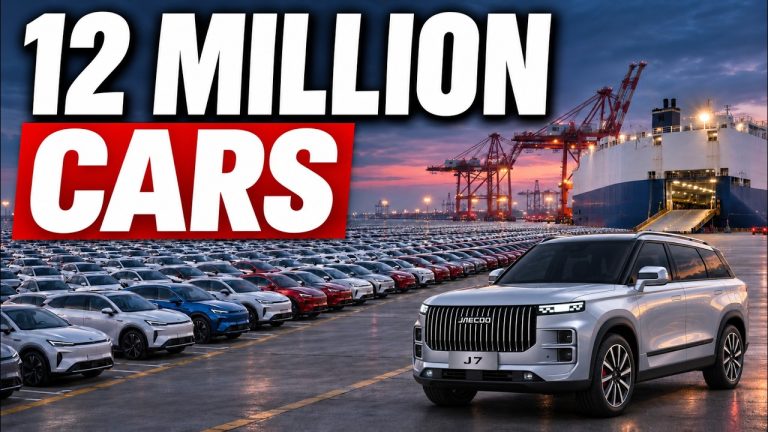
A Chinese car brand that only launched three years ago has become the best-selling car in Britain for two months running, and that is just a small part of a much bigger story. According to Michael Dunne, who has tracked China’s car industry for decades, the wave of Chinese car exports is not going to slow down. In fact, he argues that China cannot stop exporting cars even if it wanted to. The numbers this year are staggering: China is on track to export 12 million vehicles in 2026, which is more than the total number of cars built in America.
Why China Is Exporting So Many Cars
The main reason for this export surge is survival, not just ambition. Car sales inside China have fallen by 25% this year, which is about 5 million fewer cars sold—equivalent to the entire Japanese car market disappearing in just 12 months. Meanwhile, China’s factories have the capacity to build 57 million cars a year, which is more than double what Chinese buyers want or can afford.
This has led to a situation where there are too many factories, a shrinking home market, and a price war that has wiped out profits for many companies. For most Chinese carmakers, exporting cars overseas is now the only way to stay alive.
Get the latest EV news first. Follow us on:
Why Weak Brands Don’t Close in China
Normally, weaker brands would shut down in this kind of environment. But according to Michael Dunne, that does not happen in China. Local officials are promoted for bringing in factories and jobs, not for making profits. Profits are just a bonus, but if they do not materialize, it does not matter as much. As a result, nobody shuts anything down—everyone just exports instead.
Impact on Global Car Markets
The world is building barely more cars than before the pandemic, so every extra car China ships is a car that does not get built somewhere else, particularly in Europe or North America. This has real consequences: Volkswagen is cutting 100,000 jobs by 2030 and four of its German factories are under threat. Mercedes has also warned it will close two German plants.
The Jaecoo 7: A Case Study in Britain and Australia
In Britain, the best-selling car is now the Jaecoo 7, built by Chery in Wuhu—a city I visited last month and will visit again in January. In Britain, the Jaecoo 7 costs about $38,000 (~AUD 57,276). In Australia, where it is called the J7, it starts at just under A$40,000 (~$26,538) drive away. There has not yet been an announcement for the US or Canada.
What This Means for Buyers and the Industry
Michael Dunne warns that buyers are cheering for cheap cars, but their own car industries and jobs are disappearing as a result. He points out that China has done this before in other industries like steel, solar panels, and batteries. I would add that while the Jaecoo comes as a petrol or plug-in hybrid, there are EV versions as well, like the J5. The real growth is in electric vehicles: last month, more than half of the vehicles China exported had a plug, and exports of fully electric cars more than doubled.
Legacy carmakers had years of warning that this was coming. The companies that survive will be the ones building electric cars that people can actually afford and that are truly competitive. Blaming customers for wanting a better deal is not a strategy.
