
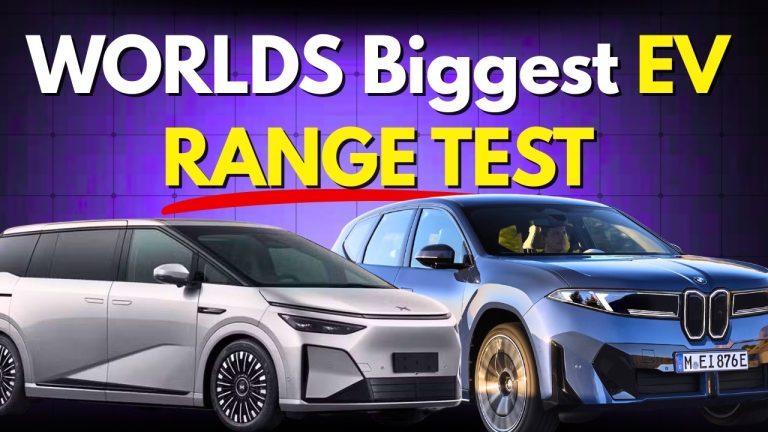
Norway’s annual summer range test by Motor and the NAF has put 24 electric cars through a real-world drive until they could no longer hold the speed limit, and Sam Evans says the results show most EVs come very close to their WLTP range claims. The test also included the new BYD Atto 3 EVO, and the car that beat its claim by the widest margin was a seven-seat Chinese electric van.
How the test works
Each of the 24 cars was charged to 100% overnight. They were then driven on a fixed loop out of Oslo towards the mountains, climbing as they went, all on the same day and in the same conditions. A car was pulled to the side of the road once it lost power and could no longer hold the speed limit. Sam says this is more like real life than Carwow’s similar test, which drives cars until they are completely dead.
Sam says the test is not really about which car drives the furthest. It is about which car keeps the promise on the window sticker. He argues that a car claiming 500 km that beats its figure probably matters more to an owner than a car claiming 750 km that delivers a lot less. He notes that many people, including mainstream media and social media users, say EVs can never reach their WLTP range. Sam says the facts from this kind of testing show otherwise, with most cars landing extremely close to their WLTP estimates.
Get the latest EV news first. Follow us on:
BMW iX3 goes furthest, Xpeng X9 beats its claim by the most
The BMW iX3 went the furthest of any car, covering 781 km on a single charge. The tested version had bigger wheels than the version rated at 800 km, so its WLTP figure was 770 km. That means it beat its own claim by 11 km, or 1.4%. Early in the run it was estimating 887 km with 93% battery left, and some viewers thought it might crack 800 km. Sam says it is not cheap but has incredible performance. He points out that the iX3 uses new NMC cylindrical cells slightly bigger than Tesla’s. He says CATL had basically called these cells a waste of time and Tesla’s focus on them a failure, so the result suggests that maybe that’s not the case.
Sam calls the Xpeng X9 the moral winner. The big seven-seat MPV stopped at 646 km against a WLTP figure of 580 km, beating it by 66 km, or 11%. Sam says it is bizarre that the car with the most range relative to its claim was a brick-shaped seven-seat van. He says the old assumption was that Chinese EVs were cheap and you’d pay for it in the real world, and this test kind of says the opposite. Xpeng beat Mercedes, Polestar, BMW and Lucid on the metric Sam says matters most: getting the range claimed.
Luxury cars at the bottom of the table
The Lucid Gravity, which Sam says costs $167,000 (~AUD 251,700) in Europe, covered 720 km. Sam described it as 28% short of its claim and the worst deviation by far, although the deviation table he went through lists the Gravity at minus 3.7%. The MG IM6 missed its number by 12%, which Sam says is not great. The Mercedes CLA Shooting Brake came up 33 km short (minus 4.7%). Sam says that is very close, but with a premium badge and premium price you might want a little better.
The cheapest car in the test costs around $27,000 (~AUD 40,700) in China despite 40% EV tariffs on its price. Sam says without those tariffs it might be around $18,000 (~AUD 27,100). The Lucid costs six times as much. The organisers noted the gap between the most and least expensive cars was over $100,000 (~AUD 150,700) and about 460 km of range. Sam says that on keeping its range promise, the cheap Chinese car kind of embarrassed the luxury Lucid flagship.
Full deviation results, including the BYD Atto 3 EVO
The Toyota bZ4X landed exactly on its WLTP number at 506 km. Sam says you’d expect the same from the Subaru Solterra, which was not tested but is essentially the same vehicle. The Hyundai Inster beat its claim by 4.2%. The Kia EV2, the shortest-range car in the test with its small battery and a claimed 308 km, exceeded its range by 5.4%.
Other results Sam ran through: Mercedes GLC 400 plus 3.4%, Toyota C-HR+ minus 3.3%, Kia EV4 minus 3.2%, smart #5 plus 3%, Kia EV5 plus 2%, MG S6 plus 3.3%, Citroën ë-C5 Aircross minus 2.5%, Mazda 6e plus 1%, Kia PV5 plus 1.7% and KGM Musso EV minus 2.6%. The new BYD Atto 3 EVO, in its shorter-range version, was claimed at 470 km and did 460 km, a 2.1% shortfall. Sam says that is pretty close for anyone interested in the car. He also notes that Australia is about the only market yet to get the Atto 3 EVO, which is already available in Malaysia, New Zealand, Europe and China.
Missing and unreliable results
Sam says four cars had no clean figures. The Mercedes GLB stopped, but its range estimate zeroed out during the run, so its finish figure is not reliable. The Polestar 3 had no confirmed finishing number in the coverage. Another car lost power before 350 km and was ruled out. The Hyundai Ioniq 9, which Sam says should have done well, was disqualified after its driver missed a turn in Oslo.
Tesla and the entire Volkswagen group, including Volkswagen, Audi and Skoda, were not in the test. Sam says Tesla’s absence is surprising because it has been a strong deviation performer in past Norwegian tests. A separate charging test runs a few days later, and those results are not out yet.
What it means
Sam stresses that this was a summer test in Norway. It was not hugely warm, but conditions were ideal for an EV. In the winter test, cars get a lot less range, probably around 30% less on average. The drive also included little freeway driving at the 120 to 130 km/h speeds many Americans drive at, where Sam says you will not get the claimed range. He says this mix of driving partly explains why nearly every car, apart from a couple, came very close to its WLTP claim.
