
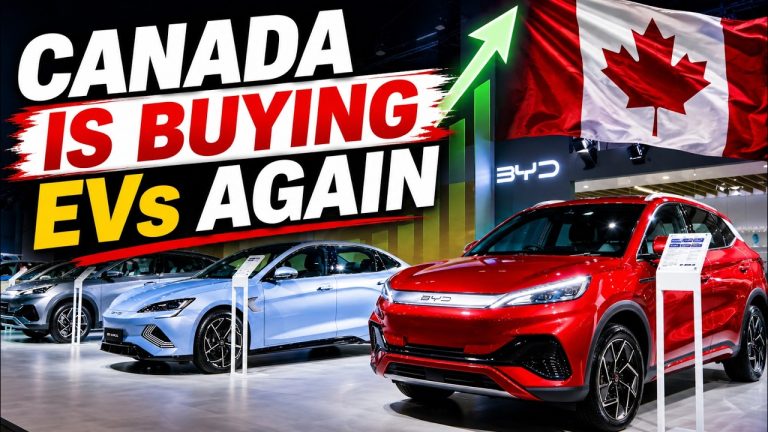
More than a third of Canadians shopping for a new car are considering an electric vehicle, and 56% of those EV shoppers say they would consider a Chinese EV that is not yet sold in Canada, according to a JD Power Canada study. Sam Evans says sentiment has shifted since China announced a deal with Canada and Tesla cut its prices, and he believes it will be very interesting to see how far ahead of the United States Canada gets on EV adoption.
EV sentiment turns positive for the first time in four years
JD Power Canada surveyed more than 5,000 new vehicle shoppers in March and April for its annual Canada Electric Vehicle Consideration Study. It found that 34% of new car buyers currently in the market said they were very likely to look at an EV for their next purchase. That is a 6 percentage point increase from last year.
According to JD Power Canada, fuel prices, federal incentives and the prospect of low-cost models from China pushed consumer EV sentiment into positive territory for the first time in four years. A JD Power managing director said the main drivers were fuel prices, elevated by the Iran war, and the return of the federal EV rebate. Sam says this shows the shift is not only about cheap, good-quality EVs from China, but also about incentives and the significant rise in fuel costs in Canada.
Get the latest EV news first. Follow us on:
JD Power said that as mass-market consumers get more exposure to EVs and automakers keep rolling out more affordable models, the Canadian EV market has a lot of headroom to grow. It added that this year-over-year improvement feels more sustainable than it may have in years past.
Sales jump after the rebate returns
In March, the first full month that Ottawa’s new rebate program was in place, the zero-emission adoption rate in Canada increased by 12.2%, nearly double the uptake from a year earlier. Sam says that in other words, EV sales doubled in March.
Lower upfront prices are also shifting sentiment. Sam says that as EV prices fall, adoption skyrockets, pointing to Australia, where affordable Chinese EVs are available and are often cheaper than combustion cars from legacy automakers. Unlike in previous years, when affordability was consumers’ main concern, JD Power said the issue has dropped out of the top three barriers to going electric.
After government and automaker incentives, several EVs in Canada now start well below previous price points. Sam highlights the Tesla Model 3, which he says is now around half the price it was a month ago, because Tesla is now using the Chinese-built model, which he says is actually slightly better, with the federal discount bringing the price down further. Sam calls the drop crazy.
Range anxiety, charging availability and winter performance remain sticking points for Canadians reluctant to switch from a combustion vehicle.
Openness to Chinese brands
As more Canadians consider an EV, many are open to buying from brands they don’t know well or haven’t bought from before. Sam says it is really interesting to see how open-minded people are.
Several big-name Chinese exporters, including BYD, Chery and Geely, and potentially Xpeng, are reportedly setting up distribution networks and working through certification to start sales in Canada. Sam says they have already started hiring hundreds of staff in the country.
Cost is far and away the biggest motivator for Canadians interested in Chinese EV brands, according to JD Power, though new technology and overall value are also big contributors. Those who are sceptical worry about longer-term issues: whether a brand will stick around in Canada, whether policies could change, and the quality of after-sales support and parts availability. Sam says these are fair questions that buyers need to consider. JD Power said the new entrants may have to prove themselves on dealer networks and service centres before mass adoption.
Pressure on legacy automakers
JD Power said the high level of interest among Canadian car shoppers should give incumbent automakers pause, describing it as reason for at least some concern and some action. Sam says this applies particularly to North American legacy automakers such as Ford, General Motors and Stellantis, which he believes are shrinking outside North America, need Canada, and are going to lose the Canadian market as well, something he calls pretty scary for them.
What it means
Sam believes Chinese brands winning over Canadian buyers is just a matter of time, as he thinks most people, though not everyone, are motivated by price more than anything else. He expects EV prices in Canada to shrink enormously over the next five years.
