
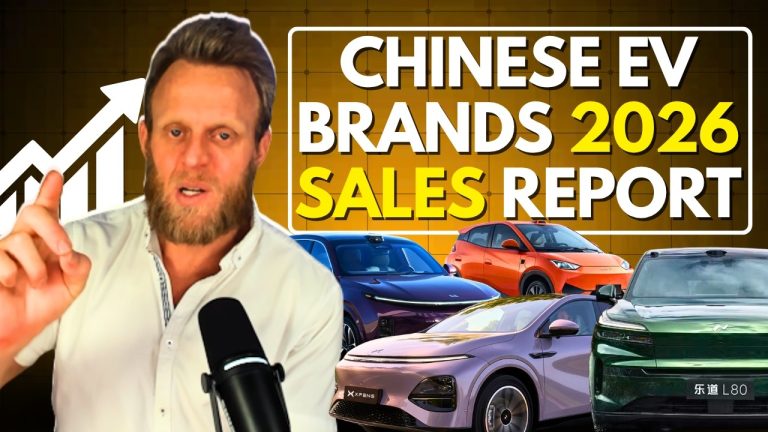
Based on the data we have so far, most Chinese automakers that mainly sell EVs, plug-in hybrids and E-REVs saw sales rebound in May 2026. BYD technically ended its eight-month losing streak, Geely’s exports surged, and Zeekr and Leapmotor both set new delivery records.
The May leaderboard
Among the major automakers in China, BYD was in first place for deliveries in May, followed by Geely and then Chery. Next came SAIC-GM-Wuling, a tri-venture between General Motors, Wuling and SAIC, then Leapmotor and Huawei’s HIMA alliance. Further down the list were Nio, Zeekr, Arcfox, Voyah and IM Motors. These are basically the companies selling the most EVs in China.
BYD ends its losing streak, just
BYD’s sales had declined for eight months in a row, and in May it fixed that, sort of, but not by a whole lot. Overseas sales were the big positive. They grew by 80%, with BYD delivering 160,644 vehicles outside China. Sales in China are still down by quite a bit versus last year.
Get the latest EV news first. Follow us on:
Overall, BYD’s May deliveries were up 0.26% on May 2025. To be honest, it basically sold the same number of cars, but that was a lot better than every other month this year. Sales were also up 20% compared with April. Across the first five months of 2026, though, BYD’s sales are down 20% on last year.
I believe BYD is clearly struggling with production of its new Blade Battery. The company isn’t saying it, but that’s why there have been huge delays with new models using it. The Great Tang has more than 100,000 orders and has been confirmed for right-hand drive markets, which is awesome, but no cars have been delivered yet because of that battery production. BYD has huge backlogs for its new models, and I’m guessing things will change over the next few months as those cars come into circulation.
Geely’s exports soar as plug-in hybrids grow
Geely’s exports hit another record, growing even faster than BYD’s at 184%. That offset a 26% decline in sales in China. Surprisingly, Geely’s EV sales fell by 19.4%, but its plug-in hybrid sales grew by 32%. In Europe the tariff on Chinese EVs is around 35 to 40%, while plug-in hybrids face a 10% tariff, so you can see why Geely is selling so many more plug-in hybrids there.
Geely sold 237,640 vehicles in May, up 1% on the same month last year. Across the first five months of 2026, Geely’s sales are almost identical to last year’s, which is a lot better than BYD. Keep in mind these figures don’t include all Geely-owned brands. Volvo, for example, isn’t listed under the Geely name.
Li Auto slips while Zeekr and Leapmotor set records
Li Auto delivered 33,000 vehicles in May, down 18% from May last year. It has sold 163,000 cars so far this year, down 3% year-on-year, which isn’t too bad considering how much the Chinese auto market is struggling. Li Auto has a new flagship EV coming that it hopes will lift sales, and it will be selling vehicles in multiple countries by the end of next year, including, I believe, Australia.
Zeekr really stands out. It delivered a record 34,400 cars in May, up 81.8% year-on-year and 8% on April, with much of that driven by its plug-in hybrid luxury cars. That’s pretty staggering. Over the first five months of this year, Zeekr’s worldwide sales are up 93.4%. I own a Zeekr 7X myself and will be publishing a review of my experience with it very soon.
Leapmotor is one of the fastest-growing car brands in the world and is absolutely killing it. It delivered 81,600 cars in May, up 81% on the same month last year and an all-time single-month record. Even with China’s car market shrinking significantly this year, Leapmotor has beaten last year’s sales in every month of 2026. It has reportedly been running incentives in China, with a benefit of up to $8,400 (~AUD 12,660) in June, which is probably part of the story. Based on these numbers, I’d estimate we’ll probably see Leapmotor deliver around 150,000 cars in November and December, which would very likely make it one of the biggest EV brands in the world.
Xpeng, Nio, Huawei and Xiaomi
Xpeng delivered 32,160 vehicles in May, down 4% year-on-year. It has delivered 126,000 cars so far this year, down 22.6% on the same period last year. The new Xpeng GX reportedly has more than 50,000 orders, and Xpeng has only just started making it, so I’m guessing it will help, along with a whole lot of new E-REVs and EVs that have just hit the market.
Nio delivered 37,700 cars in May, its best figure this year and 62% more than the same month last year. Nio’s numbers are a little confusing. Sales of the Nio brand itself are actually terrible versus last year, but including its cheaper value brand, Onvo, they look pretty good. Nio has 150,000 sales so far this year, up 68.7%, and I believe more than half of those are Onvo cars. Nio, Xpeng and Zeekr are all delivering numbers in the mid-30,000s.
Huawei’s HIMA, the Harmony Intelligent Mobility Alliance, delivered 46,000 vehicles in May, up 3.8% on last year. That beats Xpeng, Zeekr and Nio even though it’s a pretty new brand, which surprises me. Personally, I don’t find the vehicles all that appealing, but Huawei is a much-loved, very strong brand in China. HIMA is actually five different Chinese automakers whose cars all use Huawei’s software and hardware ecosystem, and together they delivered 192,000 vehicles from January to May.
Xiaomi surprises me. It touts massive order numbers, such as more than 350,000 orders, and 400,000 for the YU7 SUV, yet deliveries haven’t really increased at all. The SU7’s sales last year were fantastic, and they’re really good cars, but I’m curious why sales come nowhere near matching the order totals. It reminds me of the Tesla Cybertruck. Unlike every other automaker in China, Xiaomi doesn’t give exact sales figures or model breakdowns. It said it delivered 36,700 vehicles in April, but for May it only said it delivered over 30,000 cars. We usually don’t get the real numbers until a month or two later.
What it means
I think these sales are actually really good, considering the entire Chinese car market has shrunk by 20% versus last year. Consumer confidence isn’t very high, people aren’t buying, and incentives are down. Even so, over the last two months, electric cars, including plug-in hybrids but mostly EVs, made up a record 62% of China’s car market. EV, plug-in hybrid and E-REV sales haven’t gone down versus last year. It’s internal combustion cars and regular hybrids that have crashed.
