
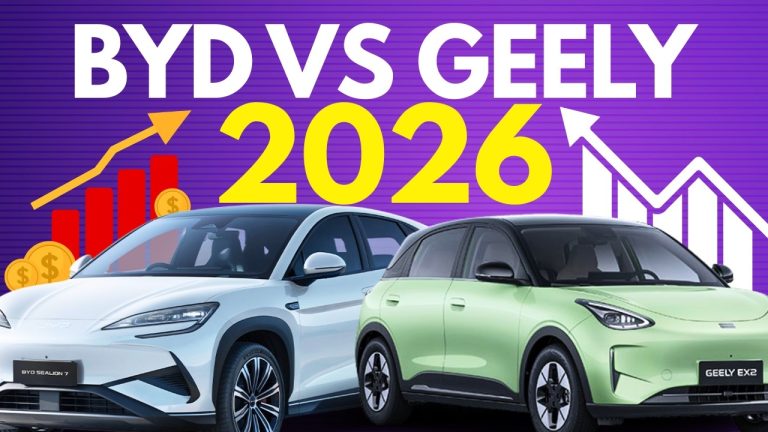
Geely Automobile Holdings’ total sales rose just over 1% year-on-year in May 2026 to 237,637 vehicles, but its domestic sales in China fell 26%. BYD delivered 383,500 vehicles in the same month, and Sam Evans says the gap shows that new technology is deciding who wins in the world’s biggest car market.
Geely Holds Steady Only Thanks to Exports
On paper, Geely’s result of roughly 238,000 cars looks steady. Sam says that is actually pretty impressive, because the Chinese car market this year has been terrible, with consumer confidence and sales both down.
The overall figure hides a sharp split. Geely’s domestic sales dropped 26% to 152,000 vehicles. The company stayed positive overall only because exports rose by over 183% to a record 85,000. Geely’s pure electric vehicle sales fell 20% in May, and its mass-market sub-brands, such as Geely Galaxy and Lynk & Co, saw double-digit domestic drops.
Get the latest EV news first. Follow us on:
These figures cover only the listed entity, Geely Automobile Holdings. They do not include the whole Geely group, which also owns Volvo and Polestar. Those brands report their sales separately.
BYD Surges Back
Sam says BYD did more than edge up. Its sales have recovered completely and are surging forward. Its 383,500 deliveries in May 2026 far outpace Geely’s core entity. He points out the surprising reversal: Geely outsold BYD in January 2026, and the position has now swung back the other way completely.
Sam believes the reason is that domestic buyers in China are moving hard towards the newest technology, and BYD has it. He says product and technology cycles decide who thrives and who gets left behind, and that once a company reveals new technology, its sales suddenly go up.
New Plug-In Hybrids and 1,000kW Flash Charging
BYD has just launched new long-range, ultra-fast-charging plug-in hybrids. Sam says their total driving range and fuel efficiency make traditional petrol cars and even older hybrids completely obsolete. He adds that they also make BYD’s current-generation plug-in hybrids, which it sells globally, obsolete, because the new ones available in China are so much better.
Sam calls the pure EV side the real hammer blow to the competition. BYD has introduced 1,000kW flash-charging, long-range EVs, led by flagship models such as the upcoming Tang SUV. Sam says the Tang now has well over 100,000 pre-orders. The cars use BYD’s Blade Battery 2.0. Sam says it brings large gains in energy density and efficiency, very good safety, and charging speeds that remove range anxiety, with a battery able to charge in 5 minutes.
Sam also points to a new BYD chip, which he says is similar to XPeng’s Turing chip. BYD does not just design the chip but makes it in its own foundry. Sam says he doesn’t think anyone knew BYD was doing this until about a week before.
Geely’s Response
Geely is trying to fight back by cutting prices on entry-level cars, including the model sold globally as the Geely EX2. Sam says it will go on sale in global markets very soon, was the best-selling EV in China in 2025, and has been improved enormously. Geely has also just revealed EVs that charge faster than BYD’s, and those are coming soon.
Geely’s premium brand Zeekr is doing really well, with sales up nearly 100% this year.
What It Means
Sam says that in the volume market, BYD’s Blade Battery 2.0 and megawatt charging are drawing a line in the sand. BYD is offering that technology in cars that cost as little as $15,000 (~AUD 22,600). Sam believes legacy giants and domestic rivals are being forced to export to survive, while BYD still dominates at home. He asks whether Geely’s global portfolio, including Volvo and Polestar, can help it withstand what he calls BYD’s new tech wave.
