
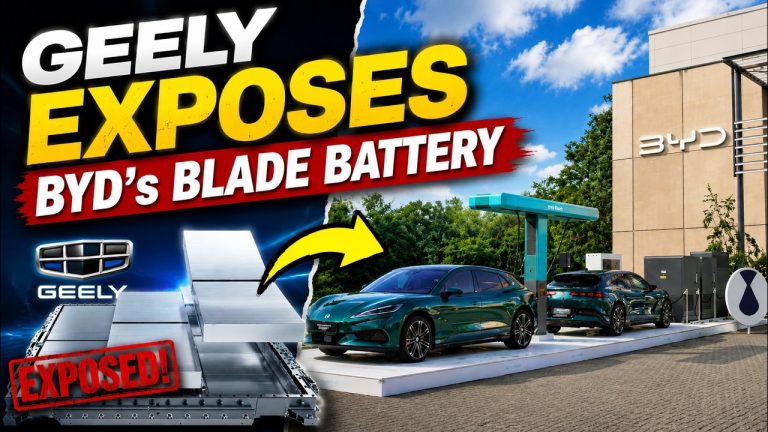
Geely has publicly challenged BYD’s flash charging technology, arguing that charging at 1,000 kW makes batteries run too hot. BYD has hit back, saying flash charging does not damage its batteries. Sam Evans says BYD’s argument does not stack up, because nobody yet has the long-term data to prove it either way.
Geely’s challenge: ‘Temperature above 65°C not recommended’
Geely published a post on its official WeChat account under the headline “Temperature above 65°C not recommended.” The post cited China’s current national standard, which says the maximum charging temperature of lithium iron phosphate (LFP) batteries should not exceed 65°C. Geely did not name BYD, but Sam says the target was obvious. BYD is advertising its 1,000 kW charging heavily. It also has 1,500 kW chargers, and Sam believes it plans to install 60 of them in the United Kingdom. BYD is talking about hundreds, maybe thousands, in Europe and already has thousands in China.
Geely cited Joule’s law, which says battery heat generation rises exponentially as current increases. “As megawatt-level charging becomes increasingly common, battery thermal management faces higher technical requirements,” Geely said. The company said its own new battery was tested by the China Automotive Technology and Research Center. It recorded a peak temperature of just 64°C while charging at 1,000 kW, the same speed as BYD’s battery. Geely said the battery passed the full Chinese GB 38031-2025 certification last May, which it called the strictest battery safety standard in history. “Charging fast is not enough. What matters more is ensuring safety,” Geely said.
Get the latest EV news first. Follow us on:
Sam’s first reaction to the story was that Geely’s golden battery charges even faster than BYD’s. It is rated at 1,200 kW, which he puts at roughly 5% faster, and he calls it currently the fastest charging battery in the world. Once he looked at the technical details, though, Sam says what Geely has done with fast charging is incredible.
The test that sparked the controversy
The controversy began on 6 May. A Chinese battery industry blogger showed one of BYD’s vehicles charging at 1,000 kW. The outside temperature was 25°C. The car charged from 9% to 97% in 9 minutes and 9 seconds. However, the battery reached a maximum of 76.4°C and stayed above 74°C for much of the charging cycle.
The blogger noted that battery temperatures generally sit around 60°C at peak charging speed and that exceeding 70°C is not allowed. He warned that excessively high temperatures could cause electrolyte gassing and trigger the risk of SEI film decomposition. Many experts said BYD’s flash charging would damage batteries.
BYD’s responses
On 7 May, the general manager of BYD’s branding and public relations division posted on Weibo. He invited everyone to visit the Flaming Mountains during the hottest months of July and August and try flash charging there. Sam says the statement made no real sense to him. Flash charging a car a couple of times is not the issue, he says. The problem is doing it hundreds of times.
According to CnEVPost, other battery makers then joined the discussion. On 17 May, an executive at Gotion High-Tech told an industry conference that ultra-fast charging does affect battery life. Gotion makes its own advanced LFP and sodium batteries. The executive said the safe operating temperature for LFP batteries is 60°C. Lithium hexafluorophosphate begins to slowly decompose at 60°C, and the decomposition accelerates at 70°C. The executive noted that this material accounts for more than 60% of electrolyte costs and is key to lithium-ion conduction. Sam says it is no big news that ultra-fast charging affects battery life, because that has been known for years.
BYD eventually responded through the chief technology officer of its battery business group. “You can’t simply say flash charging damages batteries,” he said. He pointed out that every step up in charging rate, from 1C and 2C to 4C and 5C, raised questions about battery damage, and each time the technology advanced. He said the symmetrical structure of the Blade battery lets current flow out from both ends. Both the top and bottom surfaces dissipate heat at the same time, which gives relatively lower thermal resistance. He also said BYD optimised the dimensions of the second-generation Blade battery for flash charging.
Asked whether 70°C is the battery’s limit, he said it is not. He noted that only a few years ago the industry believed the ceiling for LFP batteries was 60°C. “We should not be bound by static numbers,” he said. He stressed that the key is understanding how temperature affects battery life and then pushing boundaries through innovation.
Why Sam doubts BYD’s argument
Sam says BYD’s argument does not hold up because there is no data on charging at this level. He challenges anyone to name an EV that has done more than 400,000 km while regularly using 6C charging, or even 500 kW charging, which is half the speed of BYD’s system. Sam says the technology is too new. If any such cars exist, he believes they would make up less than 0.1% of EVs on the road. He asks how BYD can know how cars will handle 500 kW-plus charging over hundreds of thousands of kilometres. Until that data exists, Sam says, BYD is relying on anecdotal claims.
Sam also questions BYD’s heat dissipation claim. If the Blade battery really sheds heat so quickly, he asks, why did it reach 76°C? Sam says something does not add up.
Sam then points to phones. Phone batteries degrade faster because they have no proper thermal management and get hot all the time, for example in your pocket or on a wireless charging pad in a car. Sam believes the main reason EV batteries last far longer than phone batteries is that they do not get as hot. He says real-world data from millions of phones, and from EVs, shows that heat damages batteries.
What it means
CnEVPost describes the debate as part of the intense rivalry between Geely and BYD. Sam says it is really a rivalry between all battery makers, including CATL, BYD and Gotion High-Tech. What he finds most interesting is that BYD is effectively claiming heat does not affect batteries.
Sam stresses that he is not saying BYD is wrong, only that its argument is wrong. BYD may turn out to be right, he says, perhaps in five years, once people have flash charged these batteries hundreds of times and the data exists. Sam says it is possible BYD has something in the second-generation Blade battery that stops extreme heat from damaging it and simply does not want to say what it is.
