
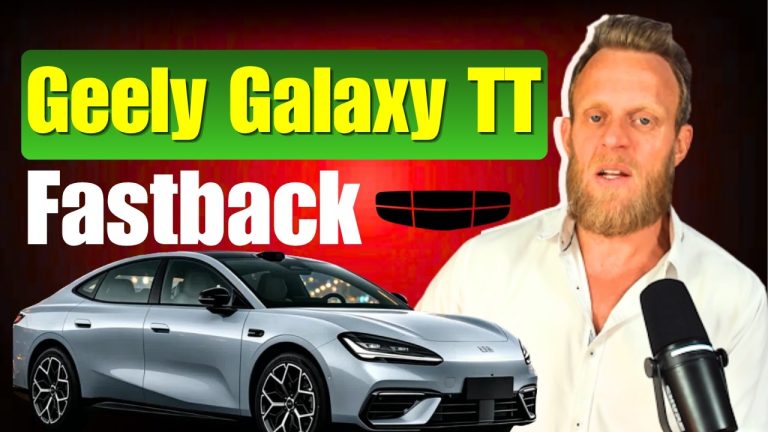
Geely has revealed the specifications in China for its Galaxy TT electric fastback, with up to 725 km of CLTC range. Sam Evans says the starting price he has heard in China is below $15,000 (~AUD 22,600), which he calls “an absolute bargain”, and he believes the car has a good chance of reaching markets outside China in the next 12 months.
Three battery packs and up to 725 km
The Galaxy TT comes with three battery pack sizes: 52.5 kWh in the smallest version, 63.8 kWh in the mid-range version and 75 kWh in the longest-range version.
The smallest battery delivers 540 km of CLTC range and the 63.8 kWh battery delivers 640 km. The all-wheel-drive long-range version is rated at 650 km, which Sam notes sounds odd because it is only 10 km more than the mid-spec car. The rear-wheel-drive version reaches 725 km.
Get the latest EV news first. Follow us on:
Size, motor and features
The Galaxy TT is 4,999 mm long, essentially 5 m, and 1,919 mm wide. Sam compares its size to the Xpeng P7.
It uses the same 245 kW electric motor as the new rear-wheel-drive version of the Geely EX5. It also has roof-mounted lidar and a liftback. Sam says the liftback makes it a more practical option than a regular sedan because it gives much more boot space.
Why Sam is watching it
Sam says cars like this can’t be bought outside China at these prices right now, but he believes they will be eventually. He says companies like Geely are launching cars at “unbelievable prices” that many people outside China are missing, because many of these launches are not being covered.
Sam stresses that the Galaxy TT is not coming to Australia, the US or Europe next week or next month. He believes there is a good chance it will arrive in the next 12 months, and that it could even undercut something like the BYD Seal.
Geely’s new battery and up to 12C charging
Sam also covered Geely’s new second-generation battery, which Geely has officially unveiled. It is claimed to support up to 12C charging. Sam says that makes it technically the fastest-charging battery in the world, even faster than BYD’s Blade Battery 2.0. It has around 1.1 MW of peak power, but Sam says it has been proven to charge at nearly 1,400 kW.
Geely claims a lifespan of 4,500 cycles. It also claims the battery can last 50 years, although Sam points out that is under ideal conditions. Sam says Geely credits advanced coatings, structural optimisation and reduced internal resistance for those results. According to Sam, the only two batteries in the world currently claiming 4,500 cycles are this Geely battery and BYD’s Blade Battery 2.0. He notes that BYD offers a lifetime warranty on the Blade Battery 2.0 to the car’s original owner. He says there is one other battery in a couple of cars right now, but not many.
LFP or LMFP?
Sam says LFP batteries have been stuck at around 3.2 volts nominal for the last decade. They are safe, cheap and long-lasting, but their energy density is average, or below average compared with NMC. Sam says BYD’s new Blade battery is not standard lithium iron phosphate but LMFP, or lithium manganese iron phosphate. He explains that the wider industry is moving toward LMFP because it increases voltage and energy density and improves overall performance without really costing more.
Geely is officially calling its new battery an LFP battery. Sam says its performance goes far beyond what traditional LFP has been capable of. He sees two possibilities: Geely has pushed LFP much further than anyone thought possible, or it is not telling the full story and the battery may contain manganese. Geely has not confirmed whether the battery is LMFP.
Sam also says BYD has split its Blade 2.0 technology into two different batteries but combined the marketing. He believes that has caused a lot of confusion and some misleading information about the Blade Battery 2.0.
What Sam makes of it
Sam says the core challenge with any chemistry is stability under extreme charging. At 8C, 10C or 12C, which he puts at between 700 and 1,400 kW, heat skyrockets, degradation accelerates and materials break down faster. For both Geely and BYD, he believes the real breakthrough is how they have stabilised their batteries under those conditions, not just the chemistry.
Sam calls the Geely and BYD batteries remarkable and says they are probably the best batteries you can get for an EV overall. He also believes Geely’s new battery marks the moment the old 3.2-volt LFP era effectively died.
