
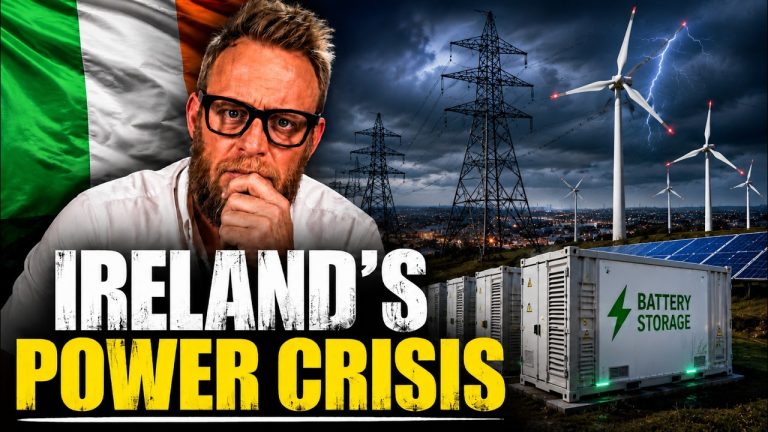
Ireland now has the most expensive household electricity in the European Union and, by the latest international comparison, the highest price of any sovereign developed country. Sam Evans says that among countries with more than a million people, Ireland is the most expensive in the world, and he believes it is a warning for every country running an energy transition, including Australia.
The Price Irish Households Pay
A typical Irish household is paying around 47 US cents (~AUD 0.69) per kilowatt hour, roughly 40% above the European average. Sam notes that some tiny countries and islands pay even more, but none with a population above a million.
Sam says this is strange because Ireland has some of the best wind resources on the planet, a small population and plenty of money. Yet it pays more for power than Germany, Belgium, Italy or the UK. He believes the answer shows how not to run an energy transition.
Get the latest EV news first. Follow us on:
Culprit One: Imported Gas
In 2025, gas generated just over 40% of Ireland’s electricity, wind supplied 32% and another 16% came through interconnections. Ireland imports more than 82% of the gas it burns, which leaves the country exposed to international gas prices.
Sam says the part most people get wrong is how the market works. Wind is cheap when it is blowing, but electricity is sold through a marginal pricing market, where the most expensive generator needed to meet demand sets the wholesale price for everyone. Because gas plants fire up whenever wind drops or demand spikes, expensive imported gas sets the price even when most of the grid is running on cheap wind. Sam says Irish consumers are effectively paying gas prices for wind power.
Ireland also has no nuclear, almost no large-scale hydro, limited long-duration storage and not much solar. Until recently it had weak connections to the rest of Europe, operating as an island system plugged mainly into Britain, which has expensive electricity of its own. The 700 megawatt Celtic Interconnector to France, Ireland’s first direct link to the continent, is still being completed.
Culprit Two: The Grid Build-Out
Irish households are not only paying for generation; they are also funding the biggest network build-out in the country’s history. The official 2025 breakdown shows energy and supply costs averaged about 25 US cents (~AUD 0.37) per kilowatt hour, with network costs added on top. Both are well above European averages.
Ireland has approved around $22 billion (~AUD 32.5 billion) of grid investment between 2026 and 2030. Sam says much of it is genuinely needed, covering new transmission, renewable connections, storage and storm resilience, but none of it is free, and network companies recover that spending straight from household bills.
Culprit Three: Data Centres
Sam says data centres are another big problem significantly increasing prices. Ireland deliberately courted the world’s biggest tech companies and became one of Europe’s largest data centre hubs. In 2015, data centres used 5% of Ireland’s electricity; by 2025 they consumed 23%, nearly as much as every Irish household combined.
Data centres need reliable power 24 hours a day and don’t switch off when the wind stops, forcing Ireland to hold more gas generation and build more grid just to keep up. Sam says data centres didn’t cause the crisis on their own, but they have made a hard problem significantly harder.
Not Green Taxes
Sam says the data does not support blaming green taxes. Ireland’s VAT and electricity taxes are lower than in several other expensive European countries, and government rebates reduced the average price in 2025. The cost, he says, is in energy supply and networks, not taxes.
The Real Lesson
Sam believes Ireland’s problem isn’t that renewables don’t work, since wind cuts fuel use and wholesale prices every time it generates. The problem is sequencing: Ireland built huge amounts of variable wind without enough battery storage, interconnection or cheap flexible backup, while staying hooked on imported gas, while demand surged and while consumers funded a massive grid upgrade, all at once.
Ireland says the fix is coming, through the French interconnector, batteries, stronger networks and more wind and solar. But Sam says that unless Ireland builds clean generation, storage and transmission faster than demand grows, Irish households will keep paying the developed world’s highest power prices for years, and every country running an energy transition should be taking note.
