
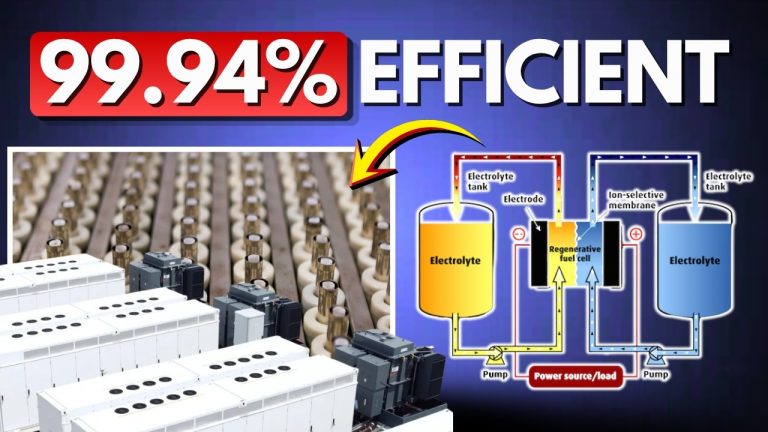
Chinese researchers have demonstrated a flowing zinc slurry battery that ran continuously for 5,128 hours, more than seven months of non-stop operation. Sam Evans says the result could change how solar and wind energy is stored at grid scale.
A flowing zinc slurry battery
The battery was developed by a team that includes researchers at Fudan University, and the results have just been published in the journal Nature Energy. Flow batteries are not new. In this design, the zinc switches reversibly between its metallic and ionic forms within the battery cell.
The study’s senior author said the idea came from visiting a zinc electrowinning plant. Watching the industrial process that converts zinc ions into metallic zinc, the author realised the same electron-gaining process could be used directly for energy storage.
Get the latest EV news first. Follow us on:
The results
Zinc manganese dioxide batteries built on the same architecture retained 81.1% of their original capacity after around 4,000 cycles. The system also ran continuously for 5,128 hours, which Sam says is a lot of time for a battery to run continuously.
Why it matters for renewables
The flowing architecture separates energy storage capacity from power delivery. To add more storage, the volume of slurry in the external tanks is simply increased, with no need to redesign the electrochemical cell itself. Sam says this is exactly the kind of scalability needed for long-duration storage: soaking up excess solar and wind generation during the day and releasing it when the sun goes down or the wind drops.
Zinc is also very cheap, abundant and safe. There is no thermal runaway risk and no exotic materials in these batteries.
The caveats
This is a laboratory-scale demonstration. The team says its next step is translating the concept toward practical long-duration storage systems. The batteries are not intended for EVs. They are designed for energy storage.
What it means
Sam says the grid storage race is not just lithium versus sodium or lithium iron phosphate versus sodium. He believes long-duration storage is the missing piece that makes 100% renewable grids possible, and that a zinc slurry battery that runs for seven months straight with near-perfect efficiency is a pretty serious contender.
If it scales, Sam says, the economics of overnight and multi-day storage change completely. On whether it will scale, Sam believes it really could.
