
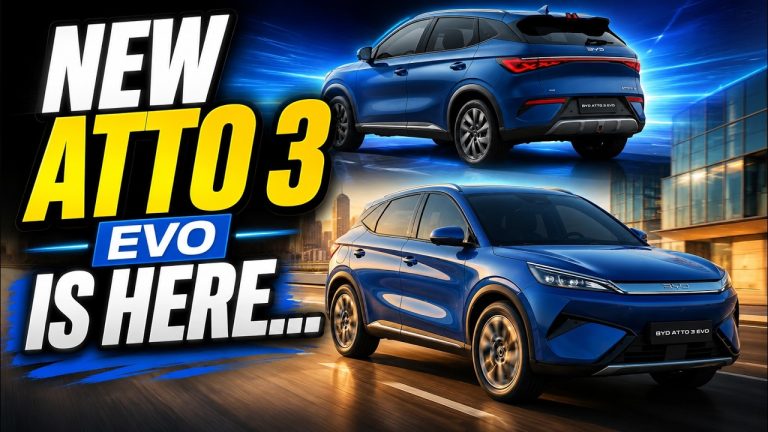
BYD Australia has emailed customers inviting them to place an order for the new Atto 3 Evo, which it describes as “coming soon”. Sam Evans says this contradicts what many Australian buyers say BYD dealers told them: that the upgraded car was at least a year away and they should buy the current model instead.
Dealers told buyers the Evo was a year away
For months, Sam has been warning viewers not to buy the current Atto 3 because a heavily upgraded version was coming soon. He points out that the car was already on sale in other right-hand drive markets. He says this advice led some people to call him a BYD hater.
According to Sam, several BYD dealerships in Australia told customers the new car was not coming and would not arrive for at least a year, so they might as well buy the old one now. Sam says customers have told him this. BYD Australia then sent the email inviting customers to place an order, which Sam describes as registering interest in a vehicle arriving very soon rather than in a year.
Get the latest EV news first. Follow us on:
Up to 330 kW and all-new drivetrain
Sam says the Evo is not a facelift. He calls it the iPhone 1 to iPhone 5 in a single generation. The current Atto 3 is front-wheel drive with 150 kW of power and fairly slow charging. According to documentation Sam says is already in Australia, the Evo comes as a rear-wheel drive version with 230 kW and an all-wheel drive version with 330 kW. That means the top-spec Evo has more than double the power of the car dealers were selling last month.
The Evo has an entirely new drivetrain, a new battery pack and more range. BYD’s email promises charging that is more than twice as fast, enhanced technology and a more premium cabin than the current model. Sam says the all-wheel drive version is basically supercar fast, with 0 to 100 km/h in 3.9 seconds.
74.8 kWh battery and 800V charging
Sam says the biggest upgrade is the battery. According to BYD’s official launch specs for the Evo, the old car’s 60 kWh pack is replaced by a second-generation 74.8 kWh battery. The architecture moves from 400 volts to 800 volts. The car uses giga casting, which makes it lighter, and Sam says it is much more efficient than the old generation.
Thanks to the 800V architecture, DC charging rises to 220 kW. Sam says it is much faster across the whole charging curve. The current Australian car maxes out at 80 kW DC and charges from 10 to 80% in around 25 minutes.
Range rises to 510 km WLTP for the rear-wheel drive version and 470 km for the all-wheel drive. The existing front-wheel drive car is rated at 420 km.
Bigger boot, frunk and new screen
The Evo is the same size as the current car but has a much bigger boot. At 490 litres, Sam says it matches a mid to large SUV. There is also a 101-litre frunk, which the current car does not have. Other features include:
A new 15.6-inch screen and vehicle-to-load at the same 3.3 kW as before, which Sam says is still enough to run a campsite or some household essentials.
The car is 4.4 m long, which Sam calls a genuinely compact SUV with a large boot, unlike the previous generation. The rear-wheel drive version weighs 1,880 kg, which Sam calls quite good for the battery size. The all-wheel drive version adds about 110 kg to reach 1,990 kg. Both can tow 750 kg braked.
BYD has not yet published final local specs, but Sam says these figures are almost certain to be correct. He believes the Evo is better than the current generation in every measurable way.
Expected price and BYD’s sales momentum
Sam expects the Evo to start at around A$45,000 (~$29,000), compared with around A$40,000 (~$27,100) for the current model. He believes almost everyone would pay about A$5,000 (~$3,400) more for potentially double the power, a 25% bigger battery, more range, a much bigger boot and more than twice the charging speed.
BYD forecast around 40,000 Australian deliveries in 2025 and delivered well over 50,000. In the first six months of 2026 it sold 52,000 cars, nearly matching the whole of last year. In June it came close to overtaking Toyota as Australia’s number one car brand, and it has already passed Tesla as the country’s biggest EV seller. Sam notes that the Atto 3 started that run in 2022, when he bought a first-generation car himself. Its replacement is now arriving with stronger sales momentum than any other brand in Australia.
Sam’s advice: stop and wait for the Evo
Sam says the dealer spin annoys him, though he concedes dealers may not be fully to blame because buyers could have done their own research. He says that if he had signed for the old 150 kW model with 80 kW charging, worse efficiency and less range after being told the new one was more than a year away, he would be furious. He says those customers drove home in a car that was obsolete before its first service. He adds that he would think twice about buying another BYD if a dealership had given him information that later proved untrue just to make a sale.
His advice is clear. Anyone about to buy an Atto 3 should stop, register interest in the Evo and wait for it. If a dealer says it is a year away, show them BYD’s own email. Anyone who already bought the old model on that advice should call the dealership and ask some very pointed questions.
