
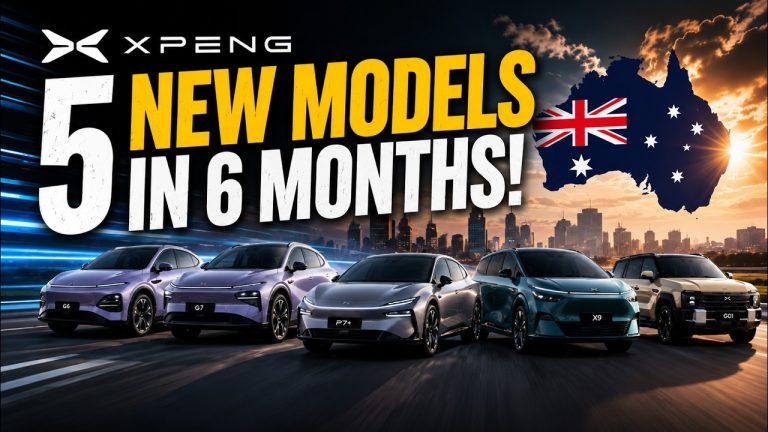
XPeng is preparing to launch five new models in Australia over the next six months, with more to follow. Sam Evans calls it one of the most aggressive product launches yet from a Chinese brand in Australia, and says it is aimed squarely at BYD, Zeekr and Tesla.
A Factory-Backed Relaunch
XPeng has relaunched in Australia under a factory-backed distributor, cutting ties with previous distributor True EV. Sam describes the split as very messy. True EV took XPeng to court earlier in 2026, and another court case for damages is set for October 2026. Sam says XPeng had been blocking some parts shipments to Australia to gain leverage.
With the factory now in charge, XPeng is offering a seven-year, unlimited-kilometre warranty, up from five years, along with an eight-year, 160,000 km battery warranty and a new parts network.
Get the latest EV news first. Follow us on:
Sam notes that XPeng has blacklisted him and he is effectively banned from the brand’s events. He still owns an XPeng G6, which has been his main car for nearly a year and a half and has covered 25,000 km. Sam says he has no incentive to sugarcoat XPeng’s products, but believes the numbers speak for themselves and that the brand makes pretty good cars, though not perfect ones.
Facelifted G6: Now on Order
The facelifted G6 can be ordered now, with deliveries yet to start. The base model is priced at A$51,800 (~$35,100), the Long Range costs A$56,800 (~$38,500) and the all-wheel-drive version is A$61,000 (~$41,300). Sam says that is pretty good value. Every version now uses an 800-volt architecture with 5C fast charging, which apparently takes the battery from 10 to 80 per cent in about 12 minutes.
The entry-level rear-wheel-drive Standard Range gets a 68.5 kWh LFP battery, 480 km of WLTP range and a peak charging speed of 382 kW. The Long Range has an 80.8 kWh LFP pack, 525 km of range, 218 kW of power and 440 Nm of torque, with 0 to 100 km/h in 6.7 seconds and charging at up to 451 kW. Sam points out that this is 55 km less range than his older-generation car. The two all-wheel-drive performance versions, a Black Edition and a regular edition, are basically the same car and use the same roughly 81 kWh pack. Sam says they are a lot cheaper than rivals with similar performance. The base car undercuts the Tesla Model Y by A$7,000 (~$4,700) with about the same range. Every G6 variant uses LFP batteries, so owners can charge to 100 per cent all the time.
Sam says reports that the G6 is expected to support XPeng’s VLA 2.0 self-driving are false. Drive.com.au reported that the cars will get XPeng’s full self-driving through its Turing chips. Sam says XPeng’s Australian spec sheets show the G6 does not have Turing chips. XPeng says VLA 2.0 will arrive by the end of 2027, but it requires cars with multiple Turing chips. Sam stresses that buyers of the current cars will not get it through an over-the-air update, though he adds that this does not mean people shouldn’t buy the car.
X9 People Mover
The X9 can also be ordered now and goes up against the Zeekr 009. Sam calls it very good value, though it costs a lot more in Australia than in China. The base front-wheel-drive Standard Range costs A$89,900 (~$60,900). It has a 255 kW motor, a 95 kWh LFP battery and 535 km of WLTP range. The all-wheel-drive Performance model costs A$20,000 (~$13,600) more. It adds a second motor, a 110 kWh NMC battery, around 395 kW of power and 580 km of range. It uses the same 800-volt architecture, with peak DC charging of 542 kW, 10 to 80 per cent in 12 minutes and 11 kW AC charging.
Sam says he would happily swap the super-fast DC charging for 22 kW AC charging, which would let him use his solar on his three-phase supply. He estimates that most people DC charge only about once every four months on average. The X9 offers 6 kW vehicle-to-load. Dual-chamber air suspension and active rear-wheel steering are standard on every variant. Sam loves rear-wheel steering, saying it makes the nearly 5.4 m car, almost as long as a Ford Ranger, feel like a hatchback. The air suspension feels good to drive, but Sam notes there have been a lot of failures of these units on this model in China, apparently because they don’t handle heat well. He says it remains to be seen how they cope in Australia’s hot climate.
Inside there are seven seats in a 2+2+3 layout, all with plenty of space. All three rows are heated, and the first and second rows are ventilated. The X9 also has a glass roof, wireless charging and power-folding rear seats that fold completely flat into the boot. As a dad who hauls kids and surfboards, Sam says this is probably exactly the kind of vehicle Australia needs more of.
The Likely Volume Seller and What Follows
The third car will probably be XPeng’s biggest seller, according to Sam. It will be a direct rival to the Geely EX5 and the GAC Aion V, and Sam thinks it will be a bit better than both. It will start at around A$45,000 (~$30,500), about the same as the new BYD Atto 3 Evo. Based on the European version launched last week, it comes with a 58 kWh LFP battery, a 180 kW rear motor and 445 km of WLTP range. A longer-range version with a 71 kWh LFP pack offers 520 km. An all-wheel-drive version adds a front motor for 285 kW in total, reaches 0 to 100 km/h in 4.5 seconds and has 440 km of range. Charging from 10 to 80 per cent takes about 20 minutes. Sam notes the car is nearly as big as the G6 and a bit bigger than the Atto 3. In China, a version with multiple Turing chips can run XPeng’s self-driving system, which Sam says is very good.
The fourth car is a large seven-seat electric family SUV due in the fourth quarter of 2026. It takes on the Kia EV9 and the six-seat Tesla Model Y L. Full details remain under wraps, but it has been testing in Australia and is around the size of a Range Rover. The fifth model, due in the first quarter of 2027, will be a larger sibling to an existing model. Beyond these five, the full-size GX luxury SUV has been confirmed, though without timing. The P7 sedan is under consideration, but XPeng vice president Dr Brian Gu says sedans are increasingly marginalised in this market. From 2027, XPeng apparently plans to bring Kunpeng range-extender versions of its models. Sam doesn’t think that’s a great idea and believes most people would prefer a fully electric car.
Sam’s Verdict
XPeng has committed to bringing models and technology to Australia at the same time as China. Sam says that is not happening now. The new G6 has been out in China for more than a year, and the X9 for a year as well. He thinks matching China’s timing is probably unlikely, though XPeng will try to get close. He also points out that XPeng promised Australian launches over the past two years through True EV, but did not ship the cars and froze the distributor out.
Sam believes XPeng should have negotiated a fair agreement and paid out the company that set the brand up in Australia, noting that people have lost their homes over the dispute. He says he wanted to buy an X9 for two years and has just sold his Zeekr 7X. Had XPeng acted honourably, he says he absolutely would have bought one. Until that happens, he says he personally cannot put his money into the company and won’t buy another XPeng. Sam has heard XPeng might be negotiating a fair payout with True EV, and says that if this happens he would be happy to support the brand. Because of the blacklisting, he now gets his XPeng information through third parties and his own research.
