
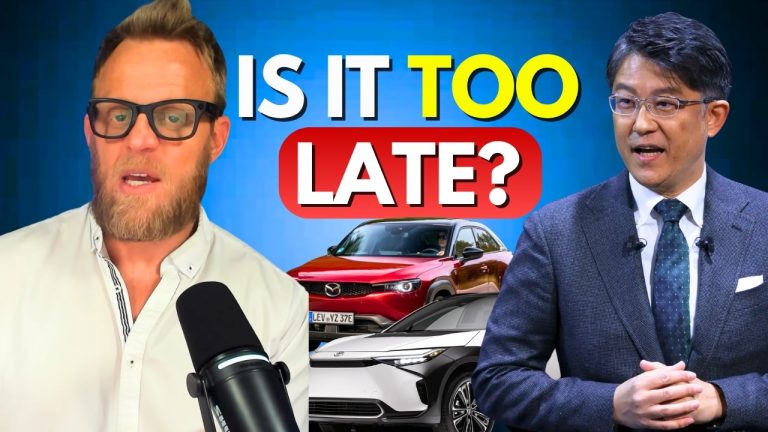
Toyota’s former CEO Koji Sato says the Japanese car industry will not survive unless every Japanese carmaker starts working together. Sam Evans says that when the man who ran the world’s biggest carmaker until a few months ago starts talking about survival, it shows how far ahead China really is.
From Toyota CEO to industry chief
Sato was replaced as Toyota’s CEO earlier in 2026 by Kenta Kon, the company’s former chief financial officer. Sato stayed on Toyota’s board and became the company’s first ever chief industry officer. He also took over as head of the Japan Automobile Manufacturers Association (JAMA).
In an interview with Automotive News, Sato set out what he sees as the single most important issue facing Japan’s car industry: it is not competitive internationally, or soon won’t be. He did not name China directly, but Sam says he didn’t need to, because everyone knew who he was talking about. Sam notes that when he started his channel around five years ago, many people mocked his warnings that Japanese carmakers had something to fear from Chinese cars. Now the man who was running Toyota seems to agree.
Get the latest EV news first. Follow us on:
The numbers behind the warning
In May, Chinese carmakers collectively outsold Japanese brands in Europe for the first time in history. In Australia, to the end of May, China was the number one source of new cars with more than 144,000 vehicles. That pushed Japan into second place for the first time ever, at 117,000. Sam says the gap is big and growing in China’s favour, and that Japan, which dominated the Australian market for 50 years, has been knocked off quickly.
Chinese brands are also pushing hard into Asia and developing markets around the world. Sam says the only major market keeping them out is the United States, and only because of tariffs.
Sato’s plan: standardise what customers never see
Sato wants Japan’s carmakers to create areas of cooperation on parts customers never see, so they can put their money into technology that matters, such as advanced driver assistance, faster-charging batteries and software. Sam says Japanese carmakers have long spent money on things like making engines 0.5% or 1% more efficient, with poor returns.
Japanese suppliers currently make around 70,000 different wiring harness variants, which Sam says makes automation almost impossible. Sato reckons standardising essential components such as harnesses, steel grades and resin specifications could improve productivity tenfold. Sam says that is not a small efficiency gain but an admission the current system is broken. He believes this is why Tesla mainly sells two models, the Model 3 and Model Y, with essentially two harnesses instead of thousands.
Sam says China has already figured this out. Chinese EV makers share suppliers, battery makers and software platforms. CATL and BYD alone hold about 60% of the battery market. He says Chinese makers iterate at a speed that, in many cases, leaves legacy manufacturers looking like they are standing still, though he adds that they sometimes move so fast they launch vehicles with serious bugs. Japan, Sam says, is now trying to copy the playbook of the country it is losing to.
The timing problem
Sato says it might take a year or two just to work out the standard specifications, and even then they cannot be introduced until the next generation of vehicles launches. Sam says that realistically means the early 2030s before it makes any real difference, and asks how far ahead BYD and other Chinese manufacturers will be by then.
The rest of the industry is on board
Nissan CEO Ivan Espinosa backs the idea, talking about a common JAMA standard with certified suppliers that everyone can use freely. Sam says Nissan has no other choice. Beyond parts, JAMA is looking at six other areas of cooperation: logistics, securing raw materials, circular recycling, recruiting talent, rebuilding Japan’s infrastructure for autonomous vehicles, and simplifying Japan’s car taxes. Sam suspects the tax item probably means asking for tax breaks.
The companies are already partly connected. Toyota owns Daihatsu and Lexus and holds stakes in Subaru, Mazda and Suzuki. Nissan owns around 27% of Mitsubishi and is reportedly close to a cooperation deal with Honda.
Sam’s take
Sam says this is the right move, though probably five years too late. When Japan’s most powerful car executive says the industry won’t survive without banding together, Sam says that is not strategy but triage. He believes China didn’t just build cheaper cars, it built a faster system, perhaps sometimes too fast, but one that is working well, and Japan is now openly admitting that. Whether Japan can close the gap before the next generation of Chinese EVs arrives is, in Sam’s words, the trillion-dollar question.
