
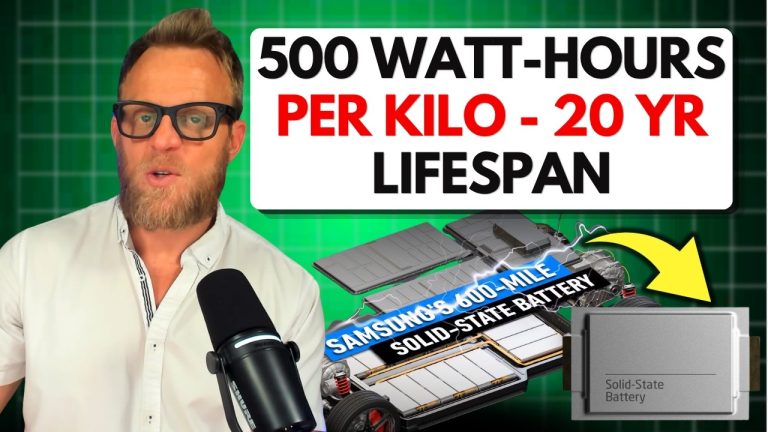
Samsung has unveiled a solid-state battery with an energy density of 500 Wh/kg, roughly double that of a conventional lithium-ion EV battery. Samsung claims 10 to 80% charging in 9 minutes and a lifespan of up to 20 years. Sam Evans says it is the highest energy density solid-state battery that is essentially in pre-production right now, and the batteries are already in EVs that have been tested for a long time.
Already in cars being tested
Sam doesn’t think this will be the first solid-state battery to reach the market. He says it almost certainly won’t be. But he says its energy density is the real deal. Chery and some other brands have solid-state batteries at around 350 Wh/kg. Sam describes that as good but not great, only marginally better than the best NMC batteries.
Samsung’s battery, by contrast, is clearly fully developed, Sam says, because it is already in EVs that have been tested for a long time. He says he knows of other batteries in development with higher figures, but none that are actually being used and tested in cars right now. He asks viewers to let him know if they know of one.
Get the latest EV news first. Follow us on:
Sam calls range, charging speed and lifespan together a trifecta that no one has really been able to deliver. He says the main reason solid-state batteries aren’t already in EVs is less about their cost and more that they just don’t last long enough.
500 Wh/kg and 600 miles from a small pack
Samsung unveiled the battery at a battery day event, and the standout number is its energy density of 500 Wh/kg. That is roughly double what a conventional lithium-ion battery such as NMC delivers today, and far more than double a lithium iron phosphate battery. BYD’s Blade battery, for example, is around 185 Wh/kg.
Sam says that density is how you get 600 miles of range without a huge 140 kWh battery. Instead, a pack of maybe around 70 kWh would do it, which would mean a relatively light car with massive range.
Samsung achieves this by replacing the liquid electrolyte in a traditional lithium-ion cell with a solid sulfide electrolyte. Sulfide is known for high ionic conductivity and stability.
Safety, charging and a 20-year lifespan
The solid electrolyte dramatically reduces the risk of overheating and fire. Sam stresses that EV battery fires are not common, but a bad crash can cause a dangerous fire, as can happen in a petrol car. He says this basically eliminates that potential, and that with a solid-state battery you’re almost not going to get thermal runaway.
Samsung claims charging from 10 to 80% in around 9 minutes. Sam says that is not quite as fast as some of the best batteries in the world today, but pretty close. He doesn’t think anything faster is needed.
The big game changer, according to Sam, is longevity. Samsung claims the battery lasts up to 20 years. Sam compares this with Tesla’s current batteries, which he says probably degrade 12 to 15% after 200,000 miles and are expected to last a similar number of years, probably around 20. Battery replacement is one of the most expensive repairs an EV can need, and a 20-year pack basically eliminates that fear. Sam adds that the most likely scenario is that the battery will still work after 20 years, just with some degradation. He says it addresses range anxiety, charging anxiety and degradation anxiety in one go, all of which could be reasons people don’t switch to an EV.
Cost, scaling and open questions
Sam says the one issue Samsung isn’t shouting about is cost. Materials and manufacturing for solid-state batteries are significantly more expensive than for lithium iron phosphate or sodium batteries today. That makes producing them at scale at a competitive price genuinely difficult in the near term. Sam expects the batteries to go into high-end luxury cars or supercars, at least for the first couple of years.
Scaling is the second problem. High-volume manufacturing introduces real technical hurdles around material consistency and the long-term durability of the solid electrolyte, which could delay mass production. Sam notes they might not, since Samsung appears to have been testing the batteries in EVs for a long time.
There are also open questions about real-world performance. It is not yet known how the cells will behave in extreme heat, such as desert conditions, or under sustained heavy use outside a controlled test environment. Sam says the cars are being tested in warm temperatures, but it is not known how they will react to extreme heat. To be fair to Samsung, he says, the company has delivered the first batch of batteries and the feedback so far has been very positive.
Recycling is another issue Sam says almost nobody is discussing, as these batteries may need new recycling processes that don’t fully exist yet. He adds that with a lifespan of 20 years or more, there is time to figure it out, so he is sure it won’t be a big issue.
Premium cars first
Samsung is focusing its testing on the premium EV segment first. Sam says that suggests a significant cost premium early on, so the first cars with this technology won’t be affordable EVs. He suggests they might start in smaller sports cars, but says he doesn’t know that for sure.
Sam says the technology doesn’t really change the industry at a price point of $130,000 (~AUD 192,000). It might not have a big impact for a few years, until the batteries can go into $40,000 to $50,000 (~AUD 59,000 to 74,000) cars. He believes that will happen eventually, but it will take some time.
What it means
Sam says the direction is set. Other manufacturers are racing to develop their own solid-state batteries, but the batteries they are working on or have developed don’t have this energy density. He believes that could make Samsung number one in the race, with longevity also a significant factor.
Sam acknowledges there is no real way of knowing for sure. Toyota, Chinese battery makers and American battery companies all make their own claims. Still, he is very bullish on Samsung’s batteries and hopes to see them in production cars within the next 12 months, which he says is possible.
