
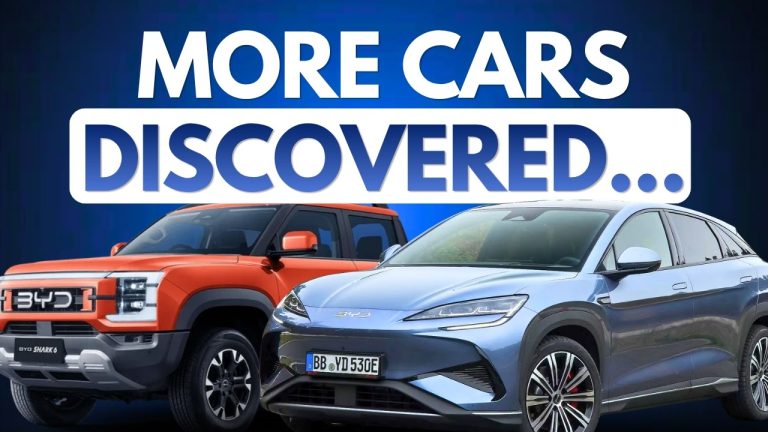
BYD has more than tripled its compensation offer to Australian customers caught up in its build-date scandal, lifting the payment from A$1,100 (~$746) to A$3,500 (~$2,373). At the same time, the number of affected vehicles keeps growing, with hundreds more cars found beyond the initial estimate.
How the build-date problem started
Earlier this month it emerged that more than 1,200 BYD customers in Australia paid for what they believed were 2026-built vehicles but were delivered cars built in 2025. BYD blamed an administrative error. Reports say the company recorded the date each car left the factory grounds as its build year, rather than the date it actually rolled off the production line. Sam Evans says this means BYD was storing older cars and then shipped them to Australia, which he says came as no surprise.
Sam says this is not paperwork trivia, because build year directly affects resale value. He recently sold his own car and says buyers asked whether it was a 2025 or 2026 model. Even when the model is identical, he says, the build year shapes how buyers see the car. A car listed as a 2025 build is worth less on the used market than an identical 2026 build, and customers paid 2026 money for 2025 cars.
Get the latest EV news first. Follow us on:
From A$1,100 to full refunds to A$3,500
Sam says BYD’s first response was to hope the issue would go away. When it did not, the company offered customers A$1,100 (~$746). Sam says that was not enough, and that everyone he saw discussing it on Facebook considered it inadequate. BYD then backflipped and put full refunds on the table, which could cost the company tens of millions of dollars.
Nearly two weeks after the story broke, BYD has settled on A$3,500 (~$2,373). A BYD spokesperson in Australia told the media the company collected data on the estimated loss in resale value, then added a margin on top to be more generous, calling A$3,500 a more suitable and appropriate remedy. Sam agrees the original amount was nowhere near enough.
Three options for affected owners
Customers now have three options. They can take the cash and keep the car. They can take a full refund, which BYD says includes consequential costs such as fees to cancel a novated lease or an insurance policy. The spokesperson said the company does not want customers to be any worse off, and Sam says BYD is doing the right thing here. The third option is to swap the car for a like-for-like replacement built in 2026 with no kilometres on the clock, keeping the existing car until the new one is ready.
Sam says he would take a full refund and wait for the new model, which he expects to arrive in a few months and to be much better. According to BYD, 72% of affected customers have taken the cash. Everyone who accepted the original A$1,100 has been contacted and given an additional A$2,400 (~$1,627).
The number of affected cars keeps climbing
The initial estimate was 1,265 vehicles, but BYD says more cars have been found, and the difference is in the hundreds. Sam says he predicted this in his first video on the story and feels vindicated. Because the original problem was a manual error, every record has to be checked by hand, and the tally keeps rising through that process. Sam says the total could be 1,500 or more, possibly thousands, and that nobody knows yet.
Assuming 1,500 affected customers and 72% taking the payment, Sam calculates a cost of about A$3.8 million (~$2.5 million), before counting refunds and replacement vehicles for the 28% who do not take the cash. Sam doubts the 72% figure will hold, but says BYD hopes it does because the cash payment is much cheaper than the alternatives.
Sam’s verdict
Sam says BYD got there in the end. Basing compensation on actual resale data plus a margin, covering consequential costs, and letting people keep driving while they wait for a replacement is, in his view, a solid remedy package. However, he notes it took public pressure, particularly on Facebook, and two weeks of headlines to move BYD from A$1,100, which he calls completely inadequate, to A$3,500.
Sam believes the discovery of hundreds of extra older cars points to sloppy record-keeping at BYD. He says that if BYD wants to be taken seriously as a challenger to large legacy carmakers, and to overtake Toyota as it has predicted it will, the systems behind its cars need to be as good as the cars themselves.
