
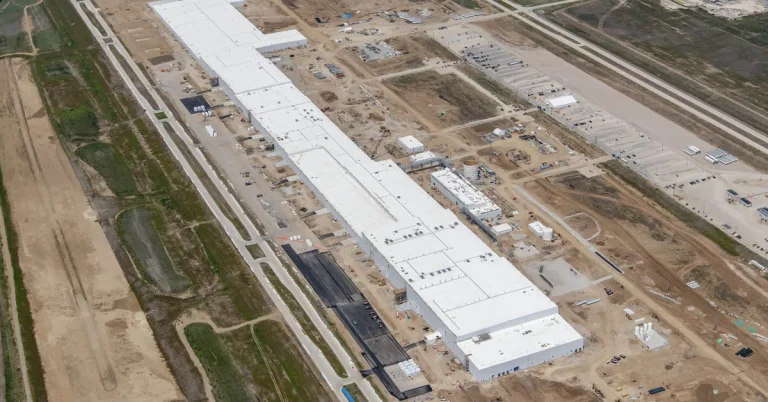
Ford shipped its first in-house lithium iron phosphate (LFP) battery cells on November 18 using licensed CATL technology. The cells will help bring lower-cost EVs to the US.
Michigan batteries head for Fathom prototypes
The rectangular cells travelled from Ford’s BlueOval Battery Park Michigan in Marshall to Louisville Assembly Plant. Prototypes of the forthcoming Fathom electric pickup will draw their power from them.
Ford owns and operates the Michigan factory, whose launch remains on schedule. Rather than a joint venture, its agreement with CATL, the Chinese battery manufacturer, is limited to technology licensing and services. CATL supplies the technology and operational support.
Get the latest EV news first. Follow us on:
With the Fathom’s launch expected in the fourth quarter of 2027, Ford plans to have the Marshall battery pack plant operational earlier that year. Preorders are planned for early 2027.
Ford’s Universal Electric Vehicle Platform will make its vehicle debut with the midsize pickup. Ford is targeting a starting price below $30,000 (~AUD 44,652), with the standard-range version planned at $28,350 (~AUD 42,196).
Lower costs through chemistry and fewer parts
LFP batteries contain neither nickel nor cobalt. They cost less than nickel-based batteries and are more durable over years of charging. The chemistry was invented in the US but commercialised mostly in China.
Alan Clarke, Ford’s Vice President of Advanced Development Projects, said Ford chose CATL after considering battery companies worldwide. Ford wanted proven technology ready for large-scale manufacturing that suited its vehicles and would quickly reduce cost and weight. CATL is the world’s largest battery manufacturer, with batteries powering about 30 million vehicles globally.
Ford’s rectangular cells fit directly into the chassis, and the battery pack also serves as a structural component. This reduces parts, weight, manufacturing complexity and cost.
The Fathom combines a right-sized battery with compact, integrated power electronics and a flexible circuit board for electrical connections. These features enable Ford’s new EV production system. Its bidirectional AC power system will let the pickup receive electricity and supply power back to a home.
Production lines move towards commercial output
The Michigan assembly lines produce 40 cells a minute, placing them among the fastest lines making rectangular LFP cells outside China. Image recognition powered by artificial intelligence is already used for quality checks. Instead of counting defects per million cells, Ford aims to track them per billion cells.
Ford completed trial production of its first rectangular LFP cells in June and tested them against CATL standards.
The February 2023 partnership announcement outlined an investment of $3.5B (~AUD 5.2B), annual capacity of 35 GWh and about 2,500 jobs. That capacity would have provided enough batteries for roughly 400,000 EVs a year, but the project was restarted in November 2023 with investment cut to $2B (~AUD 3B) and capacity cut to 20 GWh.
Ford retained the LFP project and expanded into energy storage after recording an asset write-down of $19.5B (~AUD 29B) and cancelling several EV models in December 2025.
Ford defends its licensing deal
Transportation Secretary Sean Duffy wrote to Ford CEO Jim Farley in September, expressing deep concern about Ford’s reliance on CATL-licensed technology and Chinese partnerships. Ford called the letter a “wrongheaded attempt to capture headlines” and pointed to its US battery factory while other companies import batteries from China.
Ford expects the factory to qualify for the federal battery manufacturing tax credit. It also claims it will be first to deliver US-made LFP batteries for mainstream consumer automotive use.
Why it matters
Ford’s plan brings lower-cost battery chemistry and simpler vehicle construction together in a pickup aimed at mainstream buyers. Its goal is to offer affordable EVs with performance at a price that persuades petrol-vehicle drivers to switch.
Key Specs
- Fathom planned standard-range price: $28,350 (~AUD 42,196)
- Fathom expected launch: Fourth quarter of 2027
- Planned preorder opening: Early 2027
- Battery assembly line production rate: 40 cells a minute
✎ Images and news sourced from: cnevpost.com, upi.com, indiatimes.com, carnewschina.com, interestingengineering.com, yahoo.com, theolympian.com, sohu.com, ford.com.
