
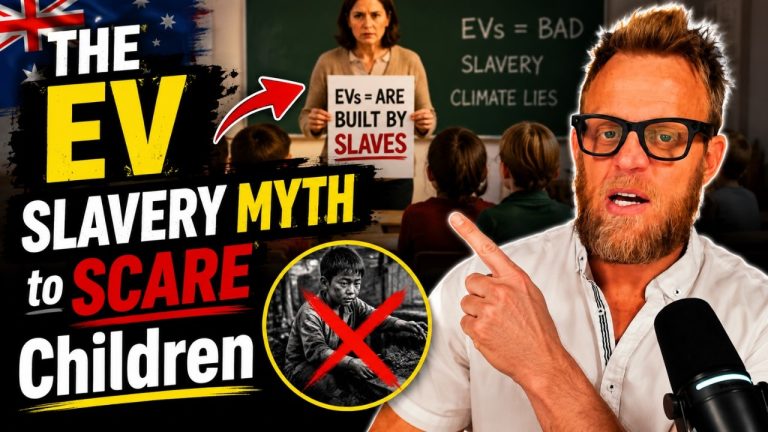
A Sydney school teacher reportedly told her class she is against electric cars because of slave children working in the mines. Sam Evans has examined both slavery claims against EVs, cobalt mining in the Congo and forced labour in China, using battery data released in 2026 and the findings of the US government’s own investigation.
A teacher, an email and a paywalled article
Sam says that whenever he makes a video about electric cars, someone claims the batteries are made by slaves: sometimes children mining cobalt in the Congo, sometimes forced labour in Chinese factories. This week a viewer named Anthony emailed him an article from the Sydney Morning Herald headlined “Modern slavery builds many EVs. What if your government is a customer?” Anthony wrote that his daughter’s teacher had told her class she is personally against electric cars because of slave children working in the mines.
The article was behind a paywall. Sam says he had to pay for a subscription to read it and cancelled it once he had finished his research.
Get the latest EV news first. Follow us on:
Who wrote it, and what he admitted
The Herald is owned by Nine Entertainment, not Murdoch. Its biggest shareholder is 97-year-old TV billionaire Bruce Gordon. Sam points out that the piece was not written by a journalist. Its author is the New South Wales anti-slavery commissioner, a government official who is currently reviewing how the state buys electric cars and buses.
Sam highlights a line from the commissioner’s own piece: supply chain links to slavery risks are “disturbingly easy to find” in basically everything, and the real question is what buyers do about them. Sam says that applies just as much to petrol and diesel cars, even though the commissioner wrote only about EVs. He says the problem is not a commissioner doing due diligence. The problem is headlines built on data from 2022 teaching Sydney school kids in 2026 that EVs run on child slavery.
Most new batteries contain no cobalt
The China Automotive Battery Innovation Alliance has released its June figures. China’s battery installations reached 76.5 GWh, up 31.5% year-on-year. Lithium iron phosphate (LFP) batteries made up 63.7 GWh of that, a record 83.3% of everything installed in Chinese vehicles. LFP batteries contain no cobalt and no nickel, and Sam notes that iron and phosphate are two of the cheapest and most abundant materials on Earth. That means more than four out of every five batteries going into vehicles in the world’s biggest EV market contain no cobalt at all.
Across the first half of 2026, LFP made up 81% of battery installations, and the share is rising every month. In 2020, ternary NMC batteries, which contain some cobalt, outsold LFP in China. Six years later they are down to 16% market share and falling. Sodium batteries, which use no cobalt, nickel or lithium, are now scaling commercially, and CATL has just signed a 5 GWh sodium storage deal in Europe.
Artisanal cobalt mining has shrunk to a sliver
Sam acknowledges that some batteries still use cobalt, and he takes on the strongest version of the argument. The horror stories come from artisanal mining, where people dig by hand, not from industrial mines. A peer-reviewed US Geological Survey study found that artisanal mining’s share of world cobalt production peaked at up to 23% around 2008 and then fell to 6 to 8% by 2020. The Cobalt Institute’s 2024 report found artisanal volumes are now under 2% of production in the Democratic Republic of Congo, or about 1% of global supply. Sam says that if LFP batteries are included in the tally, the figure comes to about 0.1%.
Sam says the images of children in pits are real and appalling. However, he says they describe a tiny sliver of the supply chain from an era before LFP batteries took over. The commissioner’s own earlier research, written in 2022, cited 15 to 30% of cobalt coming from informal Congolese mines. Sam says the world has moved on since then.
He also notes that cobalt was never an EV-only metal. It is used in smartphones, laptops, jet engines and the catalysts that refine petroleum. Petrol and diesel can only be sold after cobalt-containing catalysts remove the sulfur, so every litre pumped into a Toyota Hilux or Ford Ranger has passed through a cobalt catalyst. Sam says that if cobalt is your moral objection to EVs, you have also indicted your own petrol car, phone and laptop, and every flight you have ever taken.
CATL and the forced labour claim
On the second claim, Sam says CATL’s factories are not in Xinjiang. Its headquarters and biggest plants are in Ningde, Fujian, on China’s southeast coast. Its other factories are in places including Sichuan, and increasingly in Germany, Hungary and Indonesia. He says no one, not even the most hawkish committee in the US Congress, has alleged forced labour on CATL’s production lines. The congressional allegation was that CATL sourced some raw materials from suppliers in Xinjiang several tiers upstream.
In late 2024, the Forced Labor Enforcement Task Force, the body with legal power to ban companies under the Uyghur Forced Labor Prevention Act, was under heavy pressure from Congress. It declined to blacklist CATL or Gotion and instead listed the two alleged upstream suppliers. CATL called the accusations groundless and said the named supplier relationships had already ended.
Sam stresses that he is not saying the claims about Xinjiang are wrong. Human Rights Watch has documented credible evidence of labour transfer programs there, and he says that deserves to be taken seriously. However, the same Human Rights Watch investigation found the car industry’s exposure to Xinjiang runs mainly through aluminium. About 9% of world supply comes from the region, and it is used in engine blocks, frames and wheels. The carmakers named for failing to manage it were Volkswagen, Toyota, General Motors and Tesla. Sam notes that the report covers petrol, diesel, hybrid and electric vehicles alike.
Sam’s verdict
Sam’s message to the teacher is this. A record 83.3% of batteries in Chinese EVs contain no cobalt. Artisanal mining is down to about 1% of global cobalt supply. Petrol cannot be legally sold without cobalt catalysts. CATL’s factories are nowhere near the region where forced labour has reportedly occurred, and the US government examined the evidence and declined to blacklist the company. Meanwhile, the documented Xinjiang exposure through aluminium is in every car on Earth.
In Sam’s opinion, singling out EVs is “not a human rights position. It’s a marketing position wearing a human rights costume.” He says that if these campaigns cared about workers, they would target smartphones, refineries and the entire automotive industry. Sam believes they target EVs because the goal was always to protect the internal combustion engine, and he says that in 2026 the data has left that engine behind.
