
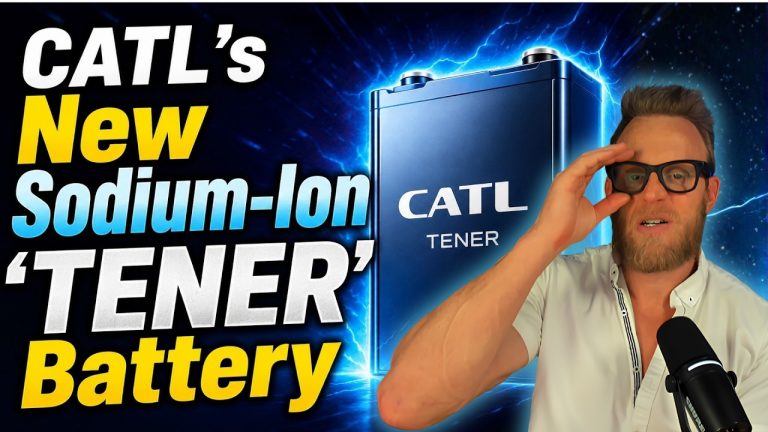
CATL has unveiled its Tener sodium energy storage system, which the company calls the world’s first validated sodium battery energy storage solution. CATL says the system reaches 15,000 cycles, with first deliveries in China due in September 2026. Sam Evans says this is a big deal, coming from a company that holds around 40% of the global battery market.
CATL’s First Mass-Market Sodium Storage Product
CATL rolled out the Tener sodium system at its 2026 CATL Energy Storage new product event in China. The company said the system has been redesigned around greater flexibility, higher operational stability and higher system availability.
Sam points out that this is not really the world’s first mass-produced sodium battery, because sodium batteries are already available from other manufacturers such as HiNa. But he says that because CATL is the world’s biggest battery company, the launch is a pretty big deal. He adds that CATL has the best sodium battery technology, with the highest energy density.
Get the latest EV news first. Follow us on:
Why Sodium Matters for Grid Storage
Sam explains why businesses, energy companies and governments building big batteries to support the grid and pair with solar should care about sodium. He says sodium batteries get about two to three times more cycles than any other battery chemistry, which means they could theoretically last up to 100 years.
He says they also work extremely well in cold places such as Canada, Alaska and Russia, losing very little capacity even at -30 to -40°C.
Modular Design and Efficiency Gains
The system has a rated capacity of more than 30 megawatt-hours and uses a fully modular design, with each module weighing 42 tons. Because it is modular, customers can order 1-hour, 2-hour, 4-hour, 6-hour or 8-hour configurations to suit their project. Sam says that a customer who starts with a 4-hour system and later wants 8 hours could fairly easily double it.
CATL said the system has a first-of-its-kind DC dual-direction voltage control, which raises the system’s round-trip efficiency by 2%. The company said that separating energy from power further simplifies project deployment. Sam says 2% may not sound like much, but wholesale electricity margins are very small, so the gain is quite a big deal.
15,000 Cycles, Climate Readiness and Self-Healing
CATL said the system can reach 15,000 cycles at 25°C before falling to 70% state of health. It says this is equivalent to a 25 to 30-year service life under constant use. Sam says that figure understates things, because 15,000 cycles is only the point where the battery reaches 70%. He believes real-world use could be more like 20,000 or more cycles, four times as many as a regular lithium iron phosphate battery. He calls this game-changing.
CATL says the system is all-climate ready. It offers more than 10,000 cycles at 45°C, which Sam notes shows that even sodium batteries are affected by heat, and it keeps more than 92% of its capacity at -20°C. CATL also said the system can suppress fire and explosion under extreme conditions. Sam questioned the explosion claim and suggested CATL may mean the casing is very strong.
CATL also described a first-of-its-kind millisecond-level self-healing solution. It can locate and isolate faults within 200 milliseconds and restore unaffected sections within 150 milliseconds, giving station-level redundancy at minimal extra cost. Sam’s reading is that a few faulty cells in the pack won’t stop the battery working, because the system can work around them. The system is fully compatible with lithium batteries and supports seamless switching.
Deliveries and CATL’s Sodium Push
CATL says mass production is ready. First deliveries in China begin in September 2026, and the company expects to ship 1 gigawatt-hour by the end of 2026. Global commercial deliveries of Tener sodium will start from June 2027. Sam says 1 GWh is not that much but is a good start. He reads the timeline as CATL having more than enough orders in China, so overseas deliveries are probably June 2027 at the earliest. He adds that buyers who have already ordered an LFP battery in China might now be thinking twice.
CnEVPost says the launch extends CATL’s push into energy storage. CATL released its five-year zero-degradation battery system in April 2024 and its 9-megawatt high-capacity Tener Stack in May 2025. CnEVPost also says the launch comes as the sodium battery industry is rapidly heating up. In April, CATL signed a three-year supply agreement with Chinese energy storage provider HyperStrong totaling 60 gigawatt-hours, a record order for sodium batteries.
CATL later announced a $740 million (~AUD 1.12 billion) investment to build 40 gigawatt-hours of sodium battery capacity in Fujian, China. Sam notes that robots now work on CATL’s production lines, sorting cells. He says CATL reported that by the end of 2025 it had spent roughly a couple of billion US dollars (~AUD 3 billion) on sodium battery research and development.
What It Means: Storage Now, EVs Next
Sam stresses that these batteries are meant for energy storage, not EVs. Based on previous CATL reports, he estimates the cells have an energy density of about 140 watt-hours per kilogram, though this is not confirmed. He says energy density matters little in packs like this. What counts is overall system performance, price and how long the batteries last.
He notes that other new CATL sodium batteries with about 175 Wh/kg are going into EVs within months, which he calls pretty damn good. He also points to Gotion High-Tech, part-owned by the Volkswagen Group, which has a new sodium battery with 262 Wh/kg that is apparently intended for electric cars. Sam says that is about the energy density of a Tesla battery cell, and he calls it wild.
