
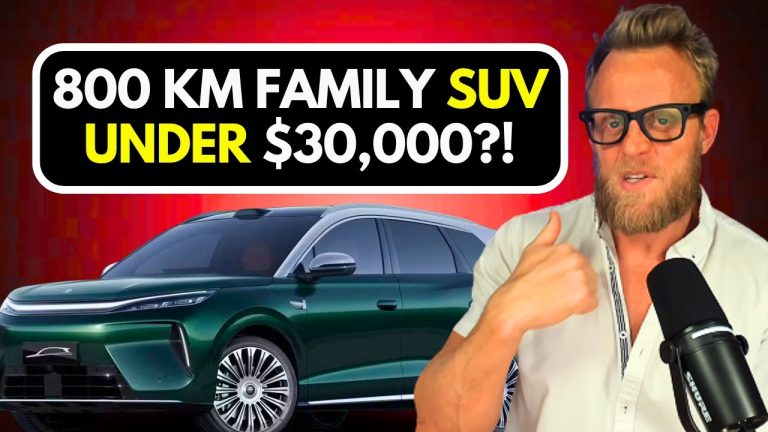
BYD has teased the 8 Series Tang, a new large electric SUV that will come in five-seat and seven-seat versions with more than 800 km of range on China’s CLTC cycle and flash charging. It is expected to be priced under $30,000 (~AUD 44,300) in China. Sam Evans says it should make buyers think twice about a seven-seat plug-in hybrid.
The 8 Series Tang revealed
On Friday, Lu Tian, general manager of BYD’s Dynasty lineup, posted two images of the 8 Series Tang on the Chinese social media platform Weibo. He called it the king of large SUVs for families focused on quality. It is a mid-to-large, value-based SUV.
The 8 Series Tang will sit alongside the 9 Series Tang EV that launched last month. BYD is calling the pair a dual flagship lineup for the Tang family. The 9 Series is the full-size seven-seater aimed at business buyers and bigger families. The 8 Series is a little smaller and a little more affordable, and Sam says that makes it a really good value proposition. It will come in both five-seat and seven-seat all-electric versions.
Get the latest EV news first. Follow us on:
Size and performance
The vehicle already appeared in filings with China’s Ministry of Industry and Information Technology earlier this month. It measures 5,045 mm long, 2 m wide and has a wheelbase of nearly 3 m. That makes it a bit bigger than the Tesla Model Y L, the stretched version of the Model Y. Sam says it has proper seven seats, not a compromise. He adds that the five-seat version should have a massive boot, probably slightly bigger than a Ford Everest’s.
The filed version is rear-wheel drive, with 300 kW (402 horsepower) and a top speed of 250 km/h. There will also be an all-wheel-drive version. Sam thinks the more affordable rear-wheel-drive model is the one most buyers will be interested in.
Second-generation Blade Battery and flash charging
The headline is the battery. The 8 Series Tang uses BYD’s second-generation Blade Battery, a lithium iron phosphate (LFP) pack. BYD says range is over 800 km on the CLTC cycle, around 500 miles. Sam says WLTP range might be about 650 km. He believes anyone would be more than happy with that in a vehicle this size.
Sam says the new Blade Battery has much higher energy density than the current-generation pack in the BYD cars on sale in Australia right now. Because of that, and the other technology in BYD’s newer models in China, he thinks waiting for this car is probably worth it.
The SUV will sit on at least an 800-volt platform, possibly higher. It will support BYD’s 1,000 kW flash charging. BYD has not confirmed an official charging time. Sam says a 10 to 97 per cent charge in around 8 minutes and 50 seconds is basically a foregone conclusion.
Why the launch matters for BYD
Sam says the Tang series is dying right now. BYD sold 9,282 Tangs in June, down 48.5 per cent year-on-year. First-half sales were down almost 50 per cent. Sam says the nameplate got old and people stopped buying it.
BYD overall is doing better, though. Its June sales grew 5.5 per cent year-on-year, its second straight month of growth after working through capacity constraints. Sam says BYD is clearly regaining momentum with all the new models it is releasing in China.
Expected pricing
Sam says the more expensive luxury version is around $35,000 (~AUD 51,600), which he calls incredibly impressive for the price. He plans a separate video on it. The 8 Series Tang is expected to come in under $30,000 (~AUD 44,300).
In Australia, Sam suspects it will probably cost around A$60,000 (~$40,700). He expects European prices to be about 20 per cent higher than in Australia, because Australia has no tariffs and is an open market.
What it means
The 8 Series Tang is expected to launch within the next three to four months. Sam believes it will be an absolute winner for a lot of families at this price point. He says it could be the most logical alternative to the Tesla Model Y L for people who don’t want a Tesla.
Sam says many people buy seven-seat plug-in hybrids because they think there is no realistic, affordable, large seven-seat electric SUV. He believes that is about to change. In his view, many of those plug-in hybrids are really last-generation technology, and he says he would personally wait.
