
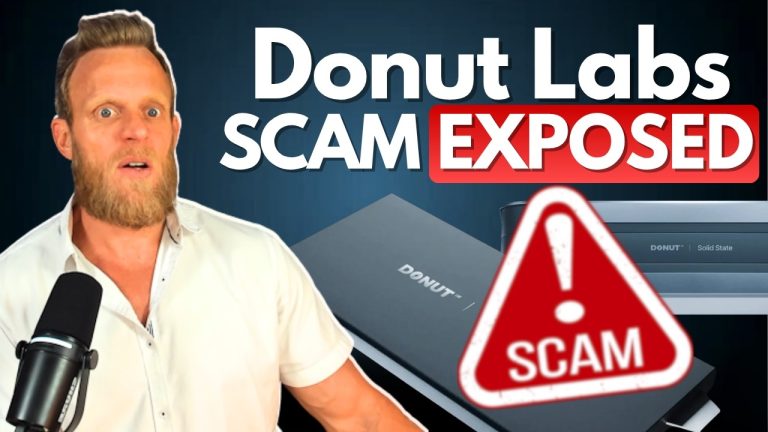
Sam Evans says a months-long forensic investigation has confirmed his long-held skepticism about Donut Labs. He says the company’s claimed lithium-free, 100,000-cycle solid-state battery is a fraud, and that the cell inside its prototype is a standard lithium-ion pouch cell.
The miracle battery claims
Donut Labs claimed to have invented a solid-state battery that needed no lithium and matched the cost of cheap lithium iron phosphate cells. It also claimed an energy density of 400 Wh/kg and a life of 100,000 cycles, which would mean a lifespan of more than 100 years.
Sam had made several videos over the past few months questioning the company. He says the physics simply did not add up. He says many viewers criticised him in the comments and sent him personal messages accusing him of having an agenda against the company. Sam says that even though he believed it was fake, he wanted the battery to be real.
Get the latest EV news first. Follow us on:
According to Sam, the CEO of a major Chinese battery maker has already called the battery a scam, and so has CATL.
What the investigation found
Sam says a new 45-minute investigative video lays out the evidence. Donut Labs had published a series of videos using third-party lab data to back its claims. Sam says the company assumed nobody would understand the charts. The investigator brought in more than 20 independent battery experts from major research institutes to review that data.
When a battery charges, ions push into the anode and make it expand. Sam explains that the expansion curve of the Donut Labs cell shows a distinct kink between 50% and 70% state of charge. That kink is a physical fingerprint that only appears when lithium ions arrange themselves into layers of graphite. Donut Labs said its cell was sodium-based and lithium-free. Sodium ions, however, are too large to fit naturally into graphite layers. Sam says this proves beyond any question that the prototype contains a standard high-nickel lithium-ion pouch cell.
Working from that, the cell’s real energy density comes out at 298 Wh/kg. Sam says that is quite high for an NMC cell but nowhere near the promised 400 Wh/kg. He calls the 100,000-cycle claim complete fantasy. He expects the cell to degrade after 1,000 or 2,000 cycles, like any other standard NMC battery pack.
The money behind the hype
Sam says the motive was to avoid bankruptcy. Donut Labs was spun out of electric motorcycle company Verge Motorcycles. Sam says internal documents show Verge was heading toward bankruptcy. He also says a formal audit by PwC failed because nearly all of Verge’s financial records, inventory data and receipts had gone missing. He calls that a big red flag.
According to Sam, the company used its own unvalidated technical data to build hype. He says it deliberately avoided institutional venture capital firms, because real tech investors would have demanded to examine the chemistry. Instead, it targeted more than 1,300 small retail investors through crowdfunding and raised $25 million (~AUD 37.7 million) on promises of 10x returns. Sam says people have lost millions of dollars as a result.
What it means, according to Sam
Sam describes the affair as a Theranos-style deception. He says it hurts real battery engineers and makes the industry look shady. He also says it makes legitimate companies working on solid-state batteries, such as CATL, BYD and Factorial, look as though they are promising things that will not happen.
Sam says exaggerating timelines is one thing in business, but fabricating a chemistry that does not exist to take money from everyday people is utterly disgraceful. He says he feels sorry for the people who were defrauded, some of whom may have lost their entire savings. He repeats his usual warning: if it’s too good to be true, it’s too good to be true.
