
This year’s fuel crisis has done what years of climate talks could not, according to the International Energy Agency (IEA). The IEA says governments around the world are now prioritizing renewable energy, not for environmental reasons, but for energy security. Oil and gas come from a limited number of places and travel through a few narrow shipping lanes, so when conflict in Iran threatened supplies, prices spiked globally. In contrast, sunshine and wind are available in nearly every country and cannot be blockaded.
IEA’s Renewables Forecast Through 2031
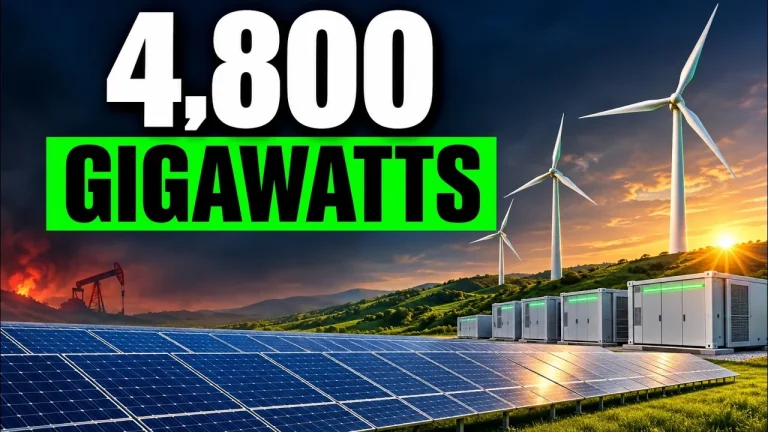
The IEA now expects the world to add 4800 gigawatts of renewable power between now and 2031. That is 57% more than was built in the previous six years. By 2031, renewables are projected to supply 45% of the world’s electricity. However, I think the real figure will be closer to 55% or 60%, since the IEA has a history of understating how many renewable energy plants and solar farms will actually be built.
Last year, renewables made up about one third of the world’s electricity. The IEA expects solar to overtake hydropower as the largest renewable source by 2029.
Get the latest EV news first. Follow us on:
Battery Storage and Solar Efficiency
Batteries are a key part of this shift. The IEA forecasts that home and business battery storage will grow almost sixfold—about 600%—by 2031. By then, more than one in three home solar systems is expected to include a battery.
Solar panels are not only cheaper but also more efficient than ever. I’ve shown in recent videos just how efficient they’ve become, with some reaching 25% efficiency, which is unbelievable.
Challenges and Warnings
Some governments are using the same crisis to approve oil and gas projects. That’s probably a reference to Trump. Meanwhile, some Chinese solar manufacturers are losing money because panels have become so cheap. But for buyers, cheap panels are the main goal—they’re more affordable and more efficient.
What This Means for the Future
The fuel crisis has made it obvious that the world’s answer is to need less fuel. The answer has never become more clear: by 2031, about half of the world’s energy will be renewable. Looking further ahead, by 2040, I think it could be about 95%, if not 100%.
