
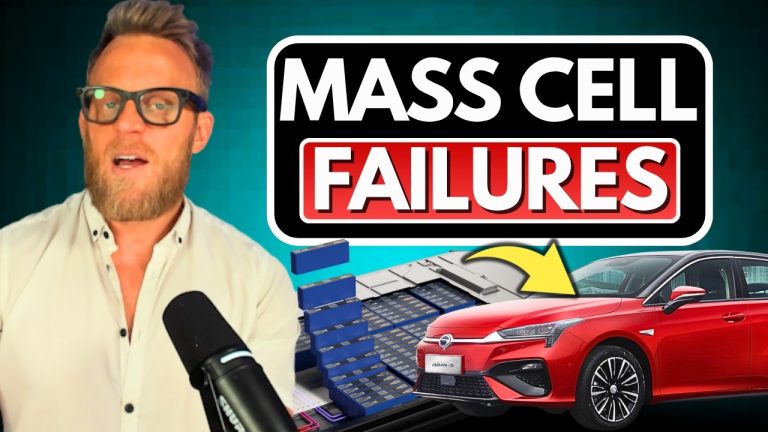
A wave of battery failures in GAC Aion vehicles fitted with lithium iron phosphate (LFP) cells from CALB has pushed GAC Aion to double the warranty on affected commercial vehicles to 8 years or 300,000 km. Sam Evans says the story might worry carmakers buying cells on the cheap.
A personal connection
Sam drives an XPeng G6 Long Range, which uses an 87 kWh NMC battery made by CALB. He has driven 24,000 km in the car and says it has been fantastic, with no issues whatsoever. The recent news about CALB still got him thinking about where the battery maker is heading.
CALB is the fourth largest EV battery manufacturer in the world. Last month it overtook Gotion High-Tech, which is part-owned by the Volkswagen Group, to become number three in China behind CATL and BYD. Its installations grew 36% in the first five months of 2026 to 23.8 GWh. Sam says that is massive for five months, and suggests we might now know how CALB achieved it.
Get the latest EV news first. Follow us on:
Swelling, leaks and insulation faults
GAC Aion vehicles fitted with CALB’s 177Ah LFP cells have seen a surge of failures, including cell swelling, electrolyte leakage and insulation faults. Sam says these are not a few isolated cars. China’s state-run news agency reported on the problem on 14 July, and according to National Business Daily, complaints about the batteries reached 182 cases in just the first 18 days of July.
Third-party inspections ruled out crashes and water damage, and the faults trace back to internal manufacturing defects. The failures cluster between 150,000 and 300,000 km, which is right where commercial vehicles such as taxis and ride-hailing cars pass out of warranty. Sam notes that LFP batteries, whether from CALB, BYD or CATL, are expected to last up to a million kilometres, so failing at that point is, in his words, kind of disastrous.
One owner had a confirmed battery defect at 230,000 km, but the dealer refused to cover it because the car had passed the 150,000 km limit, and quoted $11,800 (~AUD 17,400) for a replacement battery. Sam points out that this was a car bought specifically to save money on fuel, and that you could probably buy a whole replacement car for about $12,000 (~AUD 17,700) now.
Public pressure forces a warranty extension
On 18 July, GAC Aion extended the warranty for affected commercial vehicles from 8 years or 150,000 km to 8 years or 300,000 km, with free inspection, repair or a full pack replacement, plus remote battery monitoring. CALB says owners can go directly to its own service outlets for free repairs.
Sam says this is actually really good, and credits the company for replacing the batteries at no charge, which he says appears to be happening and is what it should do. He says that the public pressure worked, and that EV owners who hit a battery fault after their warranty expires may be able to band together, because the power of the people can sometimes win.
Why did it happen?
A battery repair engineer who has handled more than 30 of these cases told the news that the problem likely comes from the design side, and that the manufacturer probably cut validation testing time in a rush to grab market share. The engineer called it a symptom of the brutal price war gripping China’s battery industry. Sam says that is pure speculation, but notes that the cells failing today were validated during the most cutthroat phase of competition in battery history.
CALB is not alone. In late 2025, Geely’s battery unit sought around $341 million (~AUD 503 million) in compensation from Sunwoda over manufacturing consistency defects, settling in early 2026. Zeekr then recalled more than 38,000 vehicles to replace their battery packs free of charge. Sam mentions that Sunwoda is a new supplier for Tesla in China.
Sunwoda’s name also comes up in Europe. In February, Volvo recalled 40,000 EX30 electric SUVs worldwide because the battery packs risk overheating and catching fire. The cells came from Shandong Geely Sunwoda Power Battery, a Geely-backed joint venture. Until the modules are replaced, owners were told to charge to no more than 70%, and in some markets to park away from buildings. Reuters has estimated the replacement modules alone will cost $200 million (~AUD 295 million). Sam says that for a brand whose entire identity is safety, it looks bad.
Tougher rules in China
On 1 July, China brought in its toughest battery safety standards ever. Batteries must not catch fire or explode even after thermal runaway in a single cell. Sam calls this a genuinely world-leading requirement and says it will make things very difficult for some lower-tier battery companies. The catch is that it only applies to new models seeking type approval, so the millions of cars already on the road depend on existing rules being enforced.
Sam’s take
Sam says EVs are still overwhelmingly more reliable than combustion cars, given all the engine parts that can go wrong. He points out that owners of combustion cars simply expect problems at 230,000 km and don’t think to complain, and says it has happened to him many times. He adds that both LFP and NMC batteries are fundamentally much safer than combustion cars, including when it comes to fires, which are far less likely in an EV.
Still, Sam says that when an industry squeezes five years of validation into 18 months to win a price war, which is what might have happened here, physics eventually sends the bill. He believes the winners of the next phase won’t be the cheapest battery makers but probably the ones whose cells are still healthy at 400,000 km. He says watching which suppliers the big automakers quietly drop over the next 12 months will tell you everything.
