
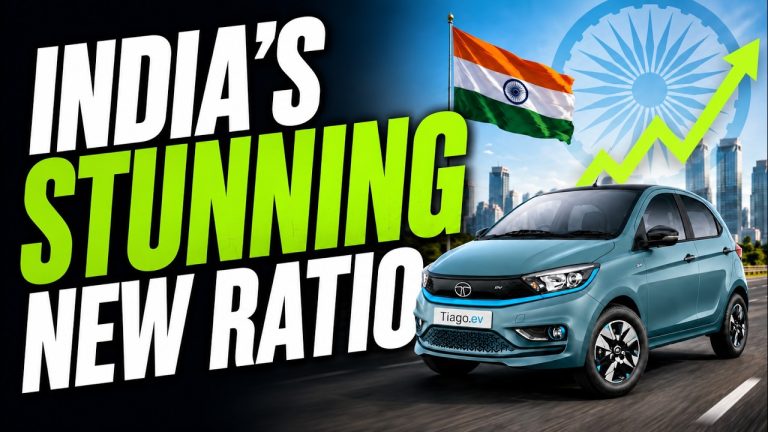
Indian automakers are set to launch 16 electrified models against only seven new petrol and diesel cars over the nine months starting June 15. Sam Evans says the numbers tell the entire story of how fast the world’s third biggest car market is moving towards electric.
16 Electrified Models Versus Seven Combustion Cars
The 16 electrified models are made up of 10 purely electric vehicles, four plug-in hybrids and two regular hybrids. That means for every combustion car launched, nearly two electrified models follow. Sam says that ratio would have been unthinkable in India even two years ago.
The launches are not coming from EV startups. The list includes Tata Motors, Maruti Suzuki, Toyota, Mahindra, Hyundai, Kia, Honda, BMW, Mercedes-Benz, BYD and MG. Sam notes that these companies built their empires on internal combustion and are now pivoting hard because they can see where the market is going, though he adds “well, sort of.”
Get the latest EV news first. Follow us on:
The Launch Calendar
June has three very different launches: the Mercedes-Benz S450e plug-in hybrid, which Sam guesses costs something like $250,000 (~AUD 377,000), the Toyota Urban Cruiser Hybrid, and the Tata Sierra EV, the one Sam is most interested in. The Sierra revives an iconic name on Tata’s electric SUV platform, with 55 kWh and 65 kWh battery packs. Sam says the packs are not huge, but the idea is to stay within a price point people can afford. Claimed range is around 500 km, and 540 km for the bigger battery, which Sam says is probably a little exaggerated.
July brings a new EV from Kia, and August the Honda Elevate EV. The bulk of the launches arrive in the festive months of September, October and November. The price spread runs from affordable mass-market hatchbacks up to luxury models costing around $240,000 (~AUD 362,000). Sam says electrification in India is no longer a rich man’s experiment and is becoming the default across every segment.
Record Market Share
Sam points out that EVs were practically nothing in India only a few years ago. In May, electric cars hit a record 6.9% of passenger vehicle sales, with only 26 models on offer. Sam compares that with Australia, a much smaller market that has around 150 models. India’s EV share is up from 4.1% in January and from 4.7% a year earlier, and Sam says penetration is accelerating month after month.
Drivers of the growth include rising petrol and diesel prices and a fast-expanding DC charging network. Sam thinks range anxiety may also be fading to some degree, but believes the growth is probably mostly driven by EVs that are not super expensive and are good value for money.
Tata’s Lead Under Pressure
Tata Motors dominates with 36 to 39% of India’s EV market, followed by Mahindra and the JSW MG joint venture. Sam explains that MG formed the joint venture with an Indian company to avoid paying India’s heavy tariffs.
Sam says Tata’s lead is exactly why this wave of launches matters: 16 new electrified models means brutal new competition for Tata, and a flood of choice for buyers who until recently had very few options.
The Risks
India still leans heavily on its affordable segment under $14,000 (~AUD 21,100), and that is where electrification has been slowest. Public charging is concentrated in a few big cities, and battery raw material costs are not going down. Margins in that segment are thin for petrol cars as well. There is also a subsidy cliff coming, with key incentives set to expire this summer, although Sam says they may possibly be extended.
What It Means
Sam says the signals from India are unmistakable. When legacy automakers in the world’s third biggest car market launch two electric models for every petrol one, he says they are voting with their factories. In his view the combustion engine in India is not being phased out by regulation but because it is being out-competed product for product.
Sam believes India has now joined China in showing the rest of the world that the transition is moving in the direction many naysayers said would not happen. He says India has been very slow to this game, but things are now starting to change very quickly.
