
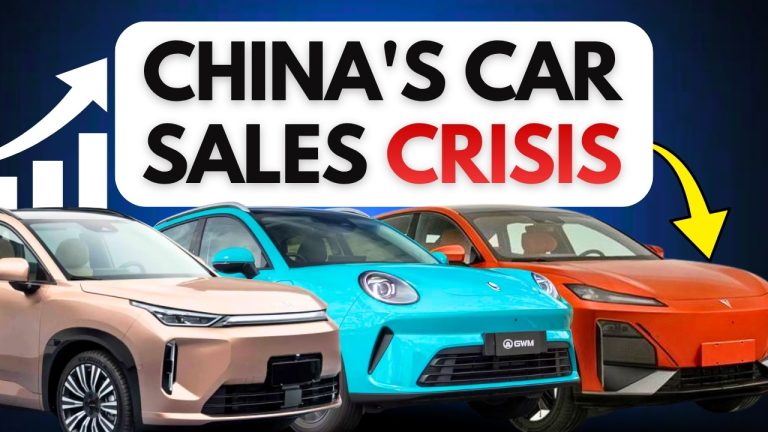
Six major listed Chinese automakers have released their first-half 2026 earnings forecasts, and four of the six are expecting large losses. Sam Evans says the numbers are worse than analysts expected, and they show that the Western belief that Chinese car companies are “just printing money” is wrong.
The numbers
Sam says many people in the West see rising sales, rising exports and BYD overtaking legacy brands, and assume Chinese car companies are winning. He adds that he may be part of that problem himself. He notes that battery makers are a different story, but the car companies are struggling. The six automakers are established listed companies, not new startups. Four are expecting large losses. The two that are still profitable have seen net profits fall by 60% or more.
GAC Group, which makes the Aion EV brand, is forecasting a net loss of around $660 million (~A$974 million) for the first half of 2026 alone. Sam points out that GAC has been around for well over a decade. Seres, the company behind the Huawei-backed AITO brand, has swung from a profit to a loss of $260 million (~A$384 million). BAIC BluePark is expecting to lose around $290 million (~A$428 million), and JAC Motors $110 million (~A$162 million). Changan is still profitable, but its profit has fallen by as much as 68%, to $110 million (~A$162 million). Great Wall Motors is forecasting a large decline in net profit.
Get the latest EV news first. Follow us on:
The official explanation
In their filings, the companies blame rising raw material costs, including lithium carbonate, copper, aluminium and especially storage chips. Sam says there is some truth to this. Contract prices for certain mature storage chips have more than doubled in the first half of the year, and another increase of 60 to 70% is expected in the second half, although Sam says that might not happen. Chip makers are prioritising AI and data centres over automotive. Per-vehicle material costs are estimated to be up by $600 to $1,000 (~A$885 to A$1,476), and possibly about $1,500 (~A$2,213) on luxury models.
Sam says he does not personally believe raw materials are the real story. In his view, $1,000 of extra cost per vehicle does not turn a healthy business into one losing $600 million (~A$885 million) in six months.
Shrinking demand and a race to the bottom
Sam says the real story is that China’s domestic retail passenger vehicle sales fell 20% in the first half of 2026, and he says no one is talking about it. With demand shrinking, companies are trying to hold on to market share by slashing prices, piling on discounts and subsidies, and launching new models at an average rate of 3.6 per day in the first five months of the year. Sam says even he cannot keep up, and that this is not a healthy market but a race to the bottom.
Sam says he has seen on his trips to China that these companies spend enormous amounts on marketing, and that some of it is “lunacy”. This includes huge sums paid to influencers who have nothing to do with cars and who, in his view, will not convince anyone to buy a car. He says he could give hundreds of similar examples. He adds that almost none of the staff in the marketing and PR departments at these companies have worked in the auto industry before. He also points to massive showrooms, expensive launch events and celebrity endorsements, and says much of it is not working because there are too many brands chasing too few buyers. Those brands are selling at prices that barely cover costs, and in many cases do not cover them at all. When margins are razor-thin or negative, Sam says, even a modest cost increase pushes a company deep into the red. In his words, the raw materials did not create the problem, they exposed it.
Consolidation ahead
Sam says the Western narrative that Chinese car companies are unstoppable and all wildly successful is not accurate. A handful, such as BYD, have the scale to survive. Many others are losing enormous amounts of money just to stay in business or to buy market share, and some hope to be among the last ones standing when consolidation comes.
Sam points to XPeng’s CEO, who has said only seven car companies will be left within a few years. There are now more than 100 EV brands, and he predicts at least 90 of them will disappear or be consolidated. Sam says S&P Global holds a similar view: companies with scale, premium product mixes and stable overseas operations will absorb the pressure, while smaller players and low-margin brands face an increasingly precarious future.
What it means
Sam says that the next time someone claims Chinese automakers are crushing it, they should be shown these numbers. Four of the six major listed automakers are losing money, and the survivors are watching their profits fall off a cliff. In his view, it is not only legacy manufacturers whose profits are disappearing. Chinese ones are affected too. He calls it a brutal war of attrition and believes many of these brands will not exist in five years.
