
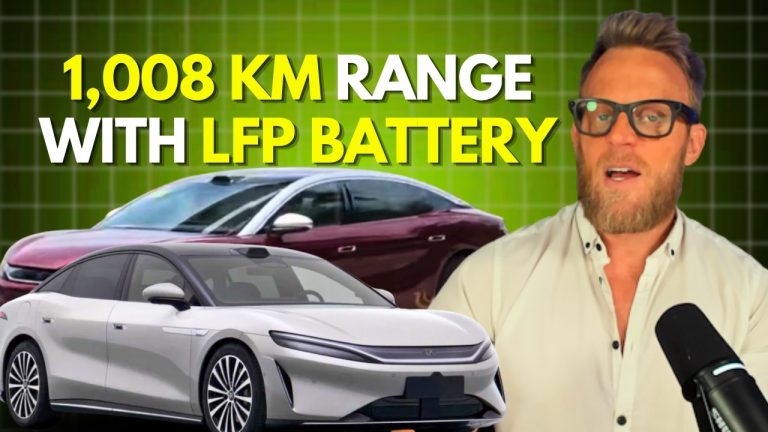
BYD’s new flagship sedan, the Da Han, also called the Great Han, has appeared on China’s Ministry of Industry and Information Technology purchase tax reduction list. The listing shows a headline range of 1,008 km (626 miles) on the CLTC cycle from a lithium iron phosphate (LFP) battery rather than any exotic chemistry.
1,008 km from LFP
The 1,008 km figure is on China’s CLTC cycle. Sam Evans says the WLTP range will probably be something like 850 km. The car uses LFP chemistry, which made up 83.3% of all batteries fitted to anything in China in June. Sam says the team believes the higher energy density versions of BYD’s new Blade Battery version 2 are doped with manganese, but there is no solid-state battery here, just LFP done at a scale he calls pretty impressive.
The pack is a 102.3 kWh LFP battery built by FinDreams, BYD’s in-house battery subsidiary. Sam compared it with the Zeekr 7X all-wheel drive performance model he owned until the day before recording. That car has an almost identical 100 kWh battery but gets 543 km of WLTP range. Sam says the Da Han’s WLTP range will be about 300 km more from the same size battery, which he calls impressive.
Get the latest EV news first. Follow us on:
A 726 kg battery pack
Sam says the figure that jumps out at him is the pack’s weight: 726 kg, or about 1,600 lb. That is over 30% of the entire car’s curb weight, so nearly a third of the vehicle is battery. Some people will say this proves LFP is too heavy for long-range cars, but Sam believes it proves the opposite. BYD has taken the cheapest, safest and most durable chemistry in mass production for EVs and squeezed over 1,000 km of range out of it. The car is expected to sell for around $44,000 (~AUD 65,000), which Sam says is roughly the price of a performance Model Y in China.
Bigger than an S-Class
Sam says the Da Han is limousine-sized, which makes the range even more impressive. It is 5,256 mm long, 2 m wide and 1,510 mm tall, and it sits on a 3.13 m wheelbase. That makes it 66 mm longer than a Mercedes-Benz S-Class. Sam says BYD is not chasing the 3 Series here. He says the car is aimed squarely at German full-size flagships at probably a fraction of the money, at least in China.
Two EVs and a plug-in hybrid
There are two fully electric versions. The rear-wheel drive EV has a single motor producing 370 kW (496 hp) and a curb weight of 2,260 kg to 2,325 kg depending on spec. Its range is 970 km to 1,008 km CLTC. Sam calls that weight very, very good for a car this size with a battery this big.
The all-wheel drive flagship uses two motors for a combined 570 kW (764 hp) and weighs a bit more, at around 2.5 tonnes. It still gets up to 880 km of CLTC range on smaller wheels, dropping to 820 km on the bigger wheels. Sam describes a 2.5-tonne luxury sedan with supercar power and over 500 miles of range from LFP as the real story.
There will also be a DM-i plug-in hybrid. It pairs a 115 kW (154 hp) 1.5 L turbo engine with a 200 kW electric motor and a 55 kWh battery, with a claimed 470 km of electric-only range. Sam says the pure electric car is the one that matters. He doesn’t understand why BYD bothered with a plug-in hybrid that will be heavier and more complicated, with disadvantages such as engine servicing and an exhaust, when the regular version has 1,000 km of range.
Charging and the current Han
The filing doesn’t reveal charging speed. Sam expects the car to use BYD’s new architecture, most likely around 1,000 volts or possibly 800 volts. Either way, he expects a minimum of 1,000 kW fast charging. Based on similar cars, that would mean around 8 minutes and 50 seconds to charge from 10% to 97%, or roughly 9 minutes.
The existing BYD Han sold 3,285 units in China in June, and the longer-bodied Han L sold only 584. Sam says the Han family needs a refresh because it isn’t selling all that well. He suggests that with BYD offering around 84 different models, buyers are probably a little confused about which one to choose.
What it means
Sam says the new car will seriously upgrade the Han family. It is a bit bigger than an S-Class, should cost well under half the price of one, has plenty of power and offers just over 1,000 km of range in rear-wheel drive form. He calls it a fantastic car and, at an estimated $44,000 (~AUD 65,000), a bargain. Sam says he wouldn’t buy one himself. However, he thinks quite a lot of well-heeled Chinese buyers who were considering a BMW 7 Series or a Mercedes-Benz S-Class will decide this is better and buy one instead.
