
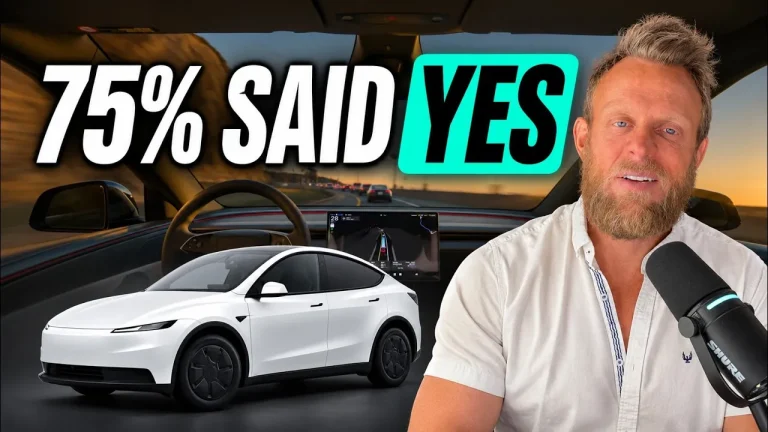
Tesla announced that three out of every four new buyers in North America last quarter chose to pay for full self-driving on the day they collected their car, despite a free trial being available. This surge has pushed Tesla’s paying software customer base to over 1.7 million for the first time, with most customers opting for a monthly subscription. According to Tesla, this recurring software revenue now approaches $1 billion (~AUD 1.47 billion) per year.
Strong Software Adoption and Financials
During its Q3 earnings call, Tesla confirmed that 75% of new owners in North America are now paying for full self-driving at delivery. Most of these customers are on a subscription model, which one analyst said works out to nearly $1 billion (~AUD 1.47 billion) annually. Tesla agreed that was about right.
In terms of vehicle sales, Tesla delivered just over 486,000 cars last quarter. While this was slightly fewer than the same quarter last year, it exceeded analyst expectations. The company set sales records in Australia, Japan, and Germany, and became the best-selling car brand of any type in South Korea.
Get the latest EV news first. Follow us on:
However, profit was a weak spot. Tesla’s net income fell 43% to $787 million (~AUD 1.16 billion), mainly due to increased investment in robots and chips, and a decline in revenue from EV credits. These credits, which other companies purchase to meet clean tax requirements, contributed less to Tesla’s bottom line compared to previous periods.
Advances in Full Self-Driving and Robotaxis
Tesla stated that the first customer cars could receive fully unsupervised driving capability—meaning drivers could potentially go to sleep—starting in the second quarter of next year in some parts of the United States. Sam Evans believes this feature will likely be limited to good driving conditions and may deactivate during storms or adverse weather.
Sam points out that this could allow Tesla owners in the US to start earning money from their cars next year, though he does not expect this to happen in Australia yet. Robotaxis are already operating without drivers in six cities, and Tesla plans to launch cyber cab rides in Dallas next month.
Expansion in AI, Robotics, and Future Goals
Tesla has begun production of the Optimus robot in Fremont, with a manufacturing line designed for up to one million robots annually. The company’s grid batteries are nearly sold out through 2027. Tesla’s target is to reach five million car sales per year by 2030, with most of those expected to be robotaxis—tripling its current sales volume within four years.
Sam questions whether this ambitious goal is achievable, but believes it is possible, depending on how many cyber cabs Tesla can sell. He notes that Tesla no longer views itself primarily as a car company, but as a software company that builds cars.
What This Means for Tesla and the Industry
Sam Evans argues that Tesla is now more of an AI company than ever before, investing billions of dollars—far more than any other automaker—into artificial intelligence. He sees the company’s future as hinging entirely on the success of its AI and robotics investments. If Tesla’s strategy works, Sam believes it could become the most valuable company in the world. However, he emphasizes that this outcome depends on Tesla’s ability to execute its ambitious plans.
