
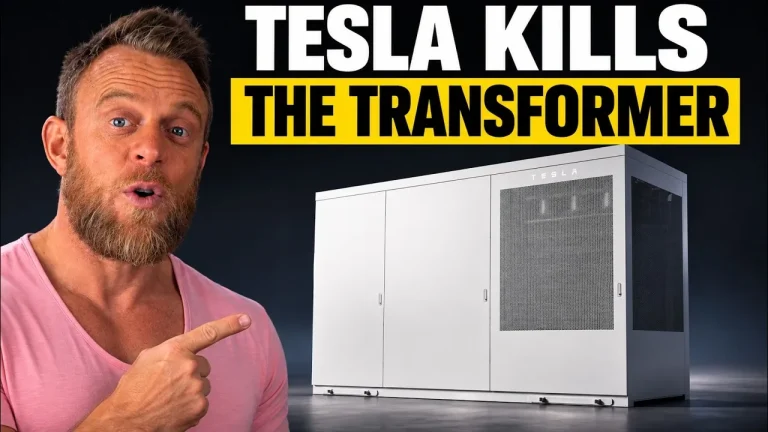
Tesla has revealed PowerCore, a new solid-state transformer that could dramatically change how solar farms, batteries, and data centers connect to the grid. PowerCore combines three functions—transformer, inverter, and circuit breaker—into a single cabinet and is designed to address severe delays in getting traditional transformers. Tesla says the first PowerCore units will be operating in 2027, with US manufacturing planned but no price or factory location announced yet.
Why Transformers Are a Bottleneck
Every large-scale solar farm, battery installation, and data center relies on transformers to connect to the grid by changing voltage levels. The basic design of these transformers—copper coils in a tank of oil—has not changed since the 1890s. However, there is now a global shortage. In 2020, ordering a large transformer took about a year. Today, the wait is more than three years, and for the largest units, up to four years. Sam Evans points out that estimates this year suggest close to half of planned data centers in the United States will be delayed or cancelled due to shortages of this essential electrical gear. Solar farms and batteries are also stuck in the same queue.
How PowerCore Works
PowerCore is a solid-state transformer, using fast-switching electronics similar to those found in electric cars instead of copper and oil. It replaces three separate pieces of equipment: the transformer, the inverter (which converts battery or solar power to grid power), and the circuit breaker (which protects the system during faults). Tesla says PowerCore’s breaker can shut off a fault in about one ten-thousandth of a second—roughly a thousand times faster than a typical circuit breaker. With no oil inside, there is also less fire risk at power stations.
Get the latest EV news first. Follow us on:
Each PowerCore unit handles 7.4 megawatts, enough to supply several thousand homes. Tesla claims nearly 99 percent efficiency and offers a 25-year warranty for the product.
Efficiency Gains for Megapack and Data Centers
The Megapack, Tesla’s large grid battery, typically uses lithium iron phosphate cells from CATL. Currently, the power from Megapack is converted twice before reaching the grid, with energy lost at each step. Tesla says PowerCore cuts these losses in half, allowing more usable energy from the same battery and reducing the amount of equipment needed. PowerCore can also be delivered much faster than the current four-year wait for traditional transformers.
Tesla is also targeting artificial intelligence data centers. PowerCore can feed a data center directly with the 800-volt power system that NVIDIA is promoting for next-generation AI. Tesla says it is working with NVIDIA on this integration. Fewer conversion steps mean less wasted electricity, so data centers can get more computing power from the same grid connection at lower cost. Tesla gives the example of a 100-megawatt data center that could be run on a solar farm five times that size, backed by enough Megapacks to keep the site running for around 17 hours with no sunlight at all. This setup could allow data centers to run on sunshine and batteries instead of waiting years for grid upgrades.
Competition and Market Impact
Sam Evans notes that Tesla is not alone in this field. One of Tesla’s former top engineers, who left the company in 2024 after 18 years, has started a business called Heron Power to build a similar product. Heron’s version is rated at about five megawatts, with full production planned for late 2027. Sam describes this as a race, indicating that oil-filled transformers are being disrupted by new technology.
There are still some unknowns about PowerCore. Tesla has not announced a price or named the factory, but says it will be built in the United States, with first installations in 2027. There is no word yet on availability in other countries, but PowerCore is designed for grid voltages used in Australia, the UK, Canada, Europe, and other regions.
What This Means for the Energy Transition
Sam Evans believes the redesign of the transformer is important because, for years, the main bottleneck for clean energy has not been solar panels or batteries, but the equipment connecting them to the grid. Sam expects PowerCore to follow the Megapack and be sold and used all over the world, which he says is great news. Tesla’s move to build PowerCore at scale could help remove a major obstacle for solar, battery, and data center projects worldwide.
