
China’s automobile manufacturing growth slowed to 0.9% year on year in October. Domestic car sales fell sharply even as new energy vehicle production and exports grew.
Factory growth slows as exports grow
Automobile manufacturing reportedly recorded its weakest growth since the Covid disruptions of 2022, as shown by data the National Bureau of Statistics released on November 16. Manufacturing value added increased 6.5% over the first ten months of this year.
October automobile output fell 7.7% year on year to 3.045 million units. Output from January to October declined 4.1% to 26.412 million units.
Get the latest EV news first. Follow us on:
New energy vehicle production moved in the opposite direction, rising 17.1% to 2.027 million units in October. Over the first ten months, output increased 12.7% to 14.482 million units.
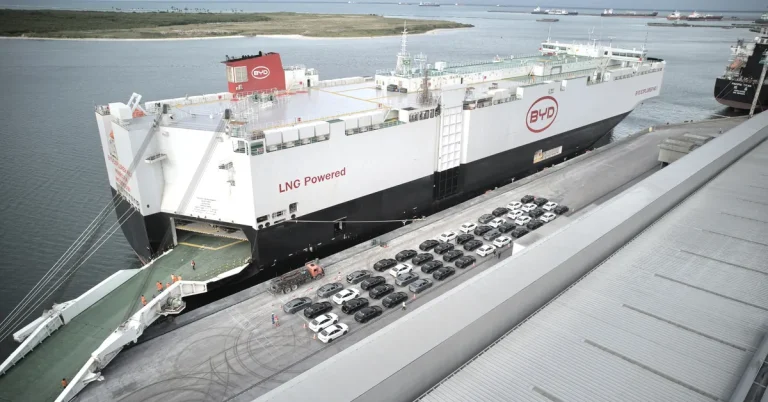
October saw passenger vehicle exports reach 928,000 units after a 68.5% increase, representing 35% of manufacturers’ passenger car sales. New energy passenger vehicle exports rose 144.7% to 582,000 units.
Wholesale figures measure manufacturers’ sales to dealers, including exports. Retail figures measure dealers’ sales to domestic users.
Domestic sales fall, including electric cars
Domestic passenger vehicle retail sales fell 27.1% year on year to 1,643,000 units in October, but increased 1.5% from September. Sales from January to October totalled 14,978,000 units, down 22.3% year on year.
October new energy passenger vehicle retail sales fell 13.7% year on year to 1,109,000 units, despite rising 2.3% from September. It was the tenth consecutive month of declining new energy vehicle retail sales. Their share of retail sales reached 67.5%.
Retail sales of battery-electric vehicles totaled 770,000 units after falling 5.3%. Across the first ten months, new energy passenger vehicle retail sales fell 12.9% to 8,869,000 units.
October’s higher subsidy threshold restrained first-time buying and favoured replacement buyers. Domestic demand leaned towards larger cars, while exports leaned towards lower- and mid-priced small cars.
High oil prices affected fuel-powered vehicles across market segments, although conventional hybrids were more resilient. Sales of internal-combustion vehicles fell 32.5% to 6.1 million over the first ten months.
Sedan retail sales dropped 38.1% year on year and 0.5% month on month to 633,000 units in October. SUV retail sales fell 17.0% year on year but rose 3.5% from September to 948,000 units. People-mover retail sales declined 29.7% year on year and 6.0% month on month to 62,000 units.
From January to October, sedan retail sales fell 32.5% to 5,936,000 units. SUV retail sales dropped 13.1% to 8,335,000 units, and people-mover retail sales decreased 21.3% to 707,000 units. Over that period, sedan output fell 21.3% to 8.448 million units, while SUV output rose 10.2% to 13.05 million units.
How the major manufacturers performed
BYD’s October domestic retail sales reached 250,301 units, up 1.4% month on month but down 15.4% year on year, giving it a 15.2% share. Geely sold 196,244 units, up 11.1% month on month but down 26.1% year on year, for an 11.9% share.
Changan’s retail sales totalled 89,064 units, rising 9.1% month on month but falling 32.6% year on year, with a 5.4% share. Chery recorded 84,148 units, down 2.4% month on month and 35.3% year on year, taking 5.1%.
Leapmotor retail sales rose 6.9% month on month and 31.1% year on year to 83,573 units, giving it a 5.1% share. FAW-Volkswagen recorded 80,379 units, up 4.6% month on month but down 40.9% year on year, for a 4.9% share.
Tesla China’s October retail sales reportedly fell 66.1% year on year to 8,817 units, their lowest since July 2022. Tesla’s total wholesale sales increased 10.3% to 67,829 units.
Some joint-venture automakers shifted their businesses, and joint-venture new energy vehicles recorded strong October growth.
Export growth faces trade pressures
Chery exported 196,704 vehicles in October, down 3.5% month on month but up 57.6% year on year, representing a 21.2% export share. BYD exported 164,679 vehicles, down 5.5% month on month but up 105.6% year on year, taking 17.7%.
Geely’s exports increased 0.7% month on month and 156.5% year on year to 106,632 vehicles. Its export share reached 11.5%.
On November 9, Cui Dongshu, secretary-general of the China Passenger Car Association, said growth in vehicle exports could ease to around 10% in 2027. Increasing trade barriers overseas, alongside pressure on exports bound for the European Union, were factors Cui cited. He identified the Middle East as a potential source of further growth.
With export-tax rebate reductions and tighter tariff conditions expected, the association warned that deliveries of some overseas orders were taking place early.
Why it matters
For EV buyers and fans, rising new energy vehicle production alongside falling domestic sales highlights the role of exports. Factory sales could receive a near-term boost from those early shipments, but export demand could be reduced in the first quarter of 2027.
Key Specs
- October automobile manufacturing value added growth: 0.9% year on year
- October domestic passenger vehicle retail sales: 1,643,000 units; down 27.1% year on year
- October battery-electric vehicle retail sales: 770,000 units; down 5.3% year on year
- October new energy vehicle retail penetration: 67.5%
- October passenger vehicle exports: 928,000 units; up 68.5% year on year
✎ Images and news sourced from: cpcaauto.com, stats.gov.cn, china.com.cn, steelhome.com, businesstoday.in, sohu.com, carnewschina.com, byd.com.
