
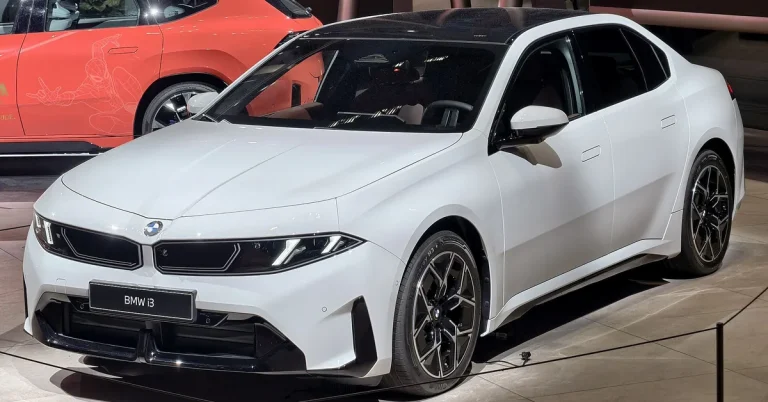
A BMW i3 50 prototype lapped the Nürburgring Nordschleife in 8 minutes 14 seconds. The run shows the track capability of an electric sedan whose i3 50 xDrive version offers up to 912 km of WLTP range.
Four hard laps, with charge left
Presenter and test driver Misha Charoudin’s video showed the prototype handling the circuit well and passing performance cars. Across the measured 12-mile lap, battery charge fell from 79% to 65%, a decrease of 14%.
After four hard laps, the battery still held 20%. Depending on the distance home, the car could have been driven back after the session.
Get the latest EV news first. Follow us on:
No brake fade or overheating was observed. The battery temperature gauge stayed in its normal zone until the final minute, when it indicated a high temperature.
Sharp handling despite the weight
Despite weighing 2,160 kg, the i3 50 showed sharp turn-in, good steering feel and a well-balanced chassis. Power delivery was strong, as was stopping performance from both regenerative and friction braking.
The prototype wore Michelin Pilot Sport 4S tyres. Stickier summer tyres in warm conditions could improve its lap performance, but that remains a possible future improvement.
The i3 50 has adaptive suspension, rear-wheel steering, launch control and a drift mode. Its brake-by-wire system works alongside strong regenerative braking. BMW’s Heart of Joy control system handles more than 95% of braking through the electric motors to recover energy.
The i3 50 xDrive, currently the only variant on sale, combines two motors with all-wheel drive. It produces 345 kW, or 463 hp, and 645 Nm of torque. That is more power than most M3s throughout their history.
BMW lists 0–100 km per hour acceleration at 4.7 seconds and a top speed of 200 km per hour for the i3 50 xDrive. The i3 50 starts at $58,182 (~AUD 86,363) in Germany.
Range, battery and charging
The i3 is BMW’s first fully electric 3 Series based on its Neue Klasse architecture. It uses the sixth generation of BMW’s electric drive technology, with new cylindrical-cell high-voltage batteries, more efficient motors, an 800-volt electrical system and bidirectional charging.
The i3 50 xDrive has 108.7 kWh of usable battery capacity, larger than the batteries in most electric sedans of its size. Its cylindrical lithium-ion cells are integrated directly into the pack, which forms part of the vehicle’s body structure.
Compared with BMW’s previous-generation electric drive technology, the new cells have 20% greater volumetric energy density, while motor energy losses are 40% lower. The new generation also delivers greater range, higher efficiency and much faster charging.
The i3 50 xDrive accepts DC fast charging at up to 400 kW. A 10-minute stop can add up to 423 km of WLTP range. Its EPA-rated range is 468 miles.
A drag coefficient of 0.21 makes the i3 50 xDrive the most aerodynamic BMW yet. Tyre rolling resistance is 14% below the EU class A requirement, and combined WLTP energy consumption is 18–13.4 kWh per 100 km.
Why it matters
For buyers interested in road trips and occasional circuit driving, the i3 pairs long range and rapid charging with demonstrated track capability. Its strong braking and balanced handling give performance-minded buyers more to consider than straight-line acceleration alone.
Key Specs
- Prototype Nürburgring lap: 8 minutes 14 seconds
- Battery remaining after four hard laps: 20%
- i3 50 xDrive maximum WLTP range: 912 km
- i3 50 xDrive EPA-rated range: 468 miles
- i3 50 xDrive usable battery: 108.7 kWh
- i3 50 xDrive maximum DC charging: 400 kW
- i3 50 xDrive power: 345 kW
✎ Images and news sourced from: youtube.com, bmwgroup.com, yahoo.com, bicarakeuangan.com, motor16.com, ilfattoquotidiano.it, insideevs.com, wikimedia.org. Featured photo: M 93, CC BY-SA 3.0 de, via Wikimedia Commons.
