
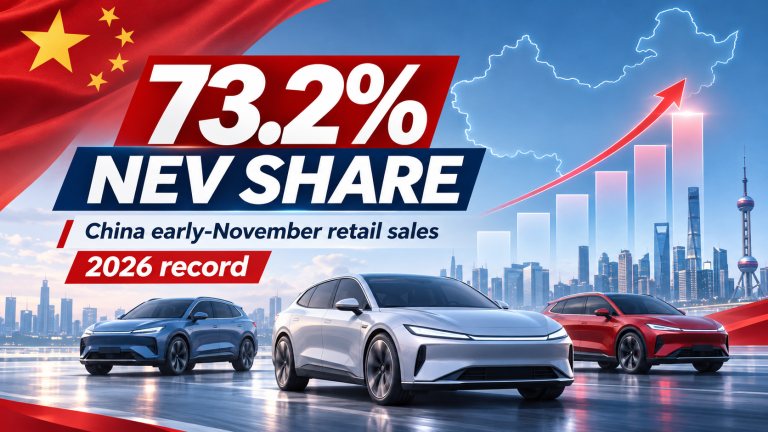
During November’s first half, new energy vehicles accounted for a 2026 record share of 73.2% in China’s retail passenger car sales. That share rose even as fewer customers visited dealerships and placed orders.
NEV share rises in a weak market
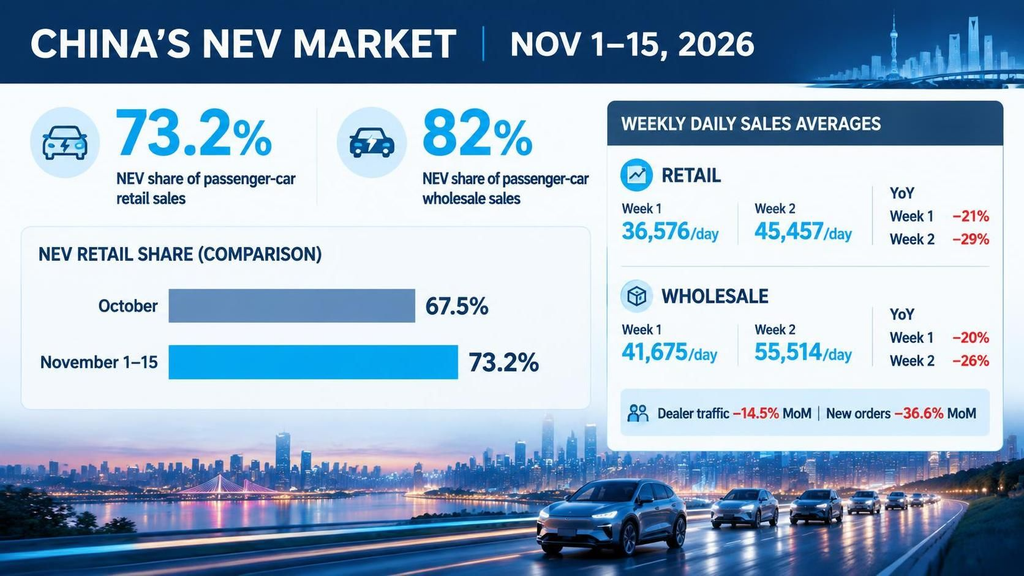
The retail share recorded from November 1–15 followed October’s 67.5%, which had set the previous monthly record. New energy vehicles also accounted for 82% of passenger car wholesale sales during the first half of November.
The China Passenger Car Association (CPCA), an industry body, described November retail conditions as a weak, policy-supported recovery, with performance varying sharply across the market.
Get the latest EV news first. Follow us on:
The China Automobile Dealers Association (CADA), which represents car dealers, recorded a 14.5% month-on-month decline in customer traffic during the first half of November. New orders fell 36.6%.
Weak expectations for household income were keeping consumers on the sidelines. Buyers were taking longer to replace their cars, extending replacement cycles in a market where demand remained uneven.
Daily sales remain below last year
Average daily passenger car retail sales in November’s first week were 36,576 units. That was 21% below the same period last year, although it was 2% higher than a month earlier.
In the second week, average daily retail sales rose to 45,457 units. Despite that increase from the opening week, the daily average was down 29% year on year and 12% month on month.
Passenger car wholesale sales averaged 41,675 units a day in the first week, down 20% year on year but up 63% month on month. The second-week daily wholesale average reached 55,514 units, down 26% from a year earlier and 13% from a month earlier.
Most automakers launched discounts for the Double 11 shopping period. The CPCA said finance and trade-in benefits associated with the promotion had been made available to customers.
New launches and subsidies may lift demand
The Guangzhou Auto Show is scheduled to begin on November 27. The CPCA expects new cars launched at the show to help lift demand later in the month.
The approaching end-of-2026 deadline for trade-in subsidies may also encourage retail purchases in the second half of November.
Among the policies proposed by the CPCA are relief on personal income tax for those buying cars and expanded efforts to promote new energy vehicles in rural areas. It also recommended purchase tax concessions for battery-electric vehicles with less than 200 km of range.
Dealers and exporters face pressure
Dealers are expected to face tight funding and high inventories. Wholesale growth is expected to reflect inventory being shifted rather than genuine demand, while weak retail sales are expected to constrain further wholesale growth.
An export VAT rebate cut from 13% to 9% next year is also expected to make 2027 a difficult year for many Chinese carmakers.
High oil prices are also suppressing purchases of petrol and other combustion-engine vehicles, shrinking their share of the market.
Why it matters
For buyers, competition now centres on advanced driver-assistance features at the high end and trade-in offers in the middle. Weaker brands are exiting as only strong battery-electric and plug-in hybrid models capture customers.
Key Specs
- China NEV retail share, November 1–15: 73.2%
- China NEV wholesale share, November 1–15: 82%
- China NEV retail share, October: 67.5%
- First-half November customer traffic, month on month: -14.5%
- First-half November new orders, month on month: -36.6%
✎ Images and news sourced from: cpcaauto.com, cnevpost.com, gasgoo.com, carnewschina.com, mysteel.com, e-cars.hu, aastocks.com.
