
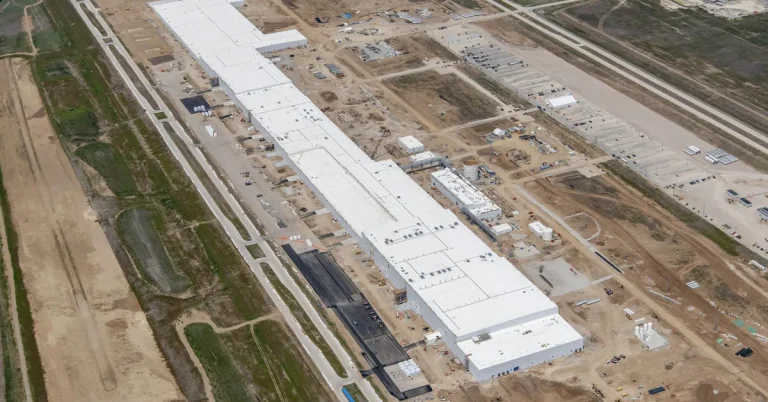
BlueOval Battery Park Michigan shipped Ford’s first in-house lithium iron phosphate (LFP) battery cells to Louisville Assembly Plant in Kentucky to power Ford Fathom prototypes, Ford CEO Jim Farley said. The shipment made Ford the first automaker to deliver US-produced LFP batteries for mainstream consumer automotive use, supporting its push for more affordable EVs.
First cells head for Fathom prototypes
The rectangular, prismatic cells came from Ford’s plant in Marshall, Michigan, using technology licensed from CATL. Ford chose that technology to reduce vehicle cost and weight.
Get the latest EV news first. Follow us on:
The Fathom electric pickup has a starting price of $28,350 (~AUD 42,489), excluding destination. Ford plans to open preorders in early 2027, with market launch and deliveries expected in the fourth quarter of that year.
Ahead of the pickup’s launch, Ford plans to begin operating its Marshall battery pack plant in 2027. Ford has not disclosed cell energy density or total pack capacity.
Michigan lines produce 40 cells a minute
BlueOval Battery Park Michigan covers 2 million square feet, and its launch remained on schedule. With output reaching 40 cells per minute, its assembly lines rank among the quickest outside China for assembling prismatic LFP batteries.
Quality checks use AI-powered image recognition, with a defect-rate target measured in parts per billion cells. Ford aims to employ 1,700 workers at full ramp.
The plant is wholly owned, staffed and operated by Ford, with no CATL management. CATL’s role covers technology licensing, operational support, and engineering assistance for equipment installation and training.
Ford structured the arrangement to comply with the Inflation Reduction Act and navigate its foreign entity of concern rules, keeping CATL’s involvement within a licensing arrangement. US Republican lawmakers and Transportation Secretary Sean Duffy raised concerns about Ford’s ties to CATL and Chinese companies.
Ford announced the CATL partnership in February 2023 with an initial investment of $3.5B (~AUD 5.2B) and annual capacity of 35 GWh. After temporarily halting the project that year, Ford restarted it in November 2023 with investment of $2B (~AUD 3B) and annual capacity of 20 GWh. Federal US EV tax credits ended in September 2025, and Ford recorded $19.5B (~AUD 29.2B) in asset impairment charges in December 2025.
A battery designed to do more than store energy
LFP chemistry uses neither nickel nor cobalt, helping keep cell costs below those of batteries in most EVs and hybrids. It also holds up well over years of charging and use.
After talking to battery companies around the world, Ford chose CATL, the world’s largest battery manufacturer, whose batteries power 30 million vehicles worldwide.
The ability to fit directly into the chassis while lowering structural costs prompted Ford to choose rectangular cells. The battery pack itself becomes a structural chassis component, rather than serving only as an energy store.
The pack uses a flexible circuit board for electrical connections and sensing, along with integrated, compact power electronics. Its architecture also helps enable Ford’s new Universal EV Production System.
Ford’s design rule favours eliminating parts or making each part serve several purposes, reducing weight and simplifying manufacturing. Describing the battery approach, Alan Clarke, Ford’s vice president of Advanced Development Projects, said Ford’s answer was “efficiency over excess.”
Why it matters
Ford’s goal is an EV that delivers the performance buyers expect at a price that persuades petrol vehicle drivers to switch. Combining lower-cost chemistry with a battery that also supports the vehicle’s structure addresses both material costs and manufacturing complexity. Fathom’s AC bidirectional power feature will let the vehicle receive and supply electricity, a use suited to LFP chemistry.
Key Specs
- Fathom starting price, excluding destination: $28,350 (~AUD 42,489)
- Assembly-line production rate: 40 cells per minute
- Employment target at full ramp: 1,700 workers
- Planned Fathom preorders: Early 2027
- Planned Fathom launch and deliveries: Fourth quarter of 2027
✎ Images and news sourced from: ford.com, cnevpost.com, x.com, automotiveworld.com, upi.com, cnet.com, 163.com, eastasiabrief.com.
