
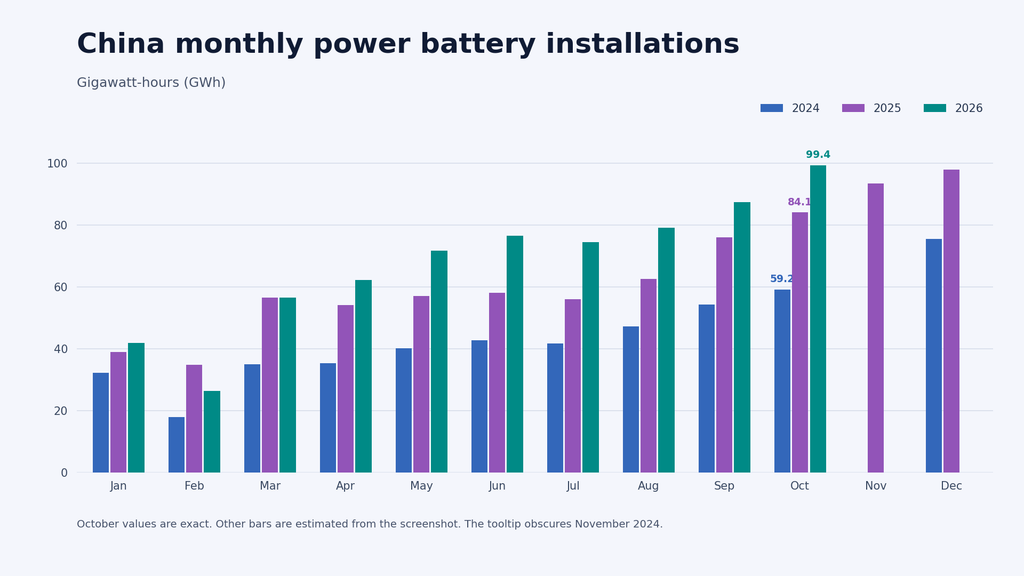
China recorded a record 99.4 GWh of power battery installations in October, figures that the China Automotive Battery Innovation Alliance (CABIA) released on Thursday showed. With a record 86.9% share of total installations, lithium iron phosphate (LFP) batteries extended their advantage over ternary batteries in the Chinese power battery market.
LFP installations grow faster than the market
Total power battery installations rose 14.0% from September and 18.2% from October last year. A new monthly high for the year was recorded in October, marking the third consecutive month to reach that milestone.
The previous record for total power battery installations was 98.1 GWh, reached in December 2025. LFP’s previous record share was set more recently, at 85.6% in August.
Get the latest EV news first. Follow us on:
LFP installations reached 86.3 GWh in October. That was an increase of 15.8% from the previous month and 27.8% from a year earlier, putting the chemistry’s growth ahead of the overall market on both measures.
Ternary battery installations totalled 12.8 GWh for the month. They increased 3.8% from September, marking their second consecutive monthly increase, but remained 22.8% below the level recorded a year earlier.
Ternary batteries accounted for 12.9% of October installations, their lowest monthly share on record. Their share fell to that low even as the amount installed increased from the previous month, because the broader market grew faster.
CATL leads the supplier figures
CATL recorded 39.60 GWh of power battery installations in China during October. Its market share was 40.00%, putting it ahead of BYD and CALB in the supplier figures.
BYD’s installations totalled 21.14 GWh for the month, giving it a market share of 21.36%. Its installed volume was higher than CALB’s but below CATL’s.
CALB recorded 8.55 GWh of installations and an 8.64% market share. Its installations increased 41.6% from September, a faster monthly rise than the overall power battery market.
Gotion’s October installations reached 5.99 GWh. That placed its installed volume below those of CATL, BYD and CALB for the month.
Ten-month installations reach 675.6 GWh
China’s cumulative power battery installations reached 675.6 GWh from January through October. The total was up 16.9% compared with the same period last year.
That cumulative growth rate edged up from the 16.7% recorded for January through September. October therefore lifted the year-to-date rate as well as setting a monthly installation record.
LFP installations totalled 563.5 GWh over the first ten months, an increase of 19.9% from a year earlier. The chemistry accounted for 83.4% of cumulative installations, leaving it with a larger share in October alone than across the year to date.
Cumulative ternary battery installations reached 110.6 GWh, up 2.7% from the same period last year. Their share of installations was 16.4% for January through October, above their share in the latest month.
The ten-month figures showed growth for both battery chemistries, although LFP installations increased faster. Ternary installations remained above their year-earlier cumulative total despite the annual decline recorded in October.
Why it matters
For EV fans following battery choices, LFP represented an even larger part of China’s latest monthly installations than of its year-to-date total. The shift came alongside a record for the overall market, rather than a decline in total installed capacity. Ternary batteries also gained volume from September, but their slower monthly growth left them with a smaller portion of the expanding market.
Key Specs
- China power battery installations, October: 99.4 GWh
- October installations growth, year on year: 18.2%
- LFP installations, October: 86.3 GWh
- LFP share of October installations: 86.9%
- Ternary share of October installations: 12.9%
- China power battery installations, January–October: 675.6 GWh
- CATL October market share: 40.00%
✎ Images and news sourced from: qq.com, cs.com.cn, autohome.com.cn, eastasiabrief.com, guandian.hk, mysteel.com, cnevpost.com, wikimedia.org. Featured photo: Yo-Co-Man, CC BY-SA 4.0, via Wikimedia Commons.
