
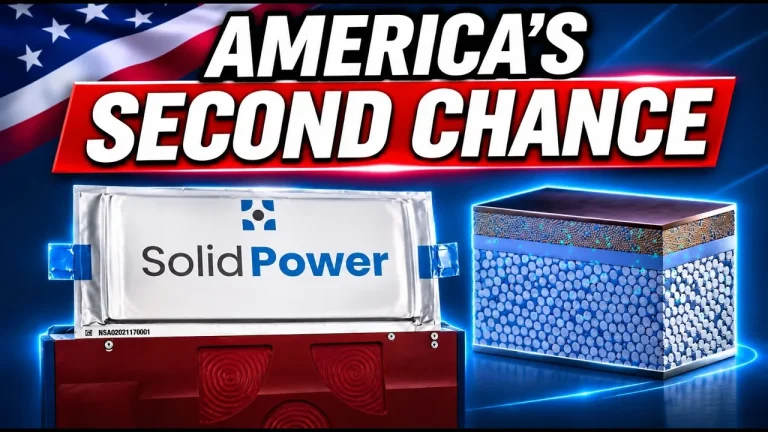
America missed out on leading the lithium-ion battery revolution, with Asian companies dominating the industry. However, John Van Scoter, CEO of Solid Power in Colorado, believes solid-state batteries could offer the United States a second opportunity to compete in the battery sector. Sam Evans agrees with this view, highlighting Solid Power’s unique approach and the potential impact of its technology.
Solid Power’s Focus: The Electrolyte, Not the Battery
Unlike most battery companies, Solid Power does not aim to manufacture complete batteries. Instead, it focuses on producing a single key ingredient: the electrolyte. The electrolyte is the material inside a battery that allows charge to move between the battery’s two sides. In conventional batteries, this material is a liquid, which is highly flammable and poses fire risks. Solid Power has developed a solid version based on sulfide, which reduces fire risk and enables higher energy storage in the same space.
Energy Storage Claims and Potential Range Increases
Solid Power makes ambitious claims about the energy storage potential of its material. According to the company, today’s nickel-based (NMC) batteries store about 250 to 300 watt-hours in every kilogram. Cells using Solid Power’s electrolyte with a nickel-based cathode and a silicon anode could reach about 390 to 400 watt-hours per kilo. With a lithium metal anode, the company says the figure could be up to 440. Sam Evans points out that this would mean significantly more range from a battery of the same size.
Get the latest EV news first. Follow us on:
Compatibility with Existing Factories and Industry Partnerships
One of the most notable aspects of Solid Power’s technology, according to Van Scoter, is that these new cells can be produced on the same machines currently used for battery manufacturing. This means battery makers would not need to overhaul their production lines, potentially saving years in the transition to solid-state technology. Solid Power’s partner list reflects industry confidence, including BMW, Ford, Samsung SDI, and SK On. BMW has already demonstrated a prototype i7 using this technology, showing that it works in practice.
Timeline: From Pilot Production to Mass Adoption
Despite these promising developments, Sam Evans urges caution. Solid Power’s pilot lines will produce around 75 tons of electrolyte per year, which is not yet mass production. The company expects the first high-end vehicles using this technology to arrive by the end of this decade, with broader adoption in mainstream cars likely in the early 2030s. Sam believes this timeline makes sense, but emphasizes that solid-state batteries are not yet ready for widespread use.
What This Means for EV Buyers and the Industry
Sam Evans is confident that solid-state batteries are coming and rejects the idea that they are vaporware. He hopes this technology will help the US regain competitiveness in the battery industry and sees increased competition as a positive for everyone. However, Sam advises against waiting for solid-state batteries before buying an EV. He stresses that current EV batteries are already safe, durable, and fast-charging, and that solid-state will be a welcome bonus when it arrives, but not a reason to delay a purchase today.
