
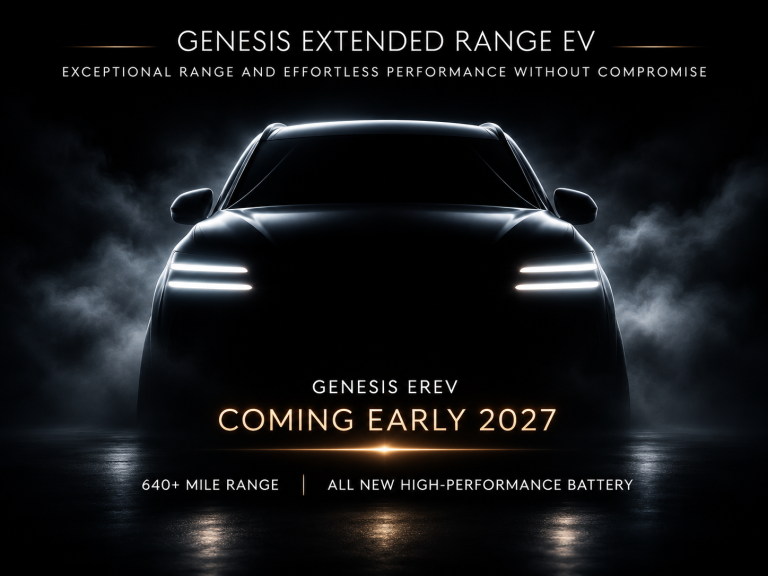
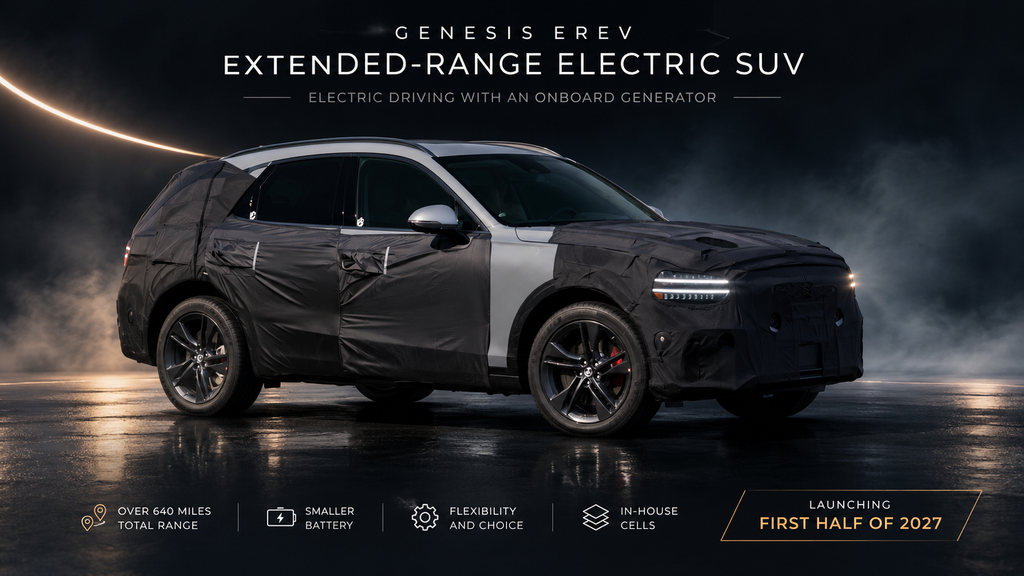
Genesis plans to launch an extended-range electric SUV in the first half of 2027, targeting a total driving range of over 640 miles. The vehicle will combine electric driving with an onboard petrol generator, adding another powertrain choice to the brand’s approach to the transition towards an all-electric future.
Genesis previews its extended-range SUV
Genesis teased the vehicle with a photo, but its name remains unrevealed.
The planned vehicle forms part of Genesis’s wider plan to introduce extended-range electric models from 2027, rather than relying on a single powertrain approach as buyers move towards electrification.
Get the latest EV news first. Follow us on:
Electric drive, with fuel available for the generator
An extended-range electric vehicle, often shortened to EREV, uses its petrol engine as an onboard generator. The engine does not drive the wheels, giving this type of vehicle an EV-like driving experience even though it carries a fuel tank.
Drivers can plug an EREV into a charger at home or use a public charging station to replenish its battery. They can also fill its petrol tank and use the generator to charge the battery while driving, providing another way to supply electricity during a journey.
An EREV can run in pure electric mode with no fuel in its tank. Electricity stored in the battery can therefore power the vehicle without petrol being available, rather than requiring the driver to keep fuel onboard for every trip. The petrol engine’s role is to generate electricity, not to provide a separate form of wheel-driven propulsion.
Hyundai plans a smaller battery
Hyundai’s planned extended-range technology will use a battery with less than half the capacity of a comparable fully electric vehicle’s battery. The approach pairs that smaller battery with the ability to generate electricity onboard, instead of depending entirely on energy stored before departure.
Hyundai also plans to use new battery cells developed in-house for its extended-range vehicles. Those cells are expected to deliver performance equivalent to comparable EVs, despite the planned reduction in battery capacity.
More choice during the electric transition
Genesis’s strategy puts customers at the centre of its powertrain decisions, with diversification and flexibility as priorities. Hybrids and extended-range electric vehicles are both bridging technologies within that approach, giving the brand ways to address different driving and charging needs during the move towards fully electric vehicles.
José Muñoz, President and CEO of Hyundai Motor Company and Genesis, described the customer focus by saying that “we have made available to our customers what they want”.
Why it matters
Extended-range vehicles offer an option for people without home charging as well as drivers with short commutes. Genesis’s planned approach aims to remove reliance on petrol for everyday driving while avoiding range anxiety on longer journeys. That addresses two concerns involved in the move to electric vehicles: how far a vehicle can travel and whether charging infrastructure will meet a driver’s needs.
Key Specs
- Target total driving range: Over 640 miles
- Planned Genesis SUV launch: First half of 2027
✎ Images and news sourced from: genesis.com, hyundaimotorgroup.com, hyundainews.com, carscoops.com, cnet.com, autoherald.co.kr, motor1.com, hyundai.com.
