
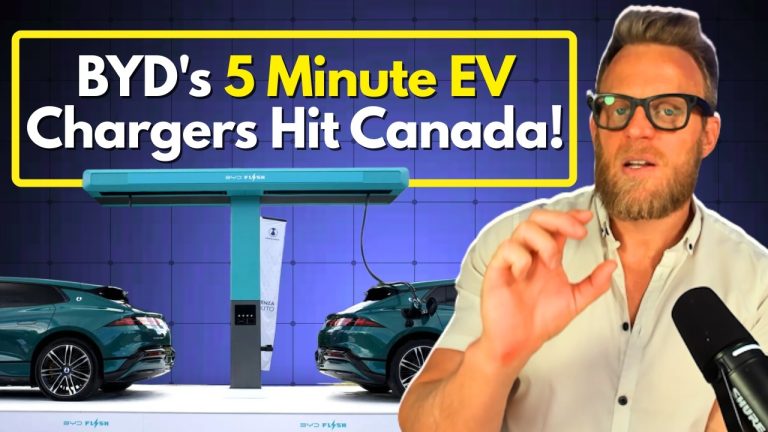
BYD is reportedly preparing to bring its 1,500 kW flash charging network to Canada, even before it has sold a single car there. Sam Evans says the move shows how seriously the Chinese automaker is taking the Canadian market, though he has doubts about how practical these ultra-fast chargers are right now.
BYD Lays the Groundwork in Canada
BYD has not sold any cars in Canada yet, but it wants to take advantage of Canada now allowing Chinese EVs in. The company is setting up showrooms across the country and, Sam says he has heard, has already hired hundreds of staff there. Sam says the order of operations is interesting and shows how serious BYD is about entering Canada.
BYD has also been negotiating with the Canadian government over assembling cars in the country. According to Sam, the government wants BYD to fully manufacture vehicles there, while BYD would prefer to send the parts and assemble them locally. Those negotiations are ongoing.
Get the latest EV news first. Follow us on:
Sam notes that if Americans want to try BYD’s flash charging, they could drive across the border or fly.
A Flash Charging Job Listing in Toronto
BYD apparently posted a Toronto job listing this week for a flash charging business development manager, to start the rollout and work out where the chargers will be built. According to sources, the manager will be responsible for building cost and profit models for the flash charging technology locally and developing local partners for power grid upgrades to make the network work. The role will also oversee the stations’ operations with partners.
Sam says grid upgrades are the challenge. The chargers don’t really work without a large battery installed next to them to handle that much power, which makes them very expensive to build. BYD’s solution is to place big batteries beside the chargers, but suitable locations still need to be found, and Sam expects that will be part of the new manager’s job, along with working out where people will be driving EVs and where demand will be highest.
What the Technology Can Do
BYD’s 1,500 kW flash charging technology was revealed earlier this year. It works only with BYD models capable of this charging, which includes many newer BYD EVs with the second-generation Blade battery and a 1,000-volt architecture. Sam says that setup can add 250 miles (400 km) of range from a five-minute charge, and a charge from 10% to 97% takes just under nine minutes. He points out that 97% is more than what is normally considered a full charge, since charging beyond 90% is usually very slow.
Sam also notes that BYD’s cars don’t actually charge at 1,500 kW; they charge at approximately 1,000 kW. The 1,500 kW capability is aimed at possible future EVs that can charge at those speeds.
A Global Rollout
BYD has been talking up a global rollout for some time, including Australia and Europe, and Sam says little had happened until now, when it has suddenly started. Apparently, there are more than 6,400 of these chargers operating across 319 cities in China, although Sam stresses he doesn’t know whether that figure is accurate and is only repeating what people are saying.
BYD wants to introduce 3,000 of the chargers in Europe by the end of next year, with each station, featuring two charging cables, reportedly costing $670,000 (~AUD 1.01 million). Sam doesn’t believe that figure, saying it wildly underestimates the cost. He thinks each will cost at least $1 million (~AUD 1.5 million) and that $670,000 is a best-case scenario, more likely to reflect the cost in China. The network is also coming to Australia and New Zealand, with plans for Latin America, the Middle East and even Africa.
Sam says charging speeds like these could make topping up an EV as quick as refuelling a petrol car, and may allow manufacturers to build EVs with smaller battery packs. He notes he has long predicted range would rise significantly, but if chargers this fast were everywhere, that might not be necessary.
Sam’s View: Awesome, but Not Yet Practical
Sam says the chargers aren’t really practical right now. He believes pulling this much power from the grid is extremely difficult, as very few locations can support two 1,000 kW chargers drawing 2,000 kW at one site, when it is already hard to find a site for four 350 kW chargers. He thinks it would make more sense at this stage of EV adoption, especially in places like Canada, to use the same 2,000 kW of power, whether from a stationary battery or the grid, for six or even eight 250 kW chargers rather than spending so much on just two charging points.
Sam believes the approach would make sense in about 10 years, once chargers are everywhere and drivers can simply choose the fastest one, but that most countries currently don’t have enough chargers, so Tesla’s strategy of building a larger number of chargers probably makes more sense. He calls BYD’s flash chargers awesome but compares them to a flashy Ferrari: they look cool but may not be super practical. Still, Sam says it is better than nothing and actually a good thing.
