
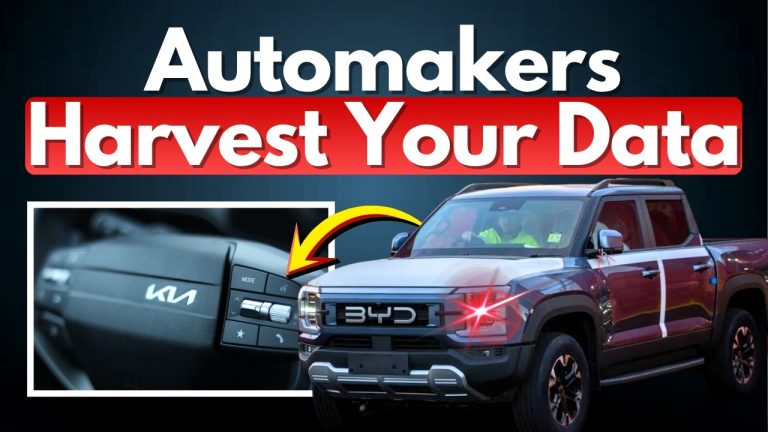
Australia’s spy agency has warned that people should not discuss confidential information inside internet-connected cars, amid growing fears that modern vehicles pose a national security risk. Sam Evans says he used to think cars weren’t listening to us, but he has now changed his mind.
Car companies are using your data
Sam says many people are concerned that their car is listening to their conversations, or at least using their personal data. He says the second part is already clear: car companies are taking drivers’ personal data, many of them are being caught for it, and it is not a conspiracy theory. General Motors admits it, and Sam says car manufacturers have admitted this several times now.
But Sam points out that there is a big difference between using your data and listening to your conversations.
Get the latest EV news first. Follow us on:
According to the warnings, drivers in Australia, the United States and Europe could have cars that are quietly harvesting large amounts of personal data. That includes location details, driving behaviour, biometric information and even snippets of audio and video. Experts warn that drivers are unprotected because laws on car data harvesting are lagging behind.
ASIO’s warning to politicians
ASIO has warned politicians and public servants not to discuss confidential information inside internet-connected cars. At a Senate estimates hearing in May, ASIO’s deputy director-general told politicians that officials should be careful when travelling in vehicles. “Obviously, a connected car may have other vectors to gather that information, but those conversations should only ever happen in places that are set up for classified conversations,” the deputy director-general said. “We would say that people should be conscious of the things that they are discussing in vehicles knowing that people may be able to get that information.”
Sam says serious spying really is happening in Australia. He describes a public news story from Australia in which a certain government hired people to pose as employers and list jobs on sites like Seek. The fake employers would find out whether applicants worked for the government or had access to government documents. They would then pay them over time for small “trial” jobs with fairly large payments, slowly drawing them in until they could get confidential information. Sam says this has happened hundreds of times to current or former government employees in Australia.
Despite ASIO’s warning, Chinese vehicles have been added for the first time to the list of taxpayer-funded cars that federal members of parliament can use privately. Six BYD models and a Chinese-made MG were added, including the top-selling Sealion SUV and the Shark plug-in hybrid ute. This happened even though a US ban is looming. Sam says he is not giving an opinion on whether the government should do this. He is just pointing out that it has ignored the advice of its own security agency.
Can cars listen to you?
Sam says yes, car companies can listen to you. In China, he says, people talk to their cars constantly and barely use buttons. The voice assistants there are extremely good and are connected to the internet. Whether cars are listening when you haven’t asked them to, Sam says, no one really knows.
Five years ago, McKinsey reported that about half of the new vehicles sold to Australians were connected to the internet. By 2035, that figure will climb to more than 95%. The same report found that sensors inside connected cars can generate 1 to 2 terabytes of raw data every day.
Sam says carmakers probably don’t care much about you personally. However, a large share of Australians and Americans work for the government in some form. He says it is possible that other countries would identify a driver as a government employee and decide that is a car they want to listen to.
Sam adds that not every modern car is connected. He has a Subaru Trailseeker in his driveway that is not connected to the internet, so any data in it stays in the car. He says that if you want a car that is definitely not collecting your data or listening to you, Subaru EVs are a good choice, though he stresses he is not telling anyone to buy one.
What investigators found
Consumer group Choice investigated how much data major car brands collect from Australian drivers. It found that almost every major brand collected driver data and shared it with third parties. Kia, Hyundai and Tesla were named specifically for sharing biometric data. Tesla was also found to record short video and audio clips that were shared. Sam says the Tesla clips were not necessarily about listening to drivers, and were more about training self-driving.
In February, the Office of the Australian Information Commissioner confirmed it was investigating two Asian vehicle manufacturers over data harvesting concerns. Sam notes it did not say whether they were Chinese or Japanese. Two other probes were dropped because enforcement action was unlikely. Sam says it is too hard to know whether cars are listening in, and asks how you would actually check.
A lawyer says the laws aren’t ready
A lawyer, Mr Singh, said dropping those two probes suggests current Australian laws are “just not equipped to protect Australian consumers.” He said most lawyers in the industry knew this was a potential problem. “The government has really dropped the ball by not strengthening these laws prior to the recent influx of vehicles from Asian vehicle manufacturers,” he said. “It is likely that the personal data of Australians is being misused.”
Mr Singh said Australia is unlikely to get its own version of Europe’s General Data Protection Regulation (GDPR) any time soon. He noted the GDPR took the EU a significant amount of time to prepare and enact. He also said large corporations would likely put significant resources into opposing or watering down such laws. Sam believes Australia should have an equivalent, and says car companies are likely to lobby against protecting your data and conversations.
Mr Singh said the issue is not limited to China, because Western manufacturers such as Tesla have also been known to collect personal data. In his view, the main difference is how the data is used. There is real concern that Chinese companies are giving personal data to the Chinese government, which is seen as far more alarming than Western companies that generally use it for marketing and targeting. Sam says he has been saying for years that data is money.
Mr Singh also said dealers should be required to disclose data collection practices at the point of sale, similar to the disclosure rules for financial products. He said failing to do so is a significant breach of consumer trust, especially since many buyers may not know that vehicles collect data. Sam says he totally agrees.
Sam’s take
Sam says this is not a lot of hoopla over nothing. He believes cars are listening to people’s conversations and says he is almost certain it is happening. He would not name particular manufacturers or countries, saying that would put him at some risk.
Sam believes people should lobby the government. He says Australia should set up regulations on vehicle data collection, as Europe did. He says he is shocked that this hasn’t happened, and describes the current situation as a bit of a free-for-all.
