
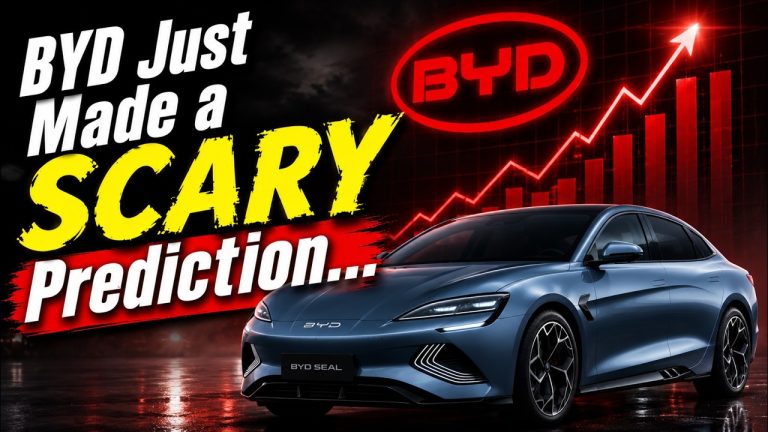
BYD has predicted the year it expects to outsell Toyota worldwide. At the company’s annual shareholder meeting in Shenzhen, chairman and founder Wang Chuanfu said BYD wants to become the world’s largest car manufacturer within five years, which would be 2031, and that its new second-generation Blade battery will be key to that expansion.
A Prediction Close to Sam’s Own
Sam Evans points out that he made a similar prediction about four years ago. In a video on what he thought would happen to the world’s 20 largest automotive companies by 2030, he predicted BYD would be number one by that year. He says he highly doubts anyone at BYD watched that video, but BYD’s 2031 target is strikingly close to his own forecast.
BYD was the world’s sixth-largest car manufacturer last year, and Sam says its ambition to be first explains why it has around 75 different models. He stresses these are models, not variants, and those are just the ones he knows of. “BYD will truly become the number one automaker globally in terms of scale in five years,” the chairman said.
Get the latest EV news first. Follow us on:
Sam says he has a lot of respect for BYD’s chairman and finds him impressive. He says some of the people the chairman has hired have made more sensational comments, but the chairman himself usually doesn’t. Sam also notes that a statement like this is easier said than done, and that a chairman would hope it boosts the stock price and perhaps sales.
The Battery Challenge From CATL
Sam believes BYD could face a major challenge if the Blade battery version 2 is central to its plan, because of CATL’s new battery technology. The second-generation Blade battery has an energy density of 192 Wh/kg, about 25% better than the previous Blade battery.
According to Sam, CATL’s new sodium battery for EVs will be cheaper than BYD’s Blade battery 2.0 and has a much higher energy density of 262 Wh/kg. It also lasts more than 10,000 cycles, which Sam says means it will easily last more than twice as long as an LFP battery, including BYD’s Blade battery. He notes that CATL is a BYD rival with around 40% to 42% of the global battery market.
The Sales Gap and a Slowing Chinese Market
Sam says BYD will have to grow extraordinarily quickly over the next five years to reach its goal, and he says it is not really on track to do that right now. In 2025 BYD sold 4.6 million vehicles. That is less than half of the 11 million sold by Toyota Motor Corporation when Lexus and Daihatsu are included. Toyota alone sold 9.6 million. Sam says this means BYD would need to grow sales by 1 million units every year for the next five years, which would be very difficult.
Sam believes BYD has a far better car portfolio than Toyota, but he says China has slowed BYD’s growth. In May, BYD sold 207,000 vehicles in China, a 29% decline there. Its sales in China have fallen for eight straight months. Sam says this is significant because China accounts for 32 million of the roughly 80 million cars sold globally each year, which is more than a third and nearly 40% of the world market.
Why Europe Matters
To offset weaker demand at home, BYD has been expanding rapidly into new markets. Sam says tariffs limit that expansion. The United States is saying no to Chinese EVs, and there is nothing BYD can do about it. BYD has already entered Mexico and is about to enter Canada, but those markets are relatively small compared with the US.
Sam believes BYD can overtake Toyota without the US, but it needs Europe to do it. Europe sells around 15 million cars a year. BYD pays tariffs of around 28% on every EV it sells there. Plug-in hybrids are exempt from the EV tariffs, although they still pay a 10% tariff.
BYD’s strategy is to set up multiple production sites in Europe. It has one in Hungary. Sam says he believes a site is potentially planned in Morocco and that he has heard of a possible plant in Turkey. BYD has also been in negotiations with Volkswagen to take over one of its factories in Germany, which may or may not happen, and Sam says he has heard news about Spain as well.
Sam’s Take: Toyota’s Target Is Getting Closer
Sam says the task may not be as hard as it sounds, because he puts the likelihood of Toyota selling 11 million cars in 2031 at about zero. He says Toyota is being disrupted. Only 2% of its car sales last year were electric, and this year it has started to struggle in markets where EV sales are rising quickly. He believes declining Toyota sales will be the story of the next five years.
That means, Sam says, BYD may not need to sell 11 million cars. Even if it sells around 8 million in 2031, which he says would still be hard, that would probably be enough to beat Toyota, because the goalpost is moving closer rather than further away. Sam believes Toyota’s sales could fall by more than 50% over the next five years. He admits that sounds insane, but he says it makes a lot of sense.
