
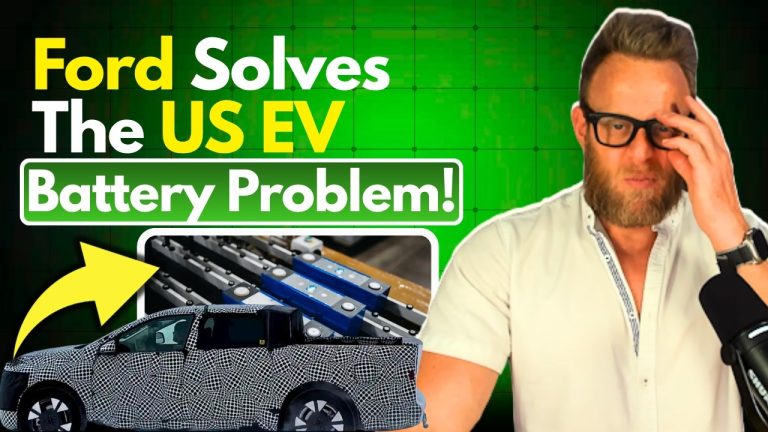
Ford is now manufacturing lithium iron phosphate (LFP) battery cells in the United States, and those cells are going into the company’s planned $30,000 (~AUD 45,000) electric pickup truck. Ford CEO Jim Farley said the company delivered its first full cells on Tuesday, making it the first in the US to ship LFP batteries for mass market automotive use.
First LFP Cells for Mainstream US Cars
The team at Ford’s BlueOval Battery Park in Michigan is now assembling LFP prismatic cells for Ford’s new Universal EV (UEV) based models, which are meant to be the company’s new cheap electric vehicles. The cells are made using battery and manufacturing technology licensed from CATL, the Chinese battery giant. Ford says LFP batteries are the real key to getting the price down.
Sam Evans notes that another company already makes LFP batteries in the US, but says “mainstream” is the key word: Ford is set to be the first to assemble LFP batteries for mainstream consumer car use in the country. Since Ford started making LFP cells in the US, its stock price has gone up by around 40%. Sam says Ford has never seen that kind of stock move in such a short period.
Get the latest EV news first. Follow us on:
The $30,000 Pickup
The new cells will be used in Ford’s affordable midsize electric pickup, the first vehicle on the UEV platform. It is apparently expected to cost around $30,000 (~AUD 45,000), and Ford is reportedly ramping up production as it prepares to launch the truck in 2027. A prototype was seen driving around Long Beach ahead of the official debut.
Sam says he is not sure the $30,000 figure is true, but that is what Ford says. Having seen photos of the truck, he says it is very small, so maybe it will hit that price. He is not sure there will be a big market for the vehicle, but says there could be.
Ford says the new LFP cells will let it make vehicles that are more efficient, more affordable and, for the first time, profitable. Sam points out that Ford has never made money selling EVs, except maybe in China, and that on average it has lost about $30,000 (~AUD 45,000) on every EV it has sold in North America.
Pushback Over CATL Technology
The plant received a fair bit of pushback over Ford’s use of CATL’s Chinese LFP technology. Lisa Drake, president of Ford Energy, defended the decision in 2025. She said the decision to build prismatic LFP batteries in the US was made years ago, in order to deliver truly affordable electric cars. Drake also said these are very good paying jobs, and that it would be a shame to build these facilities and then suddenly have to scale back.
Sam says Drake is right about the timing. He covered it several years ago when Ford, General Motors and Tesla were all considering the move. He reads her comments about jobs as a plea to Donald Trump not to suddenly block Ford from making these batteries.
Ford’s Claims Questioned
According to Ford, the LFP cells are cheaper, lighter and unlock more interior space. Sam says the claim that they are lighter than NMC batteries is not accurate. LFP batteries are definitely not lighter than NMC, he says, and he suggests the claim may have come from someone in Ford’s press team. LFP does have other advantages, though: it is cheaper, it lasts more cycles, and it can be charged to 100% without worrying about battery swelling. With NMC batteries, Sam recommends not letting the car sit at 100%. Charging to 100% is fine, he says, but drive the car straight away afterwards.
Ford also says the midsize pickup will offer more passenger space than a Toyota RAV4 and a lower cost of ownership than a Tesla Model Y. Sam says the first claim is feasible because the RAV4 is not big inside. He calls the second claim unlikely for a pickup truck. The Model Y is already a very low car at around 160-something millimetres off the ground, he says, and he doubts Ford can beat it on efficiency. Comparing the cheapest Ford pickup with the cheapest Model Y, Sam believes the claim will be proven false, though he adds that “you never know.”
Sam also notes that these LFP cells have a higher energy density than older LFP batteries, such as older-generation CATL cells or the existing older-generation BYD Blade battery. He says the newer cells are about 30% higher in energy density, which he calls a really good thing.
What It Means
Sam believes LFP batteries will dominate the North American market and take over from most of the NMC cells used in EVs, helping push down electric car prices in Canada and the United States. He thinks sodium batteries will play a big part in the rest of the world, but not so much in North America.
Sam says he may sound negative, but if Ford delivers this truck for $30,000 (~AUD 45,000), that is great for EVs. He calls the $30,000 pickup idea awesome and welcomes LFP batteries across Ford’s range. Ford has a new SUV coming soon, and he hopes Ford brings back an electric F-150. Sam says Ford’s EV decisions so far have been pretty catastrophic, with huge losses and little progress, and he believes this could be a big change for the company.
