
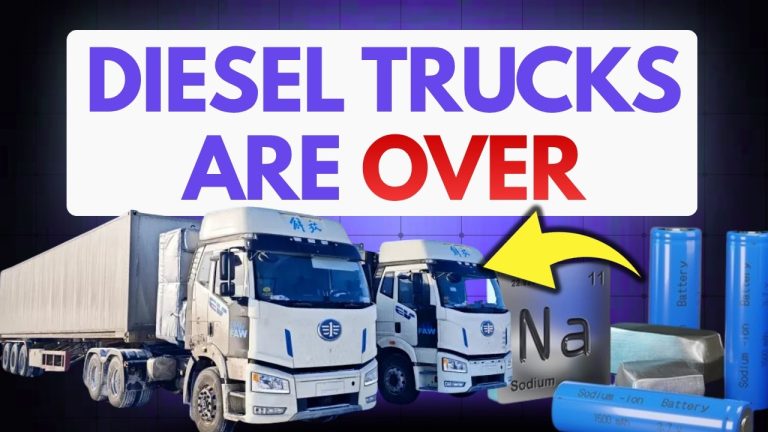
Chinese truck maker FAW has tested a heavy truck fitted with a 340 kWh sodium-ion battery over 15,000 km, with results it calls a critical breakthrough. Sam Evans says sodium batteries could push China’s trucking industry toward electrification faster than many expect. China is saying that around 50% of its trucking industry will be electric by 2030.
Strong Results in Extreme Cold
Lithium batteries in general, including LFP, can struggle in very cold temperatures. FAW, one of the largest trucking companies in China, put a 340 kWh sodium battery into one of its trucks and tested it for 15,000 km. The company describes the test as a critical breakthrough.
At -40°C, the battery kept more than 90% of its usable capacity. Sam compares that to the temperature on Mount Everest in a storm. He says this means sodium batteries will probably take over in trucks fairly quickly in very cold regions, including northwest and northeast China, Russia, Scandinavia and Northern Europe.
Get the latest EV news first. Follow us on:
Fast Charging and Double the Cycle Life
Car News China reports that the truck also showed big improvements in operational efficiency. The 340 kWh battery can be charged in 20 to 25 minutes, and the company says that means fully charged, not charged to 80%. Sam stresses that he is only estimating, because the average charging speed is not known. He works out that this equals roughly 700 kW, and says the average speed must have been above 500 kW to fill the pack in 20 minutes. He calls that very fast charging for a truck.
Sam suggests commercial trucks might be the kind of vehicle that needs quick charging. A driver could stop with around 20% left, eat lunch, and come back 20 or 30 minutes later to a full battery. Sam calls that legitimately a game changer.
The company also says the battery lasts more than 8,000 cycles under fast-charging conditions. That is double the cycle life of lithium iron phosphate batteries. Sam says this is the most important point for a truck. A trucking company that fast charges all the time to get vehicles back on the road would still get more than 8,000 charges.
Beijing Backs Electric Heavy Trucks
A Chinese outlet reports that the electrification of heavy-duty trucks is set to become the next major trend. Eleven Chinese government departments, including the Ministry of Transport and the National Development and Reform Commission, jointly released an implementation plan to scale up the use of new energy heavy trucks. In Sam’s words, the government is effectively saying it wants this to happen and asking how many billions are needed.
The policy sets a 2030 target for electric trucks to hit 40% in China, with a total fleet of more than 1.6 million units. Sam says this means the government wants 20% of all heavy-duty trucks on the road to be electric by 2030, not just 20% of trucks sold that year. He says the message is that diesel trucks are extremely polluting. He recalls riding his bicycle in China, where some passing trucks felt like a gas chamber.
Energy Density Closing the Gap
Sam also pointed to the website of a Chinese battery company that specialises in sodium batteries. It holds patents for cathode materials, anode materials and manufacturing processes. Its energy density reaches up to 165 Wh per kilo. Sam says that is not awesome, but it is basically the same as the current-generation Blade battery in the BYD cars people are buying now. He describes the energy density as actually pretty good.
What It Means
Sam believes the trucking industry is about to be disrupted in a way not yet seen, and that the change could annihilate some existing trucking companies. He calls trucks, commercial vehicles and buses the next frontier for China’s automakers. He also notes that many so-called experts once said EVs, trucks, buses and cars would never use sodium batteries. According to Sam, those people have been strangely silent over the past six months.
