
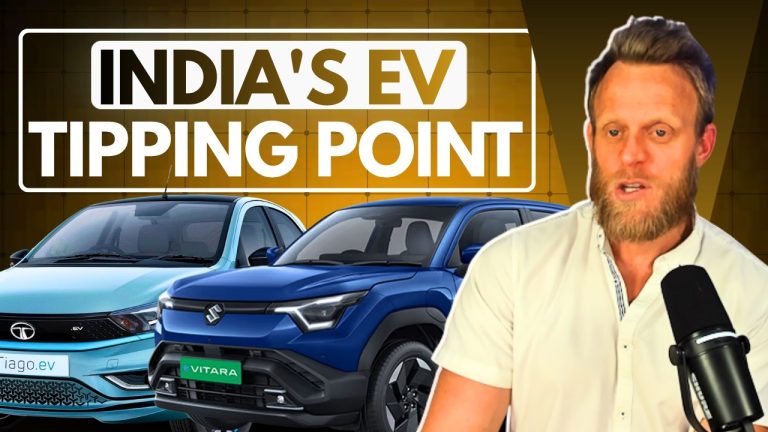
India just had its biggest month ever for EV sales, with a record 26,000 electric passenger vehicles delivered in May 2026, up a staggering 80% on the same month last year. The trigger wasn’t a subsidy or a shiny new launch. It was the price of petrol going through the roof. We’ve been saying it for years: when fuel gets painful, people switch. May 2026 just proved it in spectacular fashion.
A Record Month, and It Could Get Bigger
It’s not just about the cost of fuel, though. It’s about available options. If you don’t have options, you just have to keep buying the same old internal combustion cars. In India now, there are more options.
The 26,000 EVs in May smash the previous best of just over 25,000 in April. And get this: the number could climb another 1,500 to 2,000 once every registration across the country is counted. So EV sales in India could actually be up 100% versus this time last year. A big reason more EVs aren’t sold in India is the enormous import tariffs, which are even worse than Europe’s.
Get the latest EV news first. Follow us on:
You might think 26,000 isn’t that many cars. But India’s car market isn’t really that big for the size of its population. By far most people in India don’t actually own a car.
Fuel Price Hikes Flipped the Switch
So why did this happen? In the second half of May, oil companies hiked petrol and diesel prices four times in just 10 days. In Mumbai, petrol jumped 7%. Diesel got hit even harder at 9%, and CNG climbed 6%.
The result: the first half of May saw about 10,300 EVs sold. The second half, after the hikes, saw 16,000. Same month, completely different story. That’s the EV switch happening in real time. But remember, it’s not just fuel prices. More and more Indian car brands are bringing out EVs. In fact, I just saw some Indian EVs being tested locally here in Australia, and I’ll do a video on that soon. Indian-made EVs are coming to Australia.
Tata and Mahindra Lead the Charge
Leading the charge, pun intended, is Tata Motors. They’re the ones whose EVs I saw here in Australia. Tata cracked 10,000 EV sales in a single month for the first time, delivering 10,231 units. That’s up 102% year-on-year and pushed their market share up to 39%. A big driver is the refreshed Tiago EV, relaunched in late May for about $7,700 (~AUD 11,600). It’s a small electric hatch weighing around 1,235 kg, with a 24 kWh battery option and about 285 km of range. For that price, I think it’s really good value, and it’s the perfect fit for someone switching from a petrol car or buying their first car ever.
Mahindra’s run has been impressive as well. They cracked 6,000 sales for the first time with 6,133 EVs, up 96%, outselling Chinese brand MG for the third straight month and grabbing 23% of the market. Their weapon is the new XEV 9S, India’s first born-electric three-row, seven-seat EV. That’s something manufacturers haven’t done well in terms of getting the pricing right. It uses lithium iron phosphate cells sourced from BYD, with 59, 70 or 79 kWh battery options, and the big battery version claims a range of 679 km. At 2.2 tonnes, it’s a pretty decent weight for a vehicle this size. It does 0 to 100 km/h in about 7 seconds and charges from 20 to 80% in 20 minutes. For a family seven-seater, I think this is genuinely compelling, and the base model starts at around $22,000 (~AUD 33,200). That’s a bit of a bargain.
The Rest of the Field
MG has now been bumped to third, selling close to 5,000 vehicles. Maruti hit a new high with 1,577 sales of its e Vitara, which is basically a Suzuki e Vitara. It has 440 km of range but is a bit more expensive, hence the lower sales. A brand you might not have heard about for a while, Vietnam’s VinFast, came in fifth with 1,224 sales, beating BYD, which sold 683 vehicles.
The luxury players boomed too. BMW, Mercedes and the rest combined for a record 616 EVs, up 65%. To be fair, though, 616 across three different brands is not that many.
Tesla’s Strange Month
Here’s where things get a little strange. Tesla sold only 35 cars in India in May. Thirty-five. Its total over nine months in India is 424. Maybe now you can see why Tesla changed its mind on building a factory in India. It has now slashed the Model Y price by about $10,000 (~AUD 15,100), to roughly $56,000 (~AUD 84,400). That sounds expensive, but it’s actually not when you consider the massive tariffs India imposes on foreign-made cars. Still, in one of the most price-sensitive markets on Earth, Tesla just isn’t cheap enough.
What It All Means
Combined, April and May sales topped 50,000 units, putting India on track to blow past 300,000 EV sales in a single financial year for the very first time. Analysts are calling it a tax-cut-style shock to demand. The shock here is oil prices, and the winner is EVs.
This is the pattern we keep seeing worldwide. Make petrol and diesel painful, and people don’t just complain, they switch. India just gave us the clearest example yet. And at the same time as petrol and diesel prices went up, EV prices went down. Prices went down, options went up. It’s the perfect storm.
